Just Getting Started: App Hosting for Small Business

Just Getting Started: Application Hosting for Small Business

acoustic couplerAccessing software applications and data from a remote system isn’t new stuff.  Starting with telephone modems, acoustic couplers (those things you’d put the phone handset into so that the modem could “hear” the data), green screen ASCII terminals and host computers, users have connected to remote systems to access applications and manipulate stored data for years.  As personal computers became viable for business use, applications and data moved from centralized hosts to local computer environments.

As complexity of local environments rises and broadband becomes truly affordable and accessible, application and data management services are moving back to the centralized system approach.  It’s an expand and contract model, where new capabilities empower the endpoint (the user device) and complexity and scale economies drive centralization of resources and management.  Computing paradigms have once again reached the point where centralization of resources, along with the management and administration of the resource, makes sense for even the smallest of business organizations.  This is the new push for small business IT service delivery, and we’re just getting started.

Application Service Providers (ASPs) were once thought to be the providers who would tip the scales towards server-based computing in the new era.  Rather than creating wide-spread adoption of hosted applications and “virtual” desktops, the ASP business model fell by the wayside as part of the dot-com bust.  It was the right idea, but the market wasn’t ready to accept it and promises of the demise of the desktop turned into the demise of the ASP.

With the successful introduction of SaaS solutions and web-based applications, interest in subscription based IT models has not only grown, but becomes the specific focus of the entire IT industry.  From OEMs to channel resellers, the supply chain for IT products and services is adopting cloud and subscription-based service and business models.  What’s interesting about this second go-around with Internet-based desktop and application services is that the adoption levels are real, the revenue potential is real, and customers are seeking out these solutions rather than being sold.  Managed applications and hosted virtual desktops have become accepted, if not preferred, models for delivering IT services to businesses.

Small businesses can benefit from enterprise-class technologies when a certain economy of scale is developed, and if the environment delivers services around the software and functionality those businesses already need and use.  Logic dictates that Intuit QuickBooks desktop products might be a focus for hosting service providers, as the solution is easily the most accepted financial application by small businesses.  Businesses don’t readily change their financial and accounting software, so addressing this need is a key aspect of adoption.  Also, with QuickBooks, it is as likely as not that the business has an outside accountant who will, at some point, need access to the application and data. Meeting this need and proving the viability of hosting applications such as QuickBooks – offering the solution in the form of subscription service to the customer – has been accomplished through many years of discovery and validation by some of the providers in what is now the Intuit Authorized Host for QuickBooks program.

With the validation of the service model and Intuit’s introduction of an Authorized Host for QuickBooks program, a great deal of opportunity has been created for value added resellers and their small business customers.  Some in the industry would suggest that Intuit’s focus on the Online edition of the product indicates that opportunities around selling or hosting the desktop products have diminished, and Intuit appears to be spending heftily on the promotion of QuickBooks Online.   Yet it remains true that many customers – whether they be existing QuickBooks desktop customers or new QuickBooks customers – want the functionality and the integrations available only with the desktop editions.

For these customers, a hosted/managed application service model is the only answer.  IT resellers working with small business customers are undoubtedly getting the requests, and a few are beginning to recognize the value and service potential associated with offering hosted application services for QuickBooks and other popular small business software products.

As the largest of software vendors (like Microsoft, Intuit, etc.) with small business solutions make their licensing models available to hosting providers, resellers and hosts alike can take advantage these programs and offer their customers the benefits of mobility and managed service around the applications already in use.  Business owners like the benefits to be gained by adopting cloud computing models, but are resistant to changing their software and restructuring their processes.  It is the ability to deliver the benefit without the disruption that makes these application hosting service models attractive.

There are millions of QuickBooks desktop users out there, and only a small fraction are being hosted by authorized providers.  Intuit continues to sell the desktop solutions and the number of QuickBooks users isn’t in decline, so the opportunity to serve those QuickBooks customers continues to grow.  When it comes to providing application hosting services for small businesses, we really are just getting started.

jmbunnyfeetMake Sense?

J

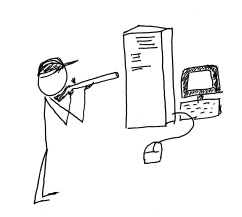
Go Ahead and Shoot the Server: End of Microsoft Small Business Server Inspires Cloud Adoption with Small Businesses

shoot_the_serverMicrosoft has made a decision to include more “cloud” capability in its offerings for small business, ending the life of the successful Small Business Server line and replacing it within the Windows Server 2012 family.  Some businesses are continuing with locally installed servers and are upgrading to Windows 2012 Essentials (or other editions) for in-house use, but more businesses every day are electing to deploy their servers and systems in the cloud instead.

Back when Microsoft introduced the Small Business Server, small business owners found that it was now really easy to implement way more technology in the business than they could directly support.  In one happy little package the SMB could get Windows Server, Exchange, SQL, SharePoint, Remote Web Access, an internal Company Website and more.  Information technology service companies, on the other hand, found it to be a big driver for delivering equipment and services to small business customers, and the product line’s adoption and implementation numbers grew.  Even the smallest of businesses could enjoy enterprise-class email, file and document sharing, client-server applications and remote access for a (relatively) affordable price.  It was this type of offering which created opportunity for server virtualization technologies to be used in small business, as the various server types each benefitted from their own “sandbox”, and IT providers recognized another opportunity to leverage their expertise at the customer location.

Business use of technology continues to expand rapidly so it makes sense that the Small Business Server offering from Microsoft is pretty popular.  In fact, Foresitetech.com says in an article on the subject that “The overwhelming majority of small businesses (80%) with less than 75 employees use Microsoft’s Small Business Server (SBS) software.”

But this fast-paced world of technology continues to move along, and Microsoft has ended the life of the SBS 2011 product.  In its place, small business customers are encouraged to upgrade to one of the editions of Windows Server 2012 as a replacement for their beloved SBS and hopefully they can find an edition which (affordably) delivers the functionality and features the business has come to rely on.  Unfortunately, there isn’t an edition of Windows Server 2012 that offers quite what SBS did, so now there is a big buying decision for the customer.  As the Clash sang it: “do I stay or do I go?”

Microsoft’s elimination of the feature-rich and friendly-sounding Small Business Server has created a lot of opportunity for VARs and IT service providers to move their customers to cloud services, SaaS solutions and hosted environments.  Particularly as information technology continues to become more complex, small businesses (well, businesses of all sizes) are recognizing that they may be better off focusing on running the business operation and managing the company as opposed to spending a lot of focus on IT system purchasing, installation, administration and management.  They have come to understand that IT services are critical to the business, but the server doesn’t have to be under the front desk or in a back closet in order to function for the business.  There is simply too much evidence in the market for these business owners to ignore;  shooting the server is now a viable option.

Every day more business owners are being inspired to [shoot their servers] seek out the services that will allow them to continue to benefit from innovations in technology while relieving them of the direct responsibilities of equipment purchasing, implementation, administration and lifecycle management.  Cloud services deliver this capability, and channel partners and Value Added Resellers should recognize their opportunity to get inspired as well, and to start offering cloud-based and hosted services to their customers and capture the “buying decision” opportunity that Microsoft has created.

Ready. Aim. Fire.

jmbunnyfeetMake Sense?

J

Client Experience and Perceived Value: It’s Looking Cloudy for Accountants Working with Small Business

Client Experience and Perceived Value: It’s Looking Cloudy for Accountants Working with Small Business

Every day it seems there is another professional accounting or bookkeeping firm asking questions about how to get new clients for their new “online accounting” business.  Most of these professionals are likely missing the point that their current clients are probably already looking at online accounting solutions and services. Just like in the days when QuickBooks was beginning to take the lead in the market; today’s increasingly popular online accounting solutions are gaining popularity with the direct users, and are bringing those solutions to the professional community (not the other way around).  Professionals who wish to build their businesses on what the market demands would do well to recognize that the push to the cloud coming from their clients is a reflection of past activities, and firms riding the wave are much more likely to see success than those fighting it.

In reflection, remember that QuickBooks, unlike the other business accounting and financial products at the time, was a retail product marketed to and sold via retail and direct-to-customer outlets rather than via a channel or reseller approach.  At that time, State of the Art Software (which became Peachtree and then Sage 50) was the solution preferred by most accounting professionals, yet more and more small business owners would come to the professionals with the QuickBooks product already in hand, so accountants threw up their hands and adopted (if not embraced) the software.  Over the years, QuickBooks became the “go to” software for small business accounting, and many professional firms didn’t just gear up to work with it, but went as far as developing standards and practices based on the product.

With the introduction of high-speed broadband access, business Internet connectivity and affordable remote/mobile service, businesses are now finding that their options for shopping for, purchasing and implementing various solutions to business problems is possible at any time and from anywhere.  Even more, social computing and the blurring of the lines between personal and business use has made it all but assured that new business owners will seek online solutions where they can access business information and perform business-related activities regardless of location or mode of access.  This is what they have come to expect as consumers of information and services, and the expectation extends no less into their small businesses.

Professional firms must recognize that these evolving paradigms represent opportunity, taking advantage of cloud-based, real-time collaboration models to provide more timely value to their clients.  Where the more traditional on-premises and paper-based models have flourished, the online working models representing lean process and sustainability become the focus.

The movement to the cloud for small business accounting started with the consumer, who ultimately became the small business, and who may eventually become the big business. The professionals who recognize the value of and wisely adopt cloud technologies and online application services in their businesses – specifically in terms of how they work with clients and deliver value – are the firms which recognize that the client experience and perception of value delivered are the most important elements of all.

jmbunnyfeetMake Sense?

J

Accounting, Technology and Small Business – The Best of 2013 from CooperMann

Accounting, Technology and Small Business – The Best of 2013 from CooperMann

cooper-mann-top-20It has been an eventful year, hasn’t it?  With the NSA lurking about collecting data, innovative new approaches to information and identity theft emerging almost daily, and complete turmoil in the IT services industry challenging trusted sales and distribution models, most of us have simply become numb to the noise.  Information technology is evolving at an increasingly rapid pace and the way people and businesses interact with and use technology is being forced to change along with it.  It’s starting to become almost, weirdly, natural.

Much of this change can be attributed to “The Cloud”, which is not a thing or a place.  Cloud has become the term which applies to just about anything having anything to do with the Internet.  For technology “purists”, cloud means something fairly specific, but for normal people (no offense to the nerds and geeks, but you know what I mean), cloud applies to pretty much anything accessible via the Internet.  Photos back up to “the cloud”; music gets stored in “the cloud”, websites are hosted in “the cloud”; businesses run their applications in “the cloud”, and you can do darned near anything you need (or want) to with a phone.  The cloud could be some guy’s server in his basement, or it could be a sophisticated network of systems housed in secure facilities around the globe.  They both qualify, sort of.  The point is that mobility, Internet services, subscription access to technology, and social computing are changing how people view technology – resulting with changes not simply in how IT is purchased, but in how IT is used and applied to daily life.

There are, however, some things that do not change even if the working environment does.  The accounting profession, for example, is undergoing a great deal of change, and much of it fueled by the advancements in technology and social computing.  But accounting fundamentals – the “truth of debits and credits” and the good old accounting equation – remain.  The basics of running a business are also unchanged, even as methods of doing business evolve and globalization of markets continues.  Business fundamentals – fiscal responsibility, cash and growth management, and focus on value and sustainability – are as necessary now as every before.

With all this change and IT “advancement”, there have certainly been impacts to how and where we work.  But the more things change, the more they remain the same.  Good business generates goodwill and more business – that doesn’t change – and bad news still tends to spread faster than good news (much faster, given social platforms that are designed to spread the word far and wide).  And when it comes down to the fundamentals – the basic and essential foundations supporting building, operating, and accounting for business – we generally find that they remain constant even as the environment in which they exist experiences change.

jmbunnyfeetMake Sense?

J

Here are the top 20 ranked posts for 2013 from CooperMann.com

  1. The 2 Most Popular Models for Working with QuickBooks Desktop Editions and the Cloud
  2. Accounting Professionals, You’re right – your clients don’t care about the numbers.
  3. Remote access to client bookkeeping comes in many forms because clients come in many forms
  4. What Small Businesses Need To Know about QuickBooks and the Cloud
  5. Intuit Introduces Changes to Authorized Commercial Host for QuickBooks Program, Introduces QuickBooks Enterprise Rental Licensing
  6. Managed Applications, Cloudpaging, and a New Flavor of Hosted QuickBooks
  7. The Language of Accounting: Disconnect between Accountants and Bookkeepers
  8. Why Accountants and Bookkeepers Use the Cloud
  9. Small Business Owner to Accountant: Make Accounting Valuable to ME
  10. Changing How We See Software: QuickBooks 2013 interface frustrates power users
  11. Bookkeeping and Benchmarks – Getting the Numbers Right
  12. In Bookkeeping, Accounting, and Information Technology: The Value of Outsourcing
  13. Hosting All My Applications in the Cloud
  14. 4 Rules of Thumb for Business Success
  15. Intuit Hosting Program for QuickBooks Website Goes Live
  16. Re-defining the role of the accountant, or going back to the good old days?
  17. Cloud Computing for Small Business: It’s All About 3 Apps
  18. The Collaborative Online Model for Small Business Accounting Professionals
  19. QuickBooks Hosting: New Program Tier Announced for QuickBooks Hosting Providers
  20. 4 Rules for Building Service Customer Loyalty
Posts by category – with Accounting Professionals, QuickBooks Hosting, QuickBooks Software, and Small Business being the top categories with ranking articles.
ACCOUNTING PROFESSIONALS
Small Business Owner to Accountant: Make Accounting Valuable to ME
Accounting Professionals, You’re right – your clients don’t care about the numbers.
The Language of Accounting: Disconnect between Accountants and Bookkeepers
Why Accountants and Bookkeepers Use the Cloud
Bookkeeping and Benchmarks – Getting the Numbers Right
In Bookkeeping, Accounting, and Information Technology: The Value of Outsourcing
Re-defining the role of the accountant, or going back to the good old days?
The Collaborative Online Model for Small Business Accounting Professionals
Remote access to client bookkeeping comes in many forms because clients come in many forms
QUICKBOOKS AND BUSINESS APPLICATION HOSTING
The 2 Most Popular Models for Working with QuickBooks Desktop Editions and the Cloud
What Small Businesses Need To Know about QuickBooks and the Cloud
Intuit Introduces Changes to Authorized Commercial Host for QuickBooks Program, Introduces QuickBooks Enterprise Rental Licensing
Hosting All My Applications in the Cloud
Intuit Hosting Program for QuickBooks Website Goes Live
Cloud Computing for Small Business: It’s All About 3 Apps
QuickBooks Hosting: New Program Tier Announced for QuickBooks Hosting Providers
Managed Applications, Cloudpaging, and a New Flavor of Hosted QuickBooks
QUICKBOOKS SOFTWARE
Changing How We See Software: QuickBooks 2013 interface frustrates power users
SMALL BUSINESS
4 Rules of Thumb for Business Success
4 Rules for Building Service Customer Loyalty

Hosting Intuit QuickBooks Desktop Editions Delivers Big Benefits for Small Business

Big Benefits with Hosted QuickBooks

diagram_self_hosting-500_289Everyone, it seems, is adopting outsourced IT and cloud computing models yet one size does not fit all when it comes to serving business – whether it’s the software or infrastructure under discussion. Cloud, mobile and online application models deliver big benefits for small businesses, but it is important to know the options available before investing in something that’s hard to get out of later. Initially, a hosted application model might be the best approach, allowing the business to achieve the mobility and on-demand service they desire but without an investment in SaaS solutions that are much more difficult to change out of or grow with later.

When “QuickBooks” and “cloud” are mentioned in the same sentence, most people are likely to think about the QuickBooks Online Edition, which is Intuit’s version of QuickBooks accounting software that was developed specifically for the web.  But QuickBooks Online isn’t the only QuickBooks “flavor” finding success in the cloud.  QuickBooks desktop editions have made their way into online and hosted deliveries, giving customers the ability to run the business and grow the organization with the software they’ve already invested in, but running the apps in the cloud.

QuickBooks Online lacks the features and functionality present in the desktop product lines, and the range of 3rd party applications which integrate or work in conjunction with QuickBooks desktop is huge and continues to grow.  Developers with SaaS products often find that their target customers prefer the desktop editions of QuickBooks, even though there may be connections to QBO available.  All of these connected software products can be hosted with or connected to hosted QuickBooks, providing businesses with mobile and remote access for all their business applications, not just the web-based ones. *Note: not all QuickBooks hosting companies will also host whatever 3rd party integrations a business needs, so make sure to verify before you buy! What sounds like a great hosting deal now could turn into something you need to change later.  The good thing is, you can change…. unlike with QBO.

The popularity of desktop application hosting continues to grow because users have investments in software, data and business processes. Adding remote access and mobility doesn’t require an entire change of software, but it does introduce new benefits that can have a big positive impact on work quality, productivity and efficiency. QuickBooks hosting models and application hosting in general gives business owners a basis for helping employees balance (or integrate) work and life time and activities, and addresses the issues of data security and mobility by keeping information securely stored on the host.

Better information security, work/life balance, mobility, making the most of your existing investments and creating sustainability in the business so you can grow. These and more are benefits of hosting QuickBooks software for your business.

jmbunnyfeet Make Sense?

J


New York or Las Vegas? It doesn’t matter if you can work online.

New York or Las Vegas?  It doesn’t matter if you can work online.

Skyline
Skyline

The 10th annual Accounting Solutions Conference, held by The Sleeter Group, is being held in Las Vegas on November 3-6.  By all accounts, it’s looking like the conference will again bring together some of the best and brightest in accounting and business technologies.

The annual “Sleeter Conference” event is among the best opportunities accounting and bookkeeping professionals have to explore and learn about the technologies, service models, client management tools and other elements involved in delivering accounting, bookkeeping and consulting services to small business clients.  With the introduction of so many new ideas and solutions designed for small businesses and their accountants, it is no wonder that professionals look to this conference to help make sense of it all.

With the right strategy and through the innovative and efficient use of technology, people and processes, even the smallest of organizations can compete with the big boys.  Accounting professionals, pro bookkeepers, and small business consultants and advisors are not simply participants in the financial processes of these small organizations – they are the influencers and implementors of the solutions and methodologies which will generate the positive impact in the client business.  Information technology -mobile access solutions and innovative tools for working together – makes it possible to deliver these benefits to clients, whether they’re in Vegas or the Big Apple.  Come to the conference and hear all about it.

While you’re there, stop by the Uni-Data Skyline Cloud Services booth and check out some of the new stuff that’s going on in the QuickBooks and general application hosting world.  It’s pretty cool!  I give it 5 bunnies.

J