Go Ahead and Shoot the Server: End of Microsoft Small Business Server Inspires Cloud Adoption with Small Businesses

shoot_the_serverMicrosoft has made a decision to include more “cloud” capability in its offerings for small business, ending the life of the successful Small Business Server line and replacing it within the Windows Server 2012 family.  Some businesses are continuing with locally installed servers and are upgrading to Windows 2012 Essentials (or other editions) for in-house use, but more businesses every day are electing to deploy their servers and systems in the cloud instead.

Back when Microsoft introduced the Small Business Server, small business owners found that it was now really easy to implement way more technology in the business than they could directly support.  In one happy little package the SMB could get Windows Server, Exchange, SQL, SharePoint, Remote Web Access, an internal Company Website and more.  Information technology service companies, on the other hand, found it to be a big driver for delivering equipment and services to small business customers, and the product line’s adoption and implementation numbers grew.  Even the smallest of businesses could enjoy enterprise-class email, file and document sharing, client-server applications and remote access for a (relatively) affordable price.  It was this type of offering which created opportunity for server virtualization technologies to be used in small business, as the various server types each benefitted from their own “sandbox”, and IT providers recognized another opportunity to leverage their expertise at the customer location.

Business use of technology continues to expand rapidly so it makes sense that the Small Business Server offering from Microsoft is pretty popular.  In fact, Foresitetech.com says in an article on the subject that “The overwhelming majority of small businesses (80%) with less than 75 employees use Microsoft’s Small Business Server (SBS) software.”

But this fast-paced world of technology continues to move along, and Microsoft has ended the life of the SBS 2011 product.  In its place, small business customers are encouraged to upgrade to one of the editions of Windows Server 2012 as a replacement for their beloved SBS and hopefully they can find an edition which (affordably) delivers the functionality and features the business has come to rely on.  Unfortunately, there isn’t an edition of Windows Server 2012 that offers quite what SBS did, so now there is a big buying decision for the customer.  As the Clash sang it: “do I stay or do I go?”

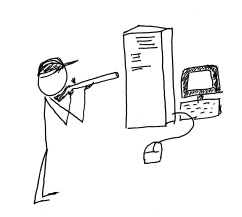
Microsoft’s elimination of the feature-rich and friendly-sounding Small Business Server has created a lot of opportunity for VARs and IT service providers to move their customers to cloud services, SaaS solutions and hosted environments.  Particularly as information technology continues to become more complex, small businesses (well, businesses of all sizes) are recognizing that they may be better off focusing on running the business operation and managing the company as opposed to spending a lot of focus on IT system purchasing, installation, administration and management.  They have come to understand that IT services are critical to the business, but the server doesn’t have to be under the front desk or in a back closet in order to function for the business.  There is simply too much evidence in the market for these business owners to ignore;  shooting the server is now a viable option.

Every day more business owners are being inspired to [shoot their servers] seek out the services that will allow them to continue to benefit from innovations in technology while relieving them of the direct responsibilities of equipment purchasing, implementation, administration and lifecycle management.  Cloud services deliver this capability, and channel partners and Value Added Resellers should recognize their opportunity to get inspired as well, and to start offering cloud-based and hosted services to their customers and capture the “buying decision” opportunity that Microsoft has created.

Ready. Aim. Fire.

jmbunnyfeetMake Sense?

J

Why Accounting in the Cloud?

Why Accounting in the Cloud?

Business owners and managers need to keep close control of their financial data.  They need to know where they stand at all times, and having information available to make business decisions is essential.  When the financial information is in the office but the owner isn’t, how can wise decisions be made without access to supporting data?  They can’t, and that’s a problem.  The solution is simple: work in the cloud.

A cloud computing model properly applied to accounting and bookkeeping systems helps businesses of any size keep their financial data and accounting applications in a safe a secure environment, yet accessible to those who need it.  By locating the business applications and data in a protected central location, access to programs and data sets can be provided to authorized users regardless of location or computing platform.  For a small business owner, this means that working from home or on vacation can be as productive as working in the office.  In larger businesses, cloud-based accounting means the accounting department, CFO and financial advisers might all access the same financial records and applications no matter where they work from.

Cloud computing and hosted application models applied to accounting and bookkeeping represent a viable option for managing, securing and providing access to critical financial information.  Businesses outsourcing their accounting or bookkeeping work find that cloud based approaches offer workflow and process efficiencies to help get the necessary information in the hands of those who need it, quickly and efficiently.

Keeping accounting and bookkeeping systems safe yet available, providing business decision makers with the flexibility of accessing their financial data from anywhere and at any time is a highly valuable service. Accounting and finance professionals can act as the trusted adviser to their clients, providing important business insight and information, with guidance in developing cloud computing and online accounting approaches being among the benefits the firm offers.   Working closer with clients allows professionals to produce better, more accurate and insightful results.   Cloud computing models remove distance barriers and allow professionals and their clients to work more collaboratively with applications and data than ever before.

Many firms are just recently discovering the relationship between technology adoption and business competitiveness.  Those that embrace new computing paradigms gain the ability to meet client requirements in innovative, efficient and timely ways while those that do not adopt these new models continue to struggle, unable to communicate value and differentiation in their service offerings.

There are some recognized truths in business, and one is that is isn’t what you know but who you know.  Another truth, an understanding that is just now being fully recognized, is that it’s not what you do, but how you do it that matters.  Accounting and bookkeeping for business is absolutely an area where cloud computing and the wise application of technology and service can improve cost efficiency, accuracy and turnaround times, allowing the firm to provide a higher level of service to clients.  Accounting in the cloud is a technology-enabled approach which propels the firm into an entirely new range of capabilities and potential service offerings, reaching higher levels of performance and profitability.

Joanie Mann Bunny FeetMake Sense?

J

Efficiency and Value with Cloud Accounting

For some accounting professionals, the problem is finding a way to provide services that are valuable to the client, and doing it in a way that makes it profitable for the provider.  Outsourced and online accounting models are the answer, employing innovative tools in the practice and with clients: tools and resources necessary to get more informed and run the business better.

accountingCloud

With online accounting solutions the firm is able to increase profitability with the range of services offered, often adding clients and work without hiring more personnel.  Online solutions allow professionals and their clients to work from anywhere at any time, providing both with the freedom to focus on core business capabilities (and lifestyle).

Reducing the requirement for sophisticated on-premises technology may mean providing everyone with the ease of use and security of server-based computing models, which is among the benefits of a cloud IT approach.  Centralizing and managing applications, protecting valuable data resources, and streamlining business processes are among the benefits to be achieved with an outsourced, managed application hosting solution.  Businesses who outsource their IT management often realize an increased capacity to do business simply by leveraging the cloud to make the current working models more efficient and effective.

Leveraging mobility and real time access is also about increasing the overall range of opportunity to deliver value.  Contractors, employees and clients all find improvements in getting the information they need when it matters, and the firm finds a greater agility in meeting client demands and expanding service offerings.

Cloud computing and online accounting solutions have proven the viability of anytime, anywhere working models, and professional accounting practices of all sizes and orientations are realizing the benefits of working closer with their clients by applying them to the engagement.

Cloud accounting is really about improving the profitability of the accounting practice while delivering higher levels of service to the client.  The movement of information from one place to another; translating data from one form to another – these are the processes representing the cost and inefficiency in the practice, and are specific areas where a collaborative, online approach may introduce new service efficiency and value.

jmbunnyfeet

Make Sense?

J

It is worth noting that “cloud accounting” and online accounting models do not necessarily require the use of a SaaS solution.  QuickBooks Online, Xero, Freshbooks – these are new small business offerings that exist purely on the web.  QuickBooks desktop editions can be “cloudy”, too, when they’re hosted by an authorized QuickBooks hosting provider.  The point is not necessarily to use web software, but to approach IT management and systems from an outsourced perspective, allowing for centralized management and administration and delivering secure remote and mobile access.  The systems should facilitate the working model, not force it.

The Productivity Paradox: Accounting for Returns on IT Investments

The Productivity Paradox: Accounting for Returns on IT Investments

There has always been somewhat of a struggle between the IT department and “management”, much of the difficulty existing with the need to demonstrate clear returns on investments for IT purchases.  Unfortunately, expenditures in information technology are often the result of short-term views of long-standing problems, applying “solutions” that do not fully address the requirement or which do not deliver the productivity or performance gains expected, particularly in a dynamic and rapidly changing business environment. The assumption is that a wise investment in information technology will result with improved profitability and performance.  Demonstrating this on paper is not always easily accomplished.

There is a great deal of research on the subject of accounting for returns on IT investments.  Some of this research describes “The Productivity Paradox”, referring to early studies on the “relationship between information technology and productivity, and finding an absence of a positive relationship between spending on IT and productivity or profitability”. [1]  Previous to the emergence of cloud computing and widely available remote and mobile technologies (and now possibly even more with the prevalence of available options), businesses invest heavily in IT infrastructure and applications which deliver nominal benefit to the business when measured against the cost of acquisition and implementation.  Heavy IT investments are made with little or no measurable benefit to profitability, even if operational performance improvements are created.  In many cases, the difficulty in “proving” benefit from information technology investments rests with the lack of information relating to impacts in non-operational areas, such as with investors, auditors or analysts.

The early research has become a foundation for making the argument that accounting professionals should be more directly involved in determining the value and impacts of IT investments – due largely to the fact that accounting professionals are generally familiar with the variety of formulas and approaches which become relevant in measuring the effects of IT purchases.  Information technology spending will result in short-term impacts, but will impress on the business over the longer view as well. With a foundation in accounting principles, valuation and analysis, and accompanied by IT knowledge and experience, management accounting benefits from an improved ability to recognize the relevance and value in IT implementations even where no direct profit improvement is visible.

Can difference in firm performance be explained by differences in IT investments?
Can differences in firm performance be explained by differences in IT investments?

Emerging technology models are having huge impacts in business capability as well as risk, and this new paradigm requires that accounting professionals apply their skills to understanding more fully the influences from and results of IT spending in the enterprise.

Having a basis for studying valuation and recognizing the good and bad of focusing on various key measurements (return on assets vs equity vs sales vs investment…) is essential in developing a “formula” for predicting impacts of and potential returns from IT spending, and solving the puzzle that is the productivity paradox.

jmbunnyfeetMake Sense?

J

[1] Journal of Information Systems Vol. 16; “Returns on Investments in Information Technology: a Research Synthesis”

Degrees of Success: Improving Productivity and Performance through Process Automation

Degrees of Success: Improving Productivity and Performance through Process Automation

Few businesses use just one solution to get all their work done.  In most cases, the business must at least communicate, produce information and account for financial activities – and each of these functions has a software product or service associated with delivering the required capability.  While every business uses technology at some level, some businesses have more success than others in developing streamlined and efficient processes guiding the various tasks and activities performed throughout the day.  Sometimes the problem stems from a lack of understanding of the importance of process automation, and sometimes it’s the software.

integrated

The success (or lack thereof) in streamlining a business process is often enabled by the tools supporting it, yet the truth of software and systems is that not everything  is easily integrated and not all business workflows actually “flow” smoothly.  In many cases it is left to the human user to connect the processes and keep the work flowing, creating the opportunity for missed deadlines, duplicated or erroneous data, and a greater dependency on individual worker knowledge than is good for the business.

The better alternative may be the adoption of workflow and automation tools to assist with bridging and scheduling of repetitive tasks, building the knowledgebase of process and task flow supporting business sustainability efforts and easing the burdens of training new employees.  Process automation helps to improve productivity, it’s just that simple.

If the time is taken to really consider the variety and numbers of repetitive tasks employees perform throughout the day, the cost in time, lost productivity and data errors or omissions would likely add up to far more than initially expected.  People tend to adapt to using the tools they are provided, and will find ways to get things done (whether it’s the most effective way or not).   The end does not always justify the means, and many businesses ultimately find that it is here – where individual worker initiative and unguided action are most prevalent – that the operation fails to accomplish stated goals.

In order to create a sustainable operation with consistently high levels of production and performance, the business must establish a complete framework for process automation and support.  Where existing application and software functionality is not able to meet the requirement, the business should implement specialized tools to bridge the gap and embed the process knowledge in the system.

Scheduled reporting, customer and product data synchronization, import/export routines, data maintenance routines – these are among the tasks and processes which represent the regularly-performed work that may be sucking the user productivity and performance out of the business.  It’s a matter of degrees of success, and productivity improvements introduced through comprehensive process and task automation can make the difference between a little success and a lot.

Make Sense?

J

Accounting, Technology and Small Business – The Best of 2013 from CooperMann

Accounting, Technology and Small Business – The Best of 2013 from CooperMann

cooper-mann-top-20It has been an eventful year, hasn’t it?  With the NSA lurking about collecting data, innovative new approaches to information and identity theft emerging almost daily, and complete turmoil in the IT services industry challenging trusted sales and distribution models, most of us have simply become numb to the noise.  Information technology is evolving at an increasingly rapid pace and the way people and businesses interact with and use technology is being forced to change along with it.  It’s starting to become almost, weirdly, natural.

Much of this change can be attributed to “The Cloud”, which is not a thing or a place.  Cloud has become the term which applies to just about anything having anything to do with the Internet.  For technology “purists”, cloud means something fairly specific, but for normal people (no offense to the nerds and geeks, but you know what I mean), cloud applies to pretty much anything accessible via the Internet.  Photos back up to “the cloud”; music gets stored in “the cloud”, websites are hosted in “the cloud”; businesses run their applications in “the cloud”, and you can do darned near anything you need (or want) to with a phone.  The cloud could be some guy’s server in his basement, or it could be a sophisticated network of systems housed in secure facilities around the globe.  They both qualify, sort of.  The point is that mobility, Internet services, subscription access to technology, and social computing are changing how people view technology – resulting with changes not simply in how IT is purchased, but in how IT is used and applied to daily life.

There are, however, some things that do not change even if the working environment does.  The accounting profession, for example, is undergoing a great deal of change, and much of it fueled by the advancements in technology and social computing.  But accounting fundamentals – the “truth of debits and credits” and the good old accounting equation – remain.  The basics of running a business are also unchanged, even as methods of doing business evolve and globalization of markets continues.  Business fundamentals – fiscal responsibility, cash and growth management, and focus on value and sustainability – are as necessary now as every before.

With all this change and IT “advancement”, there have certainly been impacts to how and where we work.  But the more things change, the more they remain the same.  Good business generates goodwill and more business – that doesn’t change – and bad news still tends to spread faster than good news (much faster, given social platforms that are designed to spread the word far and wide).  And when it comes down to the fundamentals – the basic and essential foundations supporting building, operating, and accounting for business – we generally find that they remain constant even as the environment in which they exist experiences change.

jmbunnyfeetMake Sense?

J

Here are the top 20 ranked posts for 2013 from CooperMann.com

  1. The 2 Most Popular Models for Working with QuickBooks Desktop Editions and the Cloud
  2. Accounting Professionals, You’re right – your clients don’t care about the numbers.
  3. Remote access to client bookkeeping comes in many forms because clients come in many forms
  4. What Small Businesses Need To Know about QuickBooks and the Cloud
  5. Intuit Introduces Changes to Authorized Commercial Host for QuickBooks Program, Introduces QuickBooks Enterprise Rental Licensing
  6. Managed Applications, Cloudpaging, and a New Flavor of Hosted QuickBooks
  7. The Language of Accounting: Disconnect between Accountants and Bookkeepers
  8. Why Accountants and Bookkeepers Use the Cloud
  9. Small Business Owner to Accountant: Make Accounting Valuable to ME
  10. Changing How We See Software: QuickBooks 2013 interface frustrates power users
  11. Bookkeeping and Benchmarks – Getting the Numbers Right
  12. In Bookkeeping, Accounting, and Information Technology: The Value of Outsourcing
  13. Hosting All My Applications in the Cloud
  14. 4 Rules of Thumb for Business Success
  15. Intuit Hosting Program for QuickBooks Website Goes Live
  16. Re-defining the role of the accountant, or going back to the good old days?
  17. Cloud Computing for Small Business: It’s All About 3 Apps
  18. The Collaborative Online Model for Small Business Accounting Professionals
  19. QuickBooks Hosting: New Program Tier Announced for QuickBooks Hosting Providers
  20. 4 Rules for Building Service Customer Loyalty
Posts by category – with Accounting Professionals, QuickBooks Hosting, QuickBooks Software, and Small Business being the top categories with ranking articles.
ACCOUNTING PROFESSIONALS
Small Business Owner to Accountant: Make Accounting Valuable to ME
Accounting Professionals, You’re right – your clients don’t care about the numbers.
The Language of Accounting: Disconnect between Accountants and Bookkeepers
Why Accountants and Bookkeepers Use the Cloud
Bookkeeping and Benchmarks – Getting the Numbers Right
In Bookkeeping, Accounting, and Information Technology: The Value of Outsourcing
Re-defining the role of the accountant, or going back to the good old days?
The Collaborative Online Model for Small Business Accounting Professionals
Remote access to client bookkeeping comes in many forms because clients come in many forms
QUICKBOOKS AND BUSINESS APPLICATION HOSTING
The 2 Most Popular Models for Working with QuickBooks Desktop Editions and the Cloud
What Small Businesses Need To Know about QuickBooks and the Cloud
Intuit Introduces Changes to Authorized Commercial Host for QuickBooks Program, Introduces QuickBooks Enterprise Rental Licensing
Hosting All My Applications in the Cloud
Intuit Hosting Program for QuickBooks Website Goes Live
Cloud Computing for Small Business: It’s All About 3 Apps
QuickBooks Hosting: New Program Tier Announced for QuickBooks Hosting Providers
Managed Applications, Cloudpaging, and a New Flavor of Hosted QuickBooks
QUICKBOOKS SOFTWARE
Changing How We See Software: QuickBooks 2013 interface frustrates power users
SMALL BUSINESS
4 Rules of Thumb for Business Success
4 Rules for Building Service Customer Loyalty