It’s Not Easy Being Small – Thoughts on the Disruption and Rethinking Business Priorities

The global pandemic has been the source of disruption to business and personal lives for over a year now and businesses have found that, regardless of the challenges they face, business must continue.

With operations and supply chains strained and positive cash flow at a premium, companies everywhere are focusing on the fundamentals while enabling work-from-home and distancing mandates. COVID-19 has, in many ways, become the event that is forcing many businesses (and entire industries!) to rethink how they operate, and to look to transform their global supply chain models.

A fact that can’t be argued with is that the pandemic has exposed where many businesses are vulnerable, being heavily dependent on supplies of raw materials or finished products that are no longer readily available.

What’s also been exposed is the lack of agility in business I.T. infrastructure, as operations struggle to find ways of continuing operations with reduced personnel or users working from various locations and finding that their systems aren’t really helping in those efforts.

“Supporting small manufacturers has probably never been more important that it is now”, said a panelist at the “National Conversation with Manufacturers” session hosted by the National Institute of Standards and Technology’s Hollings Manufacturing Extension Partnership (NIST MEP). While larger companies are certainly impacted by what’s happened this year, small manufacturers face the challenge of running a company with a smaller available base of resources, technology and supporting tools.

“The conversation’s participants represented very small manufacturing companies with fewer than 20 workers. They all recounted a mad scramble over the past six months. First, they had to figure out whether their operations were essential enough to stay open under their state-mandated shutdown orders.

Then began the efforts to keep their workers safe, implement cleaning regimens, source protective materials, respond to public health protocols that evolved during the pandemic, determine what emergency support they qualified for, and go through the steps to access funds. All of this was being done with a small staff that needed also to continue getting product out and deal with obstacles to normal operations. Hurdles included delays and disarray in the supply chain, disruption in cash flow, with both account receivable extensions and overnight changes in credit terms, shipping impediments and customers still expecting on-time deliveries.”

https://www.nist.gov/blogs/manufacturing-innovation-blog/sometimes-its-not-easy-being-small-manufacturer?utm_medium=email&utm_source=marketingcloud&utm_campaign=

To add to the troubles, disruptions in global trade with China have created significant impact in supply chains worldwide. Companies who rely on direct and secondary suppliers in China are currently experiencing significant disruption, and this is likely to continue. But it isn’t just China… countries around the globe are experiencing challenges with having enough personnel, materials and technology to deliver their goods.

For so many years, businesses have focused on optimizing their supply chains to minimize costs, reduce inventories, and increase asset utilization. This streamlining has also removed the buffers and the flexibility to absorb disruption. COVID-19 has shown that many companies aren’t aware of their vulnerability when supply chains suffer from a global shock of some type.

So, how can organizations respond to the immediate challenge?

There are steps that businesses can take to help address the changing conditions facing businesses today, and a major item that should be addressed is the alignment of IT systems and support to evolving work requirements. Further, enhancements in operational systems should be made to illuminate the extended supply network and enhance inbound materials visibility, and a new focus on production scheduling agility as well as evaluating alternative outbound logistics options should be approached.

NOOBEH’s cloud solutions have been the foundation for business continuity and operational support throughout these difficult times.

We’ve helped companies around the country implement Microsoft Azure cloud servers where they are able to run their entire operations. From order entry, manufacturing, inventory management, pack and ship, and through to accounting and finance – businesses run their applications, integrations and services that allow them to keep the business operating even with reduced personnel or as their users are forced to work from home. OneDrive and SharePoint file storage, and TEAMS for closer collaboration and simplified access to information, helps hybrid working models and distributed workgroups stay in step with projects and business goals.

As a Microsoft Cloud Solution Provider, Mendelson Consulting and NOOBEH provide and administer Microsoft 365 and Azure services, enabling us to more closely manage the licensing and computing platform to make sure it works in the best possible way for your business. With NOOBEH managing your services, you get predictable performance at predictable costs, allowing your business to operate without interruption or subscription overages.

As the past year has proven, life is unpredictable. Let Mendelson Consulting and NOOBEH help your business implement the cloud services and technologies that will give your organization the ability to adjust to changing conditions because you’ll have the most agile IT platform available.

jm bunny feet

Make Sense?

J

Connecting Your Web Store to QuickBooks on Azure

If you sell products via the Internet using a web store or shopping cart application, then you are probably facing the problem of getting your order and sales activities into QuickBooks and then getting shipping and product information back into the web store. For some, the additional need is to mirror the products and pricing information between the inventory management or financial system and the web store. In many businesses, this is a big chore and requires literally hours of redundant data entry and updating.

As with any manual process, there are many opportunities for errors and mistakes which ultimately cost the business both time and money.

Online selling is a dynamic business, and the sale is made when the customer is ready and willing to buy and the seller has the item available at the right price. The web store (ecommerce system) exists to process this sale in order to meet the immediacy of customer demand. If the system is not up to date with current product or pricing information, then the customer may not find what they want, and the sale is lost.

This means that the connectivity between the online selling system and the inventory/accounting system is of paramount importance in the ability to do business.

Synchronizing inventory information between the web store and the inventory/accounting system ensures that product and quantity information is updated on the web as product is sold and shipped (or received in). At the same time, importing invoices and sales receipts into the accounting system helps to ensure proper and accurate recording of sales and payment information and improves tracking of accounts receivable, shipping charges, and sales taxes.

cloud-small-business

To make this connection between the Web store and the inventory/accounting software, an integration solution or connector is generally required. The connector gets installed on the same systems as the inventory/accounting solution (on the same systems as QuickBooks, in this case) and provides the mechanism to synchronize data between the web store and the accounting system.

Integrating an always-on web store with an on-site accounting solution can be a challenge, even for the most tech savvy business owner.

Creating seamless processes for exchanging data between these remote systems requires that both solutions be operating in a secure and accessible platform. While the web store is accessible via the Internet, getting to data in accounting and other systems residing on local PCs or networks is more problematic.

An option that many successful online businesses have adopted is NOOBEH‘s QuickBooks on Azure service, which provides centralized hosting and management for the QuickBooks desktop and any connected inventory or warehouse management applications as well as the integration to the web store.

Enabling the accounting and operational systems to be online and always on, like the web store, allows them to exchange data when and where it is required.

Connecting services in a secure and managed environment introduces new efficiencies and eliminates risk due to data entry errors or lost transactions. The QuickBooks on Azure cloud hosting service provides the system management, platform security and uptime required to ensure that the inventory and accounting systems supporting the always-on web store are also always on.

jm bunny feetMake Sense?

J

Where in The World is Your Data?

Where in the World is Your Data? Even better.. where would you like it to be? In a datacenter near you? In a datacenter far away from you? Maybe you’d like your production system nearby, but backups stored on the other side of the country. Or perhaps you want redundant systems on each coast as well as something somewhere in the middle.
With Microsoft Azure as your platform, you have all the choices in the world, literally.

Microsoft Azure is the platform of choice for businesses of all sizes, offering virtualized infrastructure and services that can be tailored and tuned to meet the unique needs of any organization. No longer tied to on-premises infrastructure, companies find that they can implement better and more comprehensive solutions because they have the agility to adapt systems to immediate needs while retaining the ability to adjust as conditions change.

With Microsoft Azure and Microsoft 365 Services, NOOBEH enables businesses to focus on transformation and improving efficiency, not the IT that supports it.

NOOBEH cloud services, part of the Mendelson Consulting team, sets up Azure infrastructure and manages it for their clients. Business users focus on getting their work done, not on the IT supporting it. NOOBEH QuickBooks on Azure services give small and medium size businesses the most flexible and resilient infrastructure available to run all their desktop and network applications.

Because QuickBooks is rarely a standalone solution, NOOBEH QuickBooks on Azure services have no limitations on what add-ons, extensions, integrations or other applications the business may need to use. All the software a business needs can be deployed on the platform, allowing the company to keep its information systems and assets secure, fully-managed and available when and where they are needed.

While NOOBEH uses Azure platform and Microsoft 365 services to continue to deliver new capability for private sector users, Microsoft is advancing innovation in the delivery of connected services and computing power for private and government sector users wherever it is needed. Azure Modular Datacenters represent a partnership that delivers computing and communications capacity anywhere in the world… and beyond.

Microsoft Azure Modular Datacenters and SpaceX

The Azure modular datacenter is basically a “data center in a box”. It comes with everything needed to deliver computing capacity anywhere in the world.

“We designed the Azure Modular Datacenter (MDC) for customers who need cloud computing capabilities in hybrid or challenging environments, including remote areas. This announcement is complemented by our Azure Space offerings and partnerships that can extend satellite connectivity anywhere in the world. Scenarios range from mobile command centers, humanitarian assistance, military mission needs, mineral exploration, and other use cases requiring high intensity, secure computing on Azure.”

https://azure.microsoft.com/en-us/blog/introducing-the-microsoft-azure-modular-datacenter/

It has power and everything else it needs, and now it also has the connectivity needed, even when there is no (zip, zero) infrastructure. Microsoft has partnered with SpaceX, using SES satellites to bring Internet connectivity to remote areas.

“We can connect via satellite links any element on the Earth to another point on the Earth..”

https://arstechnica.com/information-technology/2020/10/microsofts-new-data-center-in-a-box-will-use-spacex-starlink-broadband/

They’re calling it part of “a multi-orbit, multi-band, multi-vendor” approach to connectivity. That’s pretty cool, if you ask me.

It takes the whole bookkeeping in bunny slippers philosophy of “work when and where it works for you” to an entirely new level.

Make Sense?

jm bunny feet

J

QuickBooks Desktop 2021: Getting Paid Faster, Being More Efficient, and Improving Data Security

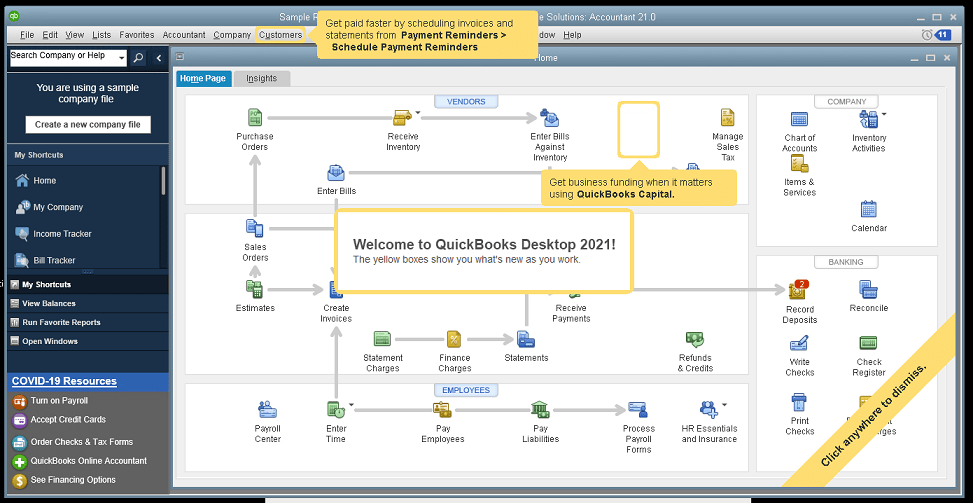
The new QuickBooks Desktop 2021 editions have new and improved features that help businesses get paid faster and secure data more effectively, making the software work even better for your company.

Many of the improvements center on automation and workflow, enabling users to get more done with fewer keystrokes and setting up automatic activities so that items don’t have to be handled manually.

Other improvements center on data and information access, allowing admins to get granular with setting user permissions and access to certain types of information, even down to the record.

Intuit has also delivered several enhancements to existing functionality in QuickBooks desktop, especially in the Enterprise edition and where inventory is involved.

Here is a brief summary of the main changes or additions introduced with QuickBooks 2021 editions.

Improved Bank Feeds
Review bank transactions and match them to existing ones in your books or quickly add new transactions using the advanced bank feeds capability. You can automatically categorize or batch-edit bank transactions by payees, accounts and classes. This can dramatically reduce the time and complexity of reconciling entered transactions with the items the bank processes.

Automated Payment Reminders and Statements
Now you can send statements automatically to customers, with each statement tailored to the customer’s needs or preferences. Set automatic reminders for customers when their invoices are due and schedule statements for your customers to let them know when they have invoices they still need to pay you for. Timely communications with customers regarding their invoices and activity is more likely to keep a customer coming back for more. It also reduces the time required to communicate individually with customers, making AR management and collection activities more efficient.

Customized Payment Receipts
Want to send certain customers a customized message on their receipts? You can use custom templates for forms like invoices, sales receipts, estimates, statements, and purchase orders so each form has the right look and information. Then use the new customer groups capability to get the right form for the right customer every time.

PDF preview
It is always a good idea to preview a document before you send it via email, but that wasn’t always a convenient thing to do in QuickBooks. Now QuickBooks lets you automatically preview attachments before emailing them to customers. You can even preview multiple attachments at once without having to manually open each one outside of QuickBooks, saving huge time and effort and smoothing out a previously-clunky workflow.

Receipt Management
Receipt management in QuickBooks desktop is a new feature that makes entering expense receipts easier and faster. You can give users access to upload expense receipts to QuickBooks using the mobile app or directly from your computer. Automate creating categorized receipt expense entries using the QuickBooks Desktop Mobile App, an option available only with the Plus subscriptions (not the one-time purchase option).

Create Customer Groups
Improve customer communication with rule-based customer groups based on fields like customer type, location, or balance. Creating customer groups allows you to find all customers that match certain criteria. Then you can create automated statements, send payment reminders or create mailing lists for specific groups of customers.
In QuickBooks Desktop Enterprise, you can even use customer groups to define permissions and access at customer and vendor group level.

Data Level Permission
Data level permissions is a new feature in QuickBooks Enterprise 21.0 that gives you more control regarding restricting access for users and roles. This makes it so the admin can create users and roles with access permissions all the way down to the record level for customers and vendors.

With data level permissions you can improve security and confidentiality of information by assigning users access only to the specific data, transactions and reports that they are responsible for. Users will only be able view, edit, or delete specific customers, vendors, or data with the permissions you delegate to them.

NOTE: Data level permissions don’t appear to be available in QuickBooks Enterprise Accountant, nor are they available with a Silver or Gold subscription. To get this feature, you have to go Platinum or Diamond, so it’ll cost you.

Add prices to barcode labels
Wouldn’t it be great if you could print barcode labels with pricing information as well as the item name and description? Now you can! Barcode labels help you accurately identify and manage inventory, providing the information most often needed by employees and customers.

Landed cost
Gain more control and flexibility over how you calculate and share landed inventory costs. Set up landed cost accounts as “COGS” (Cost of Goods sold) or “Other current assets”, and accurately calculate landed cost for old item bills from closed accounting periods. You can also print bills with or without landed cost, allowing you to better control the information you present.

Alternate vendor reports
Key inventory reports can now include alternate vendor information, improving visibility into vendor information on inventory stock status by item, inventory valuation summary and other reports. Linking to alternate vendors via these reports simplifies and streamlines the process of reordering from alternate vendors.

QuickBooks desktop software continues to be the cornerstone of small business accounting. From very small business to the growing enterprise, QuickBooks delivers the functionality that every company needs to manage their income and outgo, customers and vendors, and all their banking activities.

Starting with the early 1999 version to the current 2021 release, Intuit has continued to add capability and enhance features and usability to keep QuickBooks as the most popular small business accounting product on the market. Remember the motto “if you can write a check, you can do your own books“? That’s QuickBooks.

jm bunny feetMake Sense?

J

Building A Solid Foundation for Business Cybersecurity

The cybersecurity threat landscape has changed dramatically in the last few years. No longer primarily a big-business concern, cybersecurity has become a key focus of businesses small and large. Attacks on SMBs are on the rise, perhaps because they represent a plentiful and often easy target. And the cost of damage and disruption to business just keeps going up.

Cybersecurity is not a problem you can simply throw a bunch of money and tools at to fix.

No matter how much great software or fancy systems you implement, the people will always be a big part of the equation. The root cause of over half the data breaches reported is a result of negligent employees or contractors.

That means that nearly half of all attacks are being executed through phishing or social engineering. The only tool you can apply to this problem is education. Efforts should be focused on security awareness and training workers to be more cautious to the point of almost being paranoid. Better to be safe than sorry in this case.

Training workers to be more careful as they work with emails, documents and websites is part of it, but there is much more to making sure the business is addressing the entire cybersecurity issue. NIST (National Institute of Standards and Technology) offers a wide variety of information and guides that businesses can use to learn more about and implement cybersecurity practices. Among these resources is the Cybersecurity Framework.

According to NIST, “the Framework focuses on using business drivers to guide cybersecurity activities and considering cybersecurity risks as part of the organization’s risk management processes.” It is a highly useful tool in helping the business align and prioritize activities with business requirements, risk tolerances and resources. The standard framework includes elements that are consistent and common across sectors and critical infrastructure, so it can be oriented to any business.

Even if the business is not prepared to delve into the details of a comprehensive cybersecurity policy and guideline, a basic outline and approach cannot be avoided without asking for disaster.

Putting this squarely into the Risk Management category, there is an ongoing process of identifying, assessing, and responding to risk situations or conditions. To manage the risk, businesses need to consider the likelihood that an event will occur and what the potential impact is as a result.

Knowing the acceptable level of risk for reaching the business objective is the risk tolerance. If a business understands its risk tolerance, the company can prioritize cybersecurity activities and make informed decisions about cybersecurity expenditures.

There are five key functions to consider as it relates to cybersecurity risk: Identification, Protection, Detection, Response and Recovery. How the business addresses each of these in the context of the systems and activities is essentially the business’s cybersecurity posture, a high-level and somewhat strategic view of the organization’s management of cybersecurity risk.

The key to building a solid foundation for  business cybersecurity practice is to establish a platform where all the business applications and data can be identified and access secured.

User desktops, productivity applications, operational software and business data can be hosted on private cloud servers, allowing the business to fully-manage data and application access. The server-based model reduces or eliminates the need to sync data to devices, and remote desktops keep user environments secure, patched and up-to-date.

Our consultants can’t write your cybersecurity policies or determine your risk tolerance, but we can help implement a solution that improves fault tolerance, resilience, and recovery.

Make Sense?

J

Office 2013 Loses Support for Commercial Office 365 Services

If you’re not on a subscription for your Office desktop applications, you may lose access to your email box and other services.  Why? Because Microsoft announced that, effective October 13th, 2020, Office 365 services (like OneDrive, Hosted Exchange and more) will only support client connectivity from subscription clients or perpetual clients with mainstream support.

Basically this means that Office 2013 is about to be no fun any more.

You won’t be able to use Office 2013 Outlook to connect to your Microsoft-hosted Exchange mailbox, and your Word and Excel won’t connect to OneDrive.  If you are with a hosting provider who supplies your Office licenses as part of the service, cross your fingers and hope that it isn’t Office 2013. It will be pretty frustrating if your Outlook suddenly has problems accessing your Microsoft-hosted mailbox.

Like many other products, a lot of the functionality in the desktop software has been turned into web service and the Microsoft Office applications are a great example. With cloud connectivity being the focus, desktop solutions are more frequently leveraging online resources to extend and expand their capabilities. This also means they’re more frequently turning from one-time software purchases to subscription service.

After October, Microsoft’s ongoing investments in the Office 365 cloud services – including Exchange Online, SharePoint Online, and OneDrive for Business – will be made based on “post-Office 2013 requirements”.  Now is the time to migrate your Office 2013 to Microsoft 365 Apps (formerly Office 365 ProPlus). We highly recommend this move anyway, so businesses can take advantage of using their Office applications seamlessly on Azure servers as well as their local PC desktops and mobile devices.

Users of Office 2016 and Office 2019 have a little more time before their software no longer supports the cloud services. That end date is currently October 2023. You can find the support lifecycle site for Office mainstream support dates here.

It isn’t that Microsoft plans to actively block older Office clients from connecting to Office 365 services. It’s just that older applications may have performance or reliability issues when they try to connect to the constantly-updated cloud services.  Increased security risks are certain and users may even find that they are no longer compliant with certain requirements. The big thing is that Microsoft support will likely not be able to resolve issues related to unsupported connections.

The days of buying software once and running it forever are just about over.

Developers have recognized that cloud services can expand and enhance their solutions in ways that static local installation can’t. For many businesses, it becomes easier and ultimately more efficient to migrate to subscription service for IT platform and software. Azure cloud servers, for example, allow businesses to always have modern infrastructure that is more fault tolerant and agile than on-premises hardware.

Combing these benefits with software that is cloud-connected and always up to date means the business never faces lost productivity or revenues due to outdated systems or lost compatibility with newer solutions.

Make Sense?

J