9 Growth Hacks Any Small Business Can Implement

In 1996, an email company named Hotmail launched with a small group of users. By the end of 1997, that company had 12 million users.How did they grow so dramatically in just year and a half? Well, they looked at their initial numbers and saw that approximately 80 percent of new users came by referral from current users.

To make the most of referrals, Hotmail created their iconic email postscript: “PS. I love you. Get your free email at Hotmail.”

That single line, added at the end of every email sent through Hotmail, drove millions of new users in an ever-widening ripple effect.  Hotmail successfully created one of the first documented growth hacks.

via 9 Growth Hacks Any Small Business Can Implement.


Where do we go from here? The SMB SaaS Migration

Where do we go from here?  The SMB SaaS Migration

Forests are a great renewable resource.  You may cut them down, but you can replant and grow new ones to cut down again later.  I suppose it’s sort of like that for software vendors who provide small business solutions.  While many small businesses fail and close every year, lots and lots of them start up and continue operating each year.  Since there’s a steady stream of new prospective customers coming up each year, maybe it is OK when some of them outgrow the product and leave (leaf?).

On the other hand, maybe it makes sense to understand where those customers who do grow up and flourish will go… to which products or solutions they will migrate, and how the company might actually retain a relationship with them through that process and beyond.  Some businesses will mature successfully, and will outgrow their small business solutions and leave their vendors, but it doesn’t necessarily have to be that way for all.  For some key software vendors, a fair question to ask themselves is where their customers will go from here… where “here” is the solution the customer is using now.

When this question is applied to the small business accounting market, it ends up centering on the QuickBooks product line.  Intuit is currently encouraging all QuickBooks customers to look at the QuickBooks Online solution, the fully SaaS-based offering which is different from the desktop editions.  The QuickBooks desktop editions, on the other hand, service small businesses very well.  The functionality improves and increases as users move up the product line from the Pro version through Premier and to Enterprise edition.  This line of solutions has done a great job of serving the needs of both small and larger businesses – all within the same product set.  But now Intuit wants users to experience the benefits of subscription-based service and an online working model.  Those are great benefits, but there’s a question that is left open for the asking.  Where are QuickBooks customers supposed to go from there, assuming that at least some of them might grow beyond the capability of the online product?  It’s a fair question, and here’s why I think so.

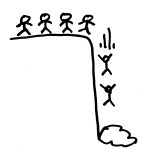
fall_from_cloudOnce a business has adopted a certain working model and the mentality that goes along with it, it is difficult to come in and tell them they have to change to a new model and find a way to adjust.  Change doesn’t come that easily for many individuals much less an entire organization, so this is a big deal and potentially very impactful to all aspects of the operation.  Yet this is exactly what is currently suggested with Intuit’s desire to have customers use the online edition.

It may be a great solution for now, but what’s the next step up from there?  Is it QuickBooks Enterprise on the desktop?  Kind of a weird message, don’t you think?  Let’s have customers adopt an anytime, anywhere subscription solution model, and then migrate them back to the desktop where the management and maintenance of the solution is higher due to number of users, and where there is no mobility, multi-location or remote access capability as there was with online.

The thought is that QuickBooks Online will eventually compete with the Netsuite and Intacct class of SaaS solutions, but right now it doesn’t and there are customers who must leave that product for something that handles their larger and deeper business needs (like the QuickBooks Premier and Enterprise solutions do).   There is a big gap between the entry level accounting products and those which are designed for the larger or midsize “small business”, and the QuickBooks desktop editions represent the only viable options in that very large space.  In fact, many businesses utilize line of business products that allow them to retain use of QuickBooks even as the enterprise scales far beyond the expectation that QuickBooks could handle the need.  But it often can, and it makes sense for businesses to leverage this ability if they are able.

The answer for these growing businesses  – the place they should go when they’ve outgrown the small business SaaS solution like QuickBooks Online (or Xero or Freshbooks or whatever) is to a hosted or remote-enabled QuickBooks model.  With the QuickBooks desktop editions hosted and managed by a cloud provider, businesses are able to retain the benefits of managed service, subscription pricing, and anytime/anywhere access while utilizing the products that are recognized as the industry standards for finance and accounting for growing businesses.

The hosted approach gives the businesses a clear path for the advancement of their systems in line with the growing needs of the business, and removes the need to shift working models from online to on-prem.  As needs increase and the complexity of systems grow through integration and scale, the service provider manages the platform and systems, enabling the business to not simply continue operating, but to grow and expand with the confidence that there is a plan to grow and expand the systems which support it.   The place to go is the cloud, and whether it is an entry-level SaaS solution or a hosted desktop and server approach, the service is there to handle the business.

jmbunnyfeetMake Sense?

J

Justifying the IT Budget: the Cost of Not Spending

it_spend“Competitive and ever-increasingly sophisticated in the marketplace”[1] describes a company positioned for long term business survival.  Complacency takes the business nowhere but into irrelevance-land, which I think we can all agree is not where most business owners wish to end up…  it makes selling the company slightly more challenging.  Even in markets which were once firmly held to be localized are now open to new – and new kinds of – competitors, due in most part to advancements the development of information technology (IT) as well as how it is applied.  These days, competition is globally facilitated rather than locally, and it’s becoming the standard approach.  Welcome to the cloud.

New paradigms in IT capability and use are spawning huge shifts in what were broadly recognized normal or traditional business approaches.  This realization has created the need for businesses to radically change their view of IT investment and the value of IT within the organization and operation.  Yet IT is rarely an area which gains a strategic focus for investment within most businesses, and is frequently considered to be like a pencil or a particular chair… something the business needs but which has little impact on the company’s ability to compete better.  Au Contraire, Mon Frère:  Information technology is at the heart of business competitiveness, but justifying the desired investment is the great challenge.  Maybe it’s because the focus is always on the great benefits to be achieved with the spend, rather than looking realistically at the impact of not doing it well or at all.  Especially with information technology, there is a large potential cost to be paid for not spending adequately.

While business operations are sustained through IT involvement, economic pressures continue to weigh down business interest in funding IT operations. (which is weird, as there is a lot of evidence that the good bet is on those who do just the opposite). This regular spending reduction and cost control plan has good intentions of reducing the overall cost of business operations. The unfortunate reality is that operations are less efficiently sustained and are even more frequently unable to create or manage any level of growth. Reducing all IT spending is only useful when profitability is also improved and quality is maintained, unless it is an effort to simply stay afloat as revenues decline (and it’s recognized that quality will decline as well). But reducing costs does not help the business seeking to remain competitive in a rapidly changing marketplace, and pulling the pins out of the department primarily responsible for at least keeping things currently in operation operating serves only to chip away at the once-solid foundation. It’s a real problem, this difficulty with increasing interest and justifying increased funding for business information technology. And it all stems from the inability of organizations to clearly and with tangible benefit cost justify the investment.

It is this justification – demonstrating IT investment as a strategic asset presenting an advantage over competitors and positioning the business for future success – which requires effort and analysis to fully describe. Information technology is not a set of servers and software, and it is not websites and portals. It’s not click thru rates or SEO scores. Well, it’s all of that, but it is none of that. There is so much to consider and incorporate, and there are many degrees of success which might be experienced along the way. Information technology is a fundamental requirement in each and every business, and dependency upon it is increasing at a startlingly rapid pace, yet we still can’t quite figure out how to put it all on paper with provable numbers.

It might be easier to forecast in little departmental or functional pieces, but that doesn’t provide a total picture of the enterprise. And it’s often really difficult to quantify the impact of not doing something, or doing it only OK rather than really well. When this data does present itself, it often comes too late and in the form of a comparison to the competition, revealing where the business just didn’t meet the mark as compared to others in the same space.

It all boils down to businesses coming to the realization that information technology investment must be made on a continuing basis. The justification for IT funding must be made, and that justification must necessarily be balanced against the potential implications and impacts of not implementing. This is the only formula which can ultimately describe the value of IT investment in the business.

Make Sense?

Read the entire article on LinkedIn

https://www.linkedin.com/today/post/article/20140624161243-633314-justifying-the-it-budget-the-cost-of-not-spending


[1] A model for investment justification in information
technology projects: A. Gunasekaran et al. / International Journal of Information Management 21 (2001) 349–364

The CPA for Small Business: Proactive, Responsive, and Helps Paint a Beautiful Picture

chartI once read an article written by Doug Sleeter which describing the findings of a published report titled What SMBs Want from Their CPA.  The report was a summary of results from a study conducted by The Sleeter Group, and was intended to help accounting professionals understand the factors in the market which influence business use of professional accounting services.  While adoption and use of technology was not named as the top item on the list, capabilities which can be rendered only if such adoption occurs were.  In short, it’s not the technology that clients demand, but the level of service that professionals can only deliver by embracing advancements in technology and applying them to the client engagement.

The report and article placed a specific focus on trends relating to technology adoption and use in the professional practice, and establishes a foundation for firms to understand why technology is and always has been a key factor in the success of the CPA-client relationship.  It’s not that the accounting professional must become a skilled technologist and promote high technology to the client.  Rather, the success factor rests with the firm’s motivation to implement technologies and tools which will improve their ability to deliver more (and more valuable) service to the client in a more direct and timely manner.

The survey’s two critical questions posed to small business owners who use the services of a CPA were 1. What factors played a role in your decision to leave your former CPA?, and 2. What types of services would you like to receive from your CPA?   Both questions are pretty straightforward, and the top responses from surveyed SMBs were equally unambiguous.

To the first question (factors playing into a decision to leave former CPA), the top two answers indicated that reactive and/or unresponsive are the problems which ultimately cause a small business owner to change accounting professionals.  The top response was “Former CPA didn’t give proactive advice, only reactive”.  The close second response was “Former CPA had poor responsiveness”.

Unfortunately, these responses more than accurately describe many professional firms and their approach to client service.  These firms are perfectly content with waiting for clients to deliver after-the-fact information, delivering reports long after their relevance has past, and providing no sense of urgency in helping clients address business issues facing them here and now.  These firms are content to work with their write-up and trial balance solutions, depreciation and amortization and tax products – and give little consideration to how they could adjust their operation to a better, more relevant and rapid delivery of service and insight to the client.

The second question, “What services do SMBs want from their CPAs?”, was met with the same responses professionals have been hearing for years; small business owners need help with business planning and business strategy and they wish the help would come from their CPA.   It is surprising how many accounting professionals list business planning and strategy among the services they promote on their websites, and then just sit back and wait for clients to ask.  Communication with clients remains relegated to annual reminders for tax information, or maybe slightly more frequent notes about other tax or compliance work to be done.  It may be a bit unfair to place all the blame on the professional.  Regulatory and reporting impacts on business are increasing and are increasingly complicated.  Many professionals find it challenging enough simply to keep up with changes relating to the services they currently and regularly provide.

This is where practitioners should seriously take notice, and accept that the ability to meet changing market and customer demands is by intelligently leveraging technology to accomplish what people and process cannot do alone.

  • It takes information technology to speed up the bookkeeping, accounting and reporting processes; technology is required to help turn information into useful and relevant data;
  • technology facilitates the faster collection of information from and the delivery of information to clients;
  • technology is applied to reflecting numbers as pictures and helping users visualize the meaning of the data, and
  • technology enables the collection and analysis of “big data”, which leads to AI advancements and greater intelligence delivered through the applications businesses use.

The Sleeter Group report clearly demonstrated that small business owners continue to need and want more than just tax returns and post-facto reports from their accounting professionals, and that the lack of attention in these areas pose a direct threat to the small business/CPA relationship.  Professionals can remove the threat by working closer with their small business clients, applying technology and process controls to get better information in a more timely manner, and returning the result with greater insight.  Be proactive and be responsive, and apply the necessary technologies and business philosophy to get there before the client base looks for satisfaction elsewhere.

I’ve said before that small business owners don’t care about the numbers, they care about the picture the numbers paint, and they care about getting to a place where the picture is absolutely beautiful.  With the right tools in place, their CPA can help guide them there.

jmbunnyfeetMake Sense?

J

4 Rules of Thumb for Considering Cloud Applications in Business

With all the talk of cloud computing and Software-as-a-Service models, businesses are increasingly questioning their continued use of on-premises and “traditional” software implementations. Having heard that cloud applications are cheaper and better than locally installed solutions, some small business owners and IT managers are actively seeking alternatives to their current software selections. In too many cases, however, these business owners or IT managers aren’t looking at the longer term impacts of their decisions, and may be adopting cloud software solutions simply because it seems to be the way things are going these days.

The cloud is simply a term being applied to a new way of looking at information technology – how businesses buy it, how they use it, and what they expect from it. Even as technology gets more complicated, users are demanding greater ease-of-use and lower costs. The response to these conditions is the cloud: addressing basic and common requirements and delivering the solution for a low-cost to many users. While the approach meets the simplicity and affordability elements, it may or may not fully address all the functional, compliance or sustainability needs of the business.

4-rules-of-thumbOne size never fits all, and this is as true with cloud computing as it is with bathing suits. For the business owner or IT manager considering adoption of cloud-based applications for the business, keep in mind these 4 Rules of Thumb so that the hype and excitement doesn’t cloud your judgment.

Rule 1: Software is software, and it is installed somewhere. Just because an application is accessed using a browser (which is software) doesn’t mean the product isn’t installed somewhere. When it’s a SaaS solution, the product is simply installed and running on the provider’s servers rather than your own computers.  Software can fail even when it isn’t on your computer, so it should be expected that failure could happen with SaaS solutions.  The difference is that a failure of an app on one machine isn’t news; failure of an app that lots of people are using at the same time is news.

Rule 2: Software that talks to other software means there is integration between the two. Whether the products are installed on the PC or whether they run from different providers’ systems, they still have to be able to communicate together at some common level. The Windows platform used to provide a “common” standard for integration of Windows applications. When applications move from the desktop platform to the web, many of the common integration approaches no longer work and new methods must be developed.  Just because a solution integrates with the desktop edition of a product does not mean it will automatically integrate with a web or SaaS edition of the product (QuickBooks exemplifies this).

Rule 3: Software still requires hardware and other resources. When cloud-based solutions are implemented, the cost of the server and storage facilities (along with other elements) may be included in the subscription price. The efficiency and scale economies developed by the provider will ultimately determine their profitability, but it is generally the case that centralization of resources, management and administration can significantly reduce the cost of operations. With most cloud solutions, it is the assumption of scale (leveraging a single asset base to many subscribing customers) which makes things more affordable than deploying similar capabilities individually for each customer. Consider also that any deployment of cloud software solutions still means that businesses must retain their local networks and devices. While PCs, laptops and tablets may not be running business applications, they are still computing devices which may need to connect to networks, have virus protection, have remote access or connection software installed on them, and any number of other things. In short, moving to the cloud does not remove the requirement to have and maintain user devices, printers and LANs.  And really, don’t most people still want Office applications on their devices, even if they also have remote access to such applications?  Office for iPad is somewhat of a tell in that respect; kind of proves the point.

Rule 4: Not all data is stored in the same manner. This is as true on a PC or LAN as it is in the cloud. However, cloud solutions can introduce quite a wrinkle when it comes to keeping copies of business data over time. With PCs and local networks, a business would back up their data in any variety of ways, preserving the files and formats for possible later use. As long as there was software available to read and open the files, the backed up data would be usable. Simply due to the popularity of some data formats, there might also be tools or utilities available to read the data even if the original application was lost. The wrinkle introduced with cloud solutions is not necessarily that the format of the data is strange – it is likely that most cloud-based business applications use fairly proven and recognizable database technology. The difficulty is that the actual database file(s) containing a company’s unique data may or may not be separate from other company data. If it is separate (single-tenant database), it is unlikely that the database as structured is portable. The fact is, most web-based or cloud solutions will allow users to export data from the database, but cannot provide actual structured data files ready for use with another application, lacking logical data or table relationships. Some solutions suggest that simple list exports are sufficient, and others may say they have data conversion capabilities, but the reality is that data existing in a cloud application is not very portable. Business intelligence is a terrible thing to waste, so it is really important to be able to take all the data with you (in a meaningful way, not as a bunch of disparate lists).

Cloud computing covers a really broad spectrum of technologies and delivery models, and most of the above is more about SaaS applications rather than actual cloud platforms. The platforms are where the applications live – server and network environments.  This is where hosting companies do their work, as the things they host live on the platforms.

Businesses electing to add mobility, management, fault tolerance and other capabilities to their systems should explore the benefits of application hosting and cloud platforms, and not immediately look to SaaS and cloud application alternatives to their existing software solutions. By deploying their systems in a managed hosting environment, businesses can often keep using their existing core software products, integrations, and data archiving methods while gaining the best benefits of “cloud”.

Joanie Mann Bunny FeetMake Sense?
J


Small #NonProfits, Crummy Computers and the #Cloud

Small NonProfits, Crummy Computers and the Cloud

There are many benefits included in the “value proposition” for cloud computing models, but there are some hidden gems in terms of how these outsourced IT models can specifically and directly address one of the biggest problems facing many smaller nonprofit organizations: they have to use old, outdated, and often just pretty crummy equipment. But now it’s OK, because even crummy old PCs can work just fine when the applications are hosted in the cloud.

picture-pcSmall nonprofit organizations often rely exclusively on donations to keep the business running.  Donations don’t always come in the form of dollars; sometimes donations include used computer equipment.  For many nonprofits, using donated equipment is the only option they have due to various budgeting constraints, and nonprofits need computers just as badly as any other business. Not only do these underfunded businesses have to try to operate with what most users would consider to be sub-par equipment, they frequently operate their systems and networks without the aid of skilled or experienced technicians.  For a small nonprofit organization, keeping up with business is tough when the computers and software aren’t able to fully meet the need.

To complicate things even more, many people working in smaller nonprofit organizations are mobile workers – functioning either as part-time participants or users who simply need to work from a variety of possible locations.  And they almost always have to use their own mobile devices.  Supporting a remote or mobile workforce is particularly challenging when even the most basic of computing requirements are barely met, so addressing the variables of everyone having their own mobile devices and remote computers is frightful at best.

With the introduction of cloud computing, affordable broadband access, and value-priced application hosting services, small nonprofit organizations finally have a workable answer.  Working with an application hosting provider, the business can move applications and data to outsourced infrastructure, where the solution is effectively delivered back in the form of a subscription service.

Accessing applications and data on central servers, and using those applications from a “virtual” or hosted desktop, can allow these small businesses to use current versions of business applications without having to purchase the powerful desktop or portable computers necessary to run them.  The applications run from the host’s servers, reducing the local PC’s involvement to handling the display, keyboard and mouse inputs, and printer outputs.  Even older computers which would be incapable of running current versions of applications like Microsoft Office or QuickBooks are generally able to access and run those applications from the cloud.

Predicting costs of operations is essential for any business but is crucial for the nonprofit.  Budgeting around a limited financial resource, small nonprofits are hard hit when unplanned failures in computer systems occur.  In many cases, there simply isn’t room in the budget to recover from these events, and productivity and performance suffers because of it.

Approaching IT services from an outsourced perspective, these small businesses can build a significant level of predictability into their business technology costs – and get higher levels of fault tolerance and disaster recovery capability along with it.  The hosting service is responsible for maintaining the operating environment, securing the systems, backing up the data, and keeping things running.  The costs associated with server hardware failures, and even regular server and system maintenance, are covered in the subscription service.  This means that unexpected break/fix, update and maintenance costs are no longer of concern.

Every small business, not just the nonprofit, should explore the options available to them with cloud and application hosting services.  Performance within any organization depends on the systems and tools available to get work done.  Owning the problem of managing and maintaining the information technology platforms and systems makes little sense these days; better to outsource the problems to a professional service provider.  Not only can this type of service introduce predictable costs for business IT services, it makes working with crummy old donated equipment a workable situation.

Joanie Mann Bunny FeetMake Sense?

J