

Revenue Recognition and closing the reporting GAAP

Revenue Recognition and closing the reporting GAAP

chartOne company earns what the other company spends.  This is business, and it seems like it would be pretty straightforward, accounting for the money coming in and the money going out.  But it is really not that simple when it comes to business finances and accounting for revenue.  With investor pressure to improve share prices and market pressures forcing greater competition, businesses have always sought out ways to make the performance look as good as possible – on paper even if not in reality.  It is this requirement to make the business look better than it may actually be that drives “innovation” in financial reporting, and encourages some companies to use whatever rules are available to mislead investors or paint a rosy picture for stakeholders.  When the balance is lost and financial reporting standards become so oblique as to allow regular and gross misrepresentation, it is time to change the standards.

There are numerous instances of fraud and scandal reported from the finance departments of big businesses, but instances of improper or misleading revenue recognition can happen in even the smallest of companies, and not necessarily on purpose.  It is important to understand that properly and accurately reporting business revenue and earnings isn’t done just for investor satisfaction, it is an essential part of describing business performance that any owner or manager must be able to rely on.

Generally Accepted Accounting Principles (GAAP) provide investors and business owners with some consistency in the financial statements they use to analyze company performance, but only minimally.  This is partly due to the fact that GAAP is based not only on some standards established by policy boards (the authoritative standards) but also on “generally accepted” standards, which are often not really standards at all but simply past practice that was found to be accepted.  Especially in the global economy where fewer businesses operate solely within traditional territorial boundaries – and where accepted reporting methods vary widely – having a single financial reporting standard has become more important than ever.

Make it so, Number One.

Now there are new rules from FASB (Financial Accounting Standards Board) and IASB (International Accounting Standards Board) which provide clear and detailed guidance for how businesses recognize revenues.  These rules are based on a consistently applied set of principles, no matter what sort of business is involved and regardless of where the business is located.

A focus of the new rules of revenue recognition centers on customer contracts, delving into the details of how earnings from those agreements should be recorded. Consider that many businesses combine multiple products and services into a single agreement, even though there may be several deliverables or milestones included.  This method of booking customer contracts allowed companies to report revenues they were not yet due as part of a total agreement, often resulting with inflated earnings reports.   Stakeholders would perceive that the company had reached one earning threshold, but the reality was something quite different and performance expectations were unmet.

“FASB and the International Accounting Standards Board (IASB) issued converged guidance on recognizing revenue in contracts with customers. The new guidance is a major achievement in the Boards’ joint efforts to improve this important area of financial reporting.”  http://www.fasb.org/jsp/FASB/Page/BridgePage&cid=1351027207987

The new rules force an additional level of discussion, including a full set of disclosure requirements that will provide more information about contracts with customers.  Businesses must identify each promised deliverable and attached revenue or earning component, which helps to better understand how the revenue may be earned (and recognized) as the business performs on the various obligations to the customer.

Just take a look at some big ERP companies and the lawsuits generated from problems and failures in delivery – problems that might have been more clearly identified to investors and stakeholders if the tie between product sales and services to be performed were more clearly described.  In many cases, these situations exemplify the revenue recognition reporting problem, where large customer contracts and license sales were fully booked and recognized even though implementation services milestones attached to those license sales remained undelivered.

“2010 – JDA Software (i2) – Dillard’s, Inc.:  Dillard’s had alleged i2 failed to meet obligations regarding two software-license agreements for which the department-store operator had paid $8 million.” http://www.zdnet.com/blog/projectfailures/erp-train-wrecks-failures-and-lawsuits/12055

For private companies, reporting periods beginning after December 15, 2017 must follow the new guidance.  It may seem like a long period of time – from the decision to apply the new rules to the effective date – but the number of businesses the new rules will impact is large.  The FASB made a decision to delay the effective date because of the broad scope of organizations affected and “the potentially significant effect that a change in revenue recognition has on other financial statement line items.”

Business owners and their accounting professionals need to make sure that financial systems and processes are up to the task and can track and produce the detailed reporting these new rules require. For investors and analysts, the new reporting rules and detailed information they generate will go a long way towards minimizing the impact of innovative revenue reporting practices, and will hopefully bring a new level of believability and usefulness to business financial reports.

Make Sense?

J

Accessing Small Business Leadership and Development Resources: More for the growing concern

Accessing Small Business Leadership and Development Resources: More for the growing concern

There are a lot of resources available for people who want to start a small business.  From business plans to funding websites to guides on entrepreneurship, the available pool of information on starting up and growing a business is huge.  So huge, in fact, that many small business owners fail to find the things they really need to help them grow the business, expand operations and hire more employees.  While entrepreneurship and starting a business is the first step, the economy grows and flourishes when small businesses grow and flourish.  This is why the site SmallBusinessLeadership.com was started in cooperation with the America’s SBDC.

Among the available resources for small business owners is the Association of Small Business Development Centers, or America’s SBDC.  These association offices are found throughout the country, and represent a wealth of support for small business which is, as we all know, the fuel powering the American economy.  A report authored by James Chrisman, PhD investigated the economic impact of the Small Business Development Center counseling activities in the US in 2010-2011, and found that the centers are indeed instrumental in supporting small business success.

Among the findings is an analysis of the contribution SBDC long-term clients made to the economy, finding that these businesses “added $6.8 billion in incremental sales and 75,166 new jobs to the nation”.  The investment in helping startups and entrepreneurs also demonstrates clear success, with “59.2% of all pre-venture clients” starting a business within one year of receiving counseling from the SBDC.

But the success with SBDC isn’t all about starting up and expanding business– it’s about retaining people (jobs) and sustaining revenue, too.  With economic challenges facing every business owner, the ability to simply maintain the operation at existing levels often becomes the biggest job of all.  In this area the SBDC also performs well for business clients, and estimates that “83,268 jobs were saved and $7.3 billion in sales revenues were maintained as a result of the [SBDC] counseling”.

And talk about fueling the small business economy!  Businesses need financing and capital to operate and grow, and as a direct result of the assistance they received from the SBDC “approximately $3.3 billion in capital” was raised by SBDC business clients, according to report estimates.  Not too shabby when you consider the difficulties many businesses are having with obtaining financing through commercial banks and other funding sources.

There is no argument with the value the SBDC brings to the small business community.  What may be a challenge, however, is finding those resources and getting involved with the information and people who can really make a difference for a business owner in a particular region or area.  While there may be SBDC counselors in the area, there is no guarantee that there’s an easily searchable website or method of gaining a little DIY education without making an appointment.  SmallBusinessLeadership.com addresses this challenge by providing location-specific access to SBDC and other resources for business owners who wish to find experts and insight relating to their particular locale or situation.  Additionally, visitors to the site can explore the varieties of content made available from SBDC offices and small business experts, ranging from success stories and case studies to tips for marketing the business, approaches to improving business process support, or even finding technologies or services to solve specific business problems.

Starting or growing a business isn’t something you do alone.  It takes a committed team from the development of the first idea through to the hiring of employees and expansion to new locations.  Working with America’s SBDC and leveraging the knowledge and resources available via SmallBusinessLeadership.com, business owners across the country will find new ways to build stronger foundations for the business, and to develop leaner and more sustainable operations than ever before.

jmbunnyfeetMake Sense?

J

smallbusinessleadership

The CPA for Small Business: Proactive, Responsive, and Helps Paint a Beautiful Picture

chartI once read an article written by Doug Sleeter which describing the findings of a published report titled What SMBs Want from Their CPA.  The report was a summary of results from a study conducted by The Sleeter Group, and was intended to help accounting professionals understand the factors in the market which influence business use of professional accounting services.  While adoption and use of technology was not named as the top item on the list, capabilities which can be rendered only if such adoption occurs were.  In short, it’s not the technology that clients demand, but the level of service that professionals can only deliver by embracing advancements in technology and applying them to the client engagement.

The report and article placed a specific focus on trends relating to technology adoption and use in the professional practice, and establishes a foundation for firms to understand why technology is and always has been a key factor in the success of the CPA-client relationship.  It’s not that the accounting professional must become a skilled technologist and promote high technology to the client.  Rather, the success factor rests with the firm’s motivation to implement technologies and tools which will improve their ability to deliver more (and more valuable) service to the client in a more direct and timely manner.

The survey’s two critical questions posed to small business owners who use the services of a CPA were 1. What factors played a role in your decision to leave your former CPA?, and 2. What types of services would you like to receive from your CPA?   Both questions are pretty straightforward, and the top responses from surveyed SMBs were equally unambiguous.

To the first question (factors playing into a decision to leave former CPA), the top two answers indicated that reactive and/or unresponsive are the problems which ultimately cause a small business owner to change accounting professionals.  The top response was “Former CPA didn’t give proactive advice, only reactive”.  The close second response was “Former CPA had poor responsiveness”.

Unfortunately, these responses more than accurately describe many professional firms and their approach to client service.  These firms are perfectly content with waiting for clients to deliver after-the-fact information, delivering reports long after their relevance has past, and providing no sense of urgency in helping clients address business issues facing them here and now.  These firms are content to work with their write-up and trial balance solutions, depreciation and amortization and tax products – and give little consideration to how they could adjust their operation to a better, more relevant and rapid delivery of service and insight to the client.

The second question, “What services do SMBs want from their CPAs?”, was met with the same responses professionals have been hearing for years; small business owners need help with business planning and business strategy and they wish the help would come from their CPA.   It is surprising how many accounting professionals list business planning and strategy among the services they promote on their websites, and then just sit back and wait for clients to ask.  Communication with clients remains relegated to annual reminders for tax information, or maybe slightly more frequent notes about other tax or compliance work to be done.  It may be a bit unfair to place all the blame on the professional.  Regulatory and reporting impacts on business are increasing and are increasingly complicated.  Many professionals find it challenging enough simply to keep up with changes relating to the services they currently and regularly provide.

This is where practitioners should seriously take notice, and accept that the ability to meet changing market and customer demands is by intelligently leveraging technology to accomplish what people and process cannot do alone.

  • It takes information technology to speed up the bookkeeping, accounting and reporting processes; technology is required to help turn information into useful and relevant data;
  • technology facilitates the faster collection of information from and the delivery of information to clients;
  • technology is applied to reflecting numbers as pictures and helping users visualize the meaning of the data, and
  • technology enables the collection and analysis of “big data”, which leads to AI advancements and greater intelligence delivered through the applications businesses use.

The Sleeter Group report clearly demonstrated that small business owners continue to need and want more than just tax returns and post-facto reports from their accounting professionals, and that the lack of attention in these areas pose a direct threat to the small business/CPA relationship.  Professionals can remove the threat by working closer with their small business clients, applying technology and process controls to get better information in a more timely manner, and returning the result with greater insight.  Be proactive and be responsive, and apply the necessary technologies and business philosophy to get there before the client base looks for satisfaction elsewhere.

I’ve said before that small business owners don’t care about the numbers, they care about the picture the numbers paint, and they care about getting to a place where the picture is absolutely beautiful.  With the right tools in place, their CPA can help guide them there.

jmbunnyfeetMake Sense?

J

Just Getting Started: App Hosting for Small Business

Just Getting Started: Application Hosting for Small Business

acoustic couplerAccessing software applications and data from a remote system isn’t new stuff.  Starting with telephone modems, acoustic couplers (those things you’d put the phone handset into so that the modem could “hear” the data), green screen ASCII terminals and host computers, users have connected to remote systems to access applications and manipulate stored data for years.  As personal computers became viable for business use, applications and data moved from centralized hosts to local computer environments.
As complexity of local environments rises and broadband becomes truly affordable and accessible, application and data management services are moving back to the centralized system approach.  It’s an expand and contract model, where new capabilities empower the endpoint (the user device) and complexity and scale economies drive centralization of resources and management.  Computing paradigms have once again reached the point where centralization of resources, along with the management and administration of the resource, makes sense for even the smallest of business organizations.  This is the new push for small business IT service delivery, and we’re just getting started.

Application Service Providers (ASPs) were once thought to be the providers who would tip the scales towards server-based computing in the new era.  Rather than creating wide-spread adoption of hosted applications and “virtual” desktops, the ASP business model fell by the wayside as part of the dot-com bust.  It was the right idea, but the market wasn’t ready to accept it and promises of the demise of the desktop turned into the demise of the ASP.

With the successful introduction of SaaS solutions and web-based applications, interest in subscription based IT models has not only grown, but becomes the specific focus of the entire IT industry.  From OEMs to channel resellers, the supply chain for IT products and services is adopting cloud and subscription-based service and business models.  What’s interesting about this second go-around with Internet-based desktop and application services is that the adoption levels are real, the revenue potential is real, and customers are seeking out these solutions rather than being sold.  Managed applications and hosted virtual desktops have become accepted, if not preferred, models for delivering IT services to businesses.

Small businesses can benefit from enterprise-class technologies when a certain economy of scale is developed, and if the environment delivers services around the software and functionality those businesses already need and use.  Logic dictates that Intuit QuickBooks desktop products might be a focus for hosting service providers, as the solution is easily the most accepted financial application by small businesses.  Businesses don’t readily change their financial and accounting software, so addressing this need is a key aspect of adoption.  Also, with QuickBooks, it is as likely as not that the business has an outside accountant who will, at some point, need access to the application and data. Meeting this need and proving the viability of hosting applications such as QuickBooks – offering the solution in the form of subscription service to the customer – has been accomplished through many years of discovery and validation by some of the providers in what is now the Intuit Authorized Host for QuickBooks program.

With the validation of the service model and Intuit’s introduction of an Authorized Host for QuickBooks program, a great deal of opportunity has been created for value added resellers and their small business customers.  Some in the industry would suggest that Intuit’s focus on the Online edition of the product indicates that opportunities around selling or hosting the desktop products have diminished, and Intuit appears to be spending heftily on the promotion of QuickBooks Online.   Yet it remains true that many customers – whether they be existing QuickBooks desktop customers or new QuickBooks customers – want the functionality and the integrations available only with the desktop editions.

For these customers, a hosted/managed application service model is the only answer.  IT resellers working with small business customers are undoubtedly getting the requests, and a few are beginning to recognize the value and service potential associated with offering hosted application services for QuickBooks and other popular small business software products.

As the largest of software vendors (like Microsoft, Intuit, etc.) with small business solutions make their licensing models available to hosting providers, resellers and hosts alike can take advantage these programs and offer their customers the benefits of mobility and managed service around the applications already in use.  Business owners like the benefits to be gained by adopting cloud computing models, but are resistant to changing their software and restructuring their processes.  It is the ability to deliver the benefit without the disruption that makes these application hosting service models attractive.

There are millions of QuickBooks desktop users out there, and only a small fraction are being hosted by authorized providers.  Intuit continues to sell the desktop solutions and the number of QuickBooks users isn’t in decline, so the opportunity to serve those QuickBooks customers continues to grow.  When it comes to providing application hosting services for small businesses, we really are just getting started.

jmbunnyfeetMake Sense?

J

Go Ahead and Shoot the Server: End of Microsoft Small Business Server Inspires Cloud Adoption with Small Businesses

shoot_the_serverMicrosoft has made a decision to include more “cloud” capability in its offerings for small business, ending the life of the successful Small Business Server line and replacing it within the Windows Server 2012 family.  Some businesses are continuing with locally installed servers and are upgrading to Windows 2012 Essentials (or other editions) for in-house use, but more businesses every day are electing to deploy their servers and systems in the cloud instead.

Back when Microsoft introduced the Small Business Server, small business owners found that it was now really easy to implement way more technology in the business than they could directly support.  In one happy little package the SMB could get Windows Server, Exchange, SQL, SharePoint, Remote Web Access, an internal Company Website and more.  Information technology service companies, on the other hand, found it to be a big driver for delivering equipment and services to small business customers, and the product line’s adoption and implementation numbers grew.  Even the smallest of businesses could enjoy enterprise-class email, file and document sharing, client-server applications and remote access for a (relatively) affordable price.  It was this type of offering which created opportunity for server virtualization technologies to be used in small business, as the various server types each benefitted from their own “sandbox”, and IT providers recognized another opportunity to leverage their expertise at the customer location.

Business use of technology continues to expand rapidly so it makes sense that the Small Business Server offering from Microsoft is pretty popular.  In fact, Foresitetech.com says in an article on the subject that “The overwhelming majority of small businesses (80%) with less than 75 employees use Microsoft’s Small Business Server (SBS) software.”

But this fast-paced world of technology continues to move along, and Microsoft has ended the life of the SBS 2011 product.  In its place, small business customers are encouraged to upgrade to one of the editions of Windows Server 2012 as a replacement for their beloved SBS and hopefully they can find an edition which (affordably) delivers the functionality and features the business has come to rely on.  Unfortunately, there isn’t an edition of Windows Server 2012 that offers quite what SBS did, so now there is a big buying decision for the customer.  As the Clash sang it: “do I stay or do I go?”

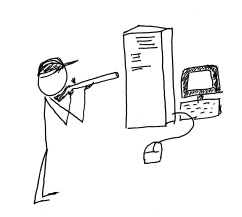
Microsoft’s elimination of the feature-rich and friendly-sounding Small Business Server has created a lot of opportunity for VARs and IT service providers to move their customers to cloud services, SaaS solutions and hosted environments.  Particularly as information technology continues to become more complex, small businesses (well, businesses of all sizes) are recognizing that they may be better off focusing on running the business operation and managing the company as opposed to spending a lot of focus on IT system purchasing, installation, administration and management.  They have come to understand that IT services are critical to the business, but the server doesn’t have to be under the front desk or in a back closet in order to function for the business.  There is simply too much evidence in the market for these business owners to ignore;  shooting the server is now a viable option.

Every day more business owners are being inspired to [shoot their servers] seek out the services that will allow them to continue to benefit from innovations in technology while relieving them of the direct responsibilities of equipment purchasing, implementation, administration and lifecycle management.  Cloud services deliver this capability, and channel partners and Value Added Resellers should recognize their opportunity to get inspired as well, and to start offering cloud-based and hosted services to their customers and capture the “buying decision” opportunity that Microsoft has created.

Ready. Aim. Fire.

jmbunnyfeetMake Sense?

J

A Higher Level of Customer Relationship Management: Building Closer Customer Relationships

A Higher Level of Customer Relationship Management: Building Closer Customer Relationships

Most businesses recognize the importance of creating a quality experience for customers doing business with them.  The thing that many business owners overlook is how their internal workflows and information management systems serve to either support or impede the delivery of a well-rounded positive customer experience.  Growing businesses must adjust their processes and improve their tools in order to have the necessary information available to workers at various levels of the organization, providing a centralized means for collaboration, data sharing and analysis.   With the right information systems and process support, even small businesses are able to function at exceptionally high levels and provide the consistently high-quality service and customer experience that establishes long-term value in each and every customer relationship.

Businesses which excel at providing very high levels of customer service tend to have a few common characteristics – features of the business that identify it as an organization geared towards growth and success in driving the customer engagement and business value.  Among these characteristics is the recognition of the need to use technology better – leveraging automation to a greater degree to create consistency in work performance, and improving information collection and integration to provide more context and depth to the data. Added efficiency which affords employees time to focus on customer oriented tasks and elevating the customer experience even more is the payback.

total-business

Many CRM solutions describe the benefits of a “360 degree” view of the customer, yet these solutions often orient themselves to supporting only sales and Contact Management and do not address product and/ or service delivery (fulfillment of what was sold/ordered)  or project management, contracts and agreements tracking or other aspects of doing business with the customer.

Granted, customer interaction occurs most frequently with sales and service teams, but there are potentially vast number of processes and tasks performed within the business which operate with the same information as sales and services, and which would benefit by integration within the same information and workflow framework.

By selecting a solution that addresses the wider variety of business and information management requirements rather than focusing solely on sales and support, business owners and managers find that they are better able to address internal workflows with streamlined process automation.

The result is significant improvement in the quality and completeness of the information available to users throughout the organization, ultimately improving the quality and nature of customer engagement and interaction. Perhaps even more impactful is the ability for the business to better understand  the context of and motivations for customer interactions, and (most importantly!) having the capability to take immediate action based on that knowledge.

With the right customer relationship and business management solution in place, and with a focus on systematic approaches to enabling process and workflow automation, businesses can become more flexible and responsive to changing customer needs and expectations.  Creating the complete view of the customer relationship and capturing the data which helps users understand the dynamics of the entire relationship serves to build closer customer relationships that will strengthen and grow over time.

When a business needs to implement a Customer Relationship Management solution to address sales and support needs, it makes sense to also review information management requirements for:

  • Delivery of products and/or services  – i.e. fulfillment of what was promised by sales
  • Scheduling of Work/Service Orders and integrated billing based on completed work
  • Time and personnel activity management as well as time reporting and billing
  • Project or job resource and time management and reporting
  • Documents, contracts, before & after pictures, and agreements of all types
  • Products and services, proposals and quotes, price books and channels

Additionally, since the processes are so closely related in terms of the information collected or used, it makes sense that the CRM solution would also work with:

  • Marketing campaigns and activities, lead generation systems and e-newsletter solutions
  • Accounting solutions which also utilize customer, product, job, time, cost and other data
  • Expense spending management, approvals and reporting

To be truly useful, the solution must also support remote and mobile workers since field service personnel and other workers are often not in the office when they need to get something done.  Whether the access is via hosted solutions providing full remote desktop functionality, or via web-based application extensions allowing device independent access (or both!), the solution should be designed to allow users to access the system and perform their work from wherever it is required.

Even more, a comprehensive approach to managing business activities and information, particularly with a focus on providing all departments with all the information and capability they need to get their jobs done properly, requires that everyone in the company be on board.  There really isn’t a great way to centralize and manage critical business data when the approach is to give a few people some information and functionality, leaving it up to human beings and individual initiative to connect the dots (and the data).  The result is almost always a series of gaping holes in various processes where information and requests get lost.

Among the best solutions I have found which delivers the foundation for all of this functionality is Results CRM.  Thousands of users have successfully migrated from ACT!, Goldmine, Telemagic, Salesforce.com and other SFA and CRM solutions to the Results CRM platform, and have benefitted from better workflow automation, more logical company and contacts associations, and a broader range of functionality supporting everything from sophisticated quote and proposal development to comprehensive project, time and expense management.

At the end of the day, it’s the reporting that wins.  If the data isn’t in the database, you can’t report on it.  If you can’t report on it, you can’t measure it. If you can’t measure it, you can’t make good business decisions and grow the business.

Make sense?

J

