Good Housekeeping for Healthy QuickBooks

QuickBooks desktop software is very easy to install and use, and that is precisely why it is the standard for small business bookkeeping and accounting. QuickBooks is simple to use.

Getting QuickBooks on your computer is also simple. You can just buy the software from wherever – your QuickBooks solution provider, a retail outlet or an online store. Then you download it to your PC and run a setup application, and voila! It’s there on your PC ready to help you do your books.

When just a single user needs to use QuickBooks, things are very straightforward because there is no networking to worry about and no multi-user access required. On the other hand, there are many businesses using QuickBooks that experience a lot of frustration with trying to install QuickBooks on a network and managing the software that must be installed on multiple computers.

Other than networking QuickBooks desktop software, it seems that the majority of issues users experience can be attributed more to poor software habits and a lack of PC housekeeping

QuickBooks desktop software has been engineered over many years to be as simple to use as possible, but at the same time has grown to be a product with lots of features, add-ons and extensions.  People have found ways to make QuickBooks do things it wasn’t really designed to do, which is sometimes a good thing and sometimes a bad thing. When it works, it works great.  When it doesn’t work, it’s beyond frustrating.

Yet there are a few things that QuickBooks desktop users should be doing regularly to keep their QuickBooks software and data in good working condition. While these items are very important to keeping your QuickBooks system working for you, they will never overcome problems with your network, the server or any of the workstations connected to it.

To solve these networking, software management and other IT platform issues, I recommend moving to a virtual cloud server on the Microsoft Azure cloud platform. NOOBEH’s QuickBooks on Azure service is just that… your QuickBooks software and data running securely on your own private cloud server in your own account on the Microsoft cloud, fully managed and supported by experts. With NOOBEH’s service, you don’t have to worry about server failures, network problems or hardware problems any longer, and we eliminate the issues surrounding multi-user, multi-location, and remote access for QuickBooks.

When it comes to PC housekeeping and other chores, I cannot stress enough the importance of keeping the QuickBooks company file in good condition

What’s the accounting and financial data worth, after all?  A little time spent taking care of the file can save on a lot of time and headaches trying to recreate or reenter the data. A QuickBooks company file is a database and is a complicated framework for keeping track of all sorts of related information.  Anyone who has used QuickBooks desktop products for a while understands that the data file can get messed up for a variety of reasons, and it can mean lost time, work and revenue when it isn’t working correctly.

What many users don’t realize that QuickBooks has built-in utilities to check and fix data problems in the company file, so it makes sense to periodically use them to check for problems.  Like a check-up with the doctor, these utilities can help diagnose issues with the data file before they become big issues. They are easy to find in the software… simply go to the File menu and select Utilities.

Run the file Verify any time the file starts to act slow or if QuickBooks crashes when the file was open, and if the Verify tells you there are errors, you should run a Rebuild to fix them. Note that a rebuild may have to run multiple times to fix all the issues in the file, and even then, may not correct everything. Some manual work may even be required to resolve all errors.

You should also back up the company file to a “portable” type file periodically, and to then restore it for use.  This doesn’t need to be done very often, maybe once a year or so. This process can not only validate the integrity of the file, but it also helps condense and condition the file.  Conditioning the data file periodically can help prevent data corruption and/or loss of data.

A very important housekeeping item for QuickBooks desktop is the file backup. Backups don’t just make copies of your company file for safekeeping, which is important to have, but when you run a backup with complete/full verification, the process also reduces the file size of the TLG file. For QuickBooks, the TLG file is a transaction log, and when it gets too big the file can perform poorly and even get corrupted.  Run backups more frequently if you have a lot of transactional activity, or less often if there is not so much going into the company file.

When you do the file backup, it is a good idea to consider where the backup will go. Keeping the backup files on your PC is convenient, but it also does nothing to protect your data if your PC gets hit with malware or has a hardware problem. Put the backup file in a protected location that isn’t stored on your PC, like Microsoft OneDrive, Google Drive, Dropbox or even a removeable USB device. You can’t put your live QuickBooks company file in this type of location, but you can store the backup files there. This way, if your PC does have a problem, you’ll have backups of your company file that you can use to get yourself back in business.

Close the company file and exit QuickBooks occasionally, please

Users who leave their computers on all the time are not allowing the computer to run periodic power-on self-tests, which means the machine or operating system could have an issue that isn’t recognized until computer restarts.  For this same reason, programs and their data files should be closed when not being used – so they can run through their own startup and validation routines before you use them.  Also, leaving the program open means it is active on the computer, and leaving the data file open means that it’s available (available=vulnerable).  A random by passer accessing the computer, a program crash, a machine crash… loss of power or a furry kitty running over the keyboard could each result in catastrophic damage to the application and/or data.  It’s just better and safer if the files and programs are closed when not being used.  Maybe use a screensaver with a password, too, or at least lock the keyboard when the machine is on but not in use.

QuickBooks and VPN / WAN are not awesome together

Just because a user can connect their remote PC to the office network doesn’t mean the PC will work like it’s in the office.  In the office, it’s a Local Area Network where the machines are all cabled together and communicate with nearby machines (e.g, Local). The speed of LAN communications is fast enough to allow multiple computers to share a QuickBooks company file in multi-user mode.  When there is a remote PC to connect, businesses often elect to utilize a VPN to provide local area network access to the remote computer. This turns the Local Area Network connection into a Wide Area Network connection, where the network has been extended to include the remote computer.

Unfortunately for QuickBooks users, the WAN connection is NOT fast enough to allow the remote user to open QuickBooks and use it like others in the network.  QuickBooks multi-user access is designed to work on a local network where local means the machines are in the same locale and on the same LAN. This is why many companies elect to use remote-access/remote-control software to access to QuickBooks desktop remotely.

Use NOOBEH QuickBooks on Azure to get remote access, managed service, update support, and the ability to run any other applications or add-ons your business needs. When QuickBooks desktop and the other software a business uses are hosted on the company’s Microsoft cloud server with NOOBEH, the QuickBooks application and the company files are all on the same environment so it works exactly as it is supposed to for all users no matter where they are located.

Use Automatic Update

New features and enhancements are provided, new technologies and operating platforms must be supported, and security and privacy must constantly be addressed in the software. What this all means is that software products necessarily change over time and users will be expected to update their products or lose out. While some IT departments may desire to prevent software from updating itself, QuickBooks users should recognize that the software’s proper function often depends on timely updates. Especially when payroll or banking is involved, it is important to keep the software current.

QuickBooks has a feature that allows the software to automatically download and install updates as they are released by Intuit. Leaving this feature turned on allows the software to check with Intuit periodically to see if there are updates available. If so, they are downloaded and readied for installation on the computer.

Updates are changes made to an edition and year version of the software. Upgrades, on the other hand, are changes from one year version to another (2021 to 2022, for example) or a change in QuickBooks edition (like Premier to Enterprise). Automatic updates manage the changes to the currently installed edition/year version, but do not upgrade the software.

Customers using NOOBEH’s QuickBooks on Azure service have their QuickBooks updates and their QuickBooks upgrade installations managed for them, as well as the other applications installed on the customer’s private cloud server.

Doing maintenance on your QuickBooks software and the company file can help keep them free from poor performance and potential corruption

It’s worth spending a little time on chores occasionally so that you avoid what could be a costly problem down the road. Some good housekeeping to keep your QuickBooks healthy is just good business.

jm bunny feetMake Sense?

J

Integrated is Better: Connecting Your Systems and Workflows

Small businesses need software and systems to help them get business done efficiently. The global pandemic has been fuel for recent growth in the small business software market where companies of all types are adopting more applications and services to better support operations.  Especially when users are no longer able to work in the office and consumers are demanding increasingly more personalized services, businesses need to find ways to get more business done in less time and with fewer resources.

According to Intuit® research “small businesses, on the average, use four or more apps to run their business”. You could consider it that business owners and managers buy software apps to get jobs done. Software can help structure the work and the information, creating workflows that improve efficiency and accuracy.

The key to getting the full benefit from any application or service is to have it connected to or integrated with your other solutions. There is almost never a completely disconnected process in a business; everything flows from and to something else. It should be the same with software and data. Saving time and improving accuracy of information means that data should only be entered once, and key data should sync between systems to remain up to date.

QuickBooks Desktop (Pro, Premier, Accountant and Enterprise), as well as other desktop accounting or ERP solutions like Sage100, AccountEdge and more, have a variety of 3rd party applications and integrations offering additional functionality or services. Just because the main solution is a desktop application does not mean that all integrated applications must also be desktop products.

To extend functionality of desktop products, developers often create web-based applications and services that sync or integrate data with the desktop product. In fact, many of the services inside of QuickBooks desktop are web-based application services which sync data to and from QuickBooks. Payroll, payments, and more are subscription-based services connected in QuickBooks but look like they are just part of the installed program.

When QuickBooks and other desktop applications are hosted with NOOBEH’s QuickBooks on Azure service, the system is running entirely on the Microsoft Cloud. This improves system flexibility, resiliency, and security, as well as providing the optimum platform for desktop applications and web-based services to connect – the bandwidth they use is cloud to cloud instead of cloud to your PC.

Even if the average small business uses four or more apps in the business, it doesn’t necessarily mean that all those apps are talking. Often, a business will implement a new application to handle a particular job but won’t consider the additional benefits to be gained by connecting the new app to the accounting system. Yes, the new app may make getting data from the field easier, as with a timesheet or field service management solution. Maybe it makes doing payroll easier because the calculation, reporting and delivery of paychecks is automated. Perhaps it is a website that takes customer orders and manages their payments.

All are cases where a business benefits a great deal from increased efficiency in data capture, reporting and more, but if all the information from the app needs to be re-entered into the accounting system, then a great deal of additional benefit is simply not there.  Data entry takes time away from other work and introduces the potential for errors that can take hours to track down (if they are even noticed).

When connecting any 3rd party solution with your accounting or ERP system, it’s important to make sure that the company fully supports the integration. Whether it is a direct connection to your QB or other software or is a “brokered” connection (as with an Integration-as-a-service connector), just make sure that the integration has the features and functionality you need and that the data will flow as you want.

We know that businesses need more than a single solution to address the variety of business problems that arise. We also know that sub-standard or improperly configured integrations risk doing more damage than good to the business data. That’s why we offer consulting and deployment services for a wide range of add-ons and integrated products. Even if it is a solution we haven’t worked with yet, our consultants know how to validate and test the integration within QuickBooks to ensure that the data flows properly and gets the right treatment in the financial system.

Get your software connected and working better for your business. Mendelson Consulting and NOOBEH Cloud Services help you focus on your business and not the IT that supports it, so that you can get more done with the resources you have. We help you work smarter, not harder.

jm bunny feetMake Sense?

J

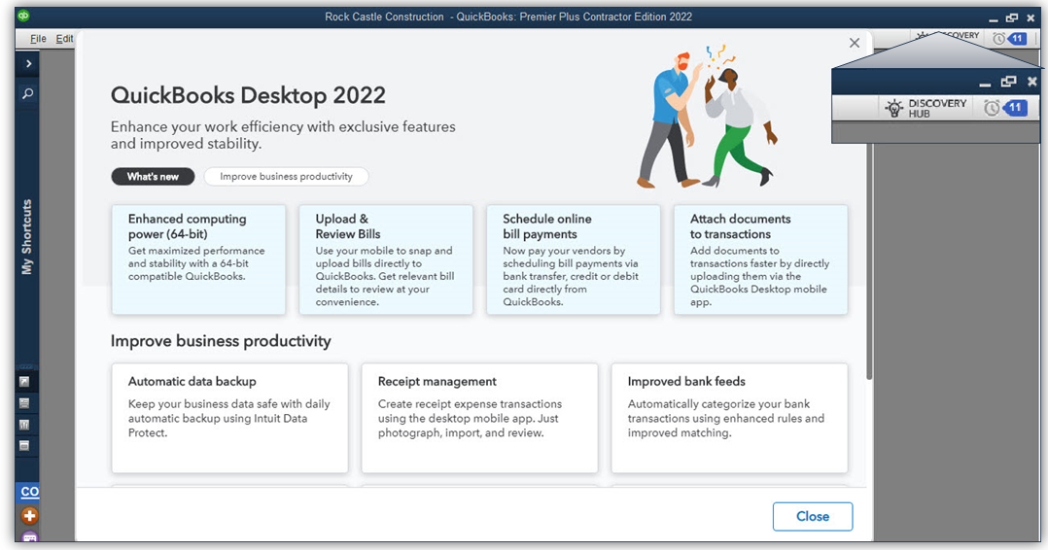
QuickBooks 2022 Boasts Modernized Foundation

Every year, businesses around the world anxiously await the release of the new versions of QuickBooks desktop software. While that may sound a bit silly, the truth is that QuickBooks is widely used in numerous countries around the world and when Intuit makes big changes to QuickBooks it impacts a lot of businesses.

While the focus for Intuit, like most software companies, is online subscription service, the fact remains that the desktop products and the ecosystem around them continues to grow.

Over the past few years, the company has invested in artificial intelligence and platform solutions that extend and add value to the desktop and online products. Some of these investments are becoming clearer with the launch of QuickBooks desktop 2022 editions.

64-bit QuickBooks [1]

The “guts” of QuickBooks was elderly and wasn’t up to current processing standards. Now, QuickBooks has a 64-bit foundation and the full capability of 64-bit processors can be used. This typically means faster application and data load times, faster report generation and an ability to handle larger data sets more efficiently. Beware of QB 2022 until you verify that your computers are all 64-bit machines, because QB 2022 can’t be installed on 32-bit systems. If you’re working with a hosting platform, you’ll need to make sure your host has modern infrastructure and up-to-date operating systems.

E-commerce for QuickBooks with Webgility [2]

Need to track your revenue from different selling platforms like Amazon, eBay, and Shopify, and sync the data directly with QuickBooks? There are a lot of e-commerce integrations for QuickBooks desktop, but Webgility wins when it comes to working with QuickBooks. There’s now a bundle that makes it easier to get the Webgility e-commerce integration for QuickBooks. Customers still must sign up with Webgility to get the service but purchasing the bundle package makes that quite a bit easier. Webgility uses a database to keep track of orders, so you’ll want to make sure your system is able to handle the extra load. If you’re on a hosting platform (other than NOOBEH), be ready to pay additional fees to support running Webgility.

Bill payment approval process

Improve your accounts payable process by creating a structured approval process so that only the right bills get paid. AP workflows can help businesses manage cash flow and improve transparency. Working in conjunction with the user’s Intuit.com account, the company can set up rules for QuickBooks to check which bills need approval for entry and payment. Users are then prompted to send bills for approval

Pay and schedule bills faster with Melio payments

Some subscription holders of QuickBooks Desktop Pro Plus, Premier Plus, or Enterprise are working with the new feature (from Melio Payments) that allows businesses to use QuickBooks to schedule and pay bills using a bank transfer, credit card or debit card. The vendor doesn’t have to have a Melio account; they can receive their payments either as ACH or paper check.

Bill entry automation and customized bill payment stubs

Save time and have QuickBooks automate bill entries from the QuickBooks Desktop mobile app (iOS or Android versions) or from bills sent via email. Review the bill data once it’s uploaded and match it to existing transactions in QB. Bill payment stubs are now on the list of customizable forms, so you can set up and email formal payment confirmations to vendors.

Upload documents [3]

Instead of scanning files on your PC to attach to QuickBooks transactions, you can now use the QuickBooks Desktop mobile app to attach documents to transactions. The attached documents feature of QuickBooks is awesome because it lets you use QB as kind of a document management solution where you can store original copies of bills, receipts, contracts, or other documents that associate with financial transactions or entities in your QB files. This new feature that allows documents to be uploaded via the QuickBooks Desktop mobile app is a great solution for businesses operating on some hosted platforms that can’t or won’t support scanning. One “gotcha” with attached documents is that many businesses forget that they have them, and when they go to migrate their QB data to another platform or computer, the file attachments either get forgotten or are so voluminous that it makes the migration difficult.

Choose from multiple customer contacts

Only available with Plus and Enterprise subscriptions is the ability to add multiple customer contacts to batch email runs. The program now lets you send emails more quickly by choosing batch mail recipients from a list of customer or vendor contacts, reducing the chances of email troubles caused by manual entry of addresses.

Instant deposit

When you use QuickBooks Payments (or any other payment service), it generally takes a few days for the money to wind up in your bank account. With a QuickBooks Payments account and for an additional fee, Intuit is now letting you get your money faster when customers pay. Instant Deposit is a service that works with a VISA or debit card to deposit the money into your checking account – any processing or other fees will continue to be debited from your regular payments bank account.

Payment links

Now you can do in QuickBooks what you can do with PayPal, Zelle and other money transfer apps. Businesses can use simple Payment links to collect payments before work is performed and even before an invoice is created. As with all other payments features, you need a QuickBooks Payments account to use this one.

Changes to software purchasing options

QuickBooks Desktop 2022 is only available as a subscription purchase. There is no outright purchase option for QuickBooks desktop any longer. For businesses that need only the most basic features of QB, Intuit is hoping the QBO platform will work, and changing the software from purchase to subscription is just one more step in moving users to adopt the web application. QuickBooks Pro and Premier are still widely used so they will be available for some time to come, but Intuit is clearly making moves to try to push smaller edition desktop users to the web.

[1] NOOBEH deploys only modern architecture, 64-bit systems for QB on Azure and other hosted solutions

[2] NOOBEH doesn’t charge extra to have Webgility or any other applications installed in your QB on Azure service

[3] NOOBEH QB on Azure  and other cloud hosting solutions support scanning directly from your local PC to QuickBooks, using specialty 3rd party tools. Whether you use QuickBooks mobile or scan directly to QB using the Attached Documents feature, NOOBEH supports it.

jm bunny feetMake Sense?

J

Into the Sunset with QuickBooks 2018

Every year when the new editions of QuickBooks desktop editions are released, Intuit discontinues services for certain older versions. This is referred to as the sunset of the version. In general, a QuickBooks desktop edition can live for up to 3 years. After that time, all bets are off. The software might continue to work, but connected services won’t, and there will certainly be no security or compatibility updates beyond that point. For businesses using QB 2018 and planning to continue using their QuickBooks software and data – you need to upgrade your QuickBooks software now.

Intuit generally notifies customers in various ways about the discontinuation of QB editions. Granted, there is a lot of other advertising about QuickBooks that users receive, so it isn’t unusual for these notices to be missed. But the software will also tell you, and those notifications shouldn’t be ignored.

May 31, 2021 marks the end of access to add-on services for QuickBooks Desktop 2018 (Windows).

This means that all Windows versions of QuickBooks Desktop, including Pro, Premier and Enterprise 18 will no longer be able to connect to add-on services like payroll or merchant services. For Pro and Premier users, the software will continue to run, but there won’t be any availability of add-on or connected services or live technical support.

From Intuit: “Your access to QuickBooks Desktop Payroll Services, Live Support, Online Backup, Online Banking, and other services through QuickBooks Desktop 2018 software will be discontinued after May 31, 2021. “

The discontinuation (sunset) also means that you’ll no longer get critical security updates for the QuickBooks 2018 software. With this being the case, and especially if you expect to continue using your QB 2018 software without connected services, make sure to install all security and other updates your software receives prior to June 1, 2021.

Here’s the list of products impacted by the discontinuation of services after May 31, 2021.

If your business uses any of these services and you want to continue using them, your option is to upgrade to the latest version of QuickBooks Desktop

  • QuickBooks Desktop Pro 2018
  • QuickBooks Desktop Premier 2018 (General Business, Contractor, Manufacturing & Wholesale, Nonprofit, Professional Services, and Retail)
  • QuickBooks Enterprise Solutions 18
  • QuickBooks Premier Accountant Edition 2018

Products for which services will be discontinued after April 27, 2021

QuickBooks Desktop Point of Sales 18.0 and 19.0 will lose access to QuickBooks Desktop Point of Sale 12 payments services

Products for which services will be discontinued after August 10, 2021

QuickBooks Desktop Point of Sales 18.0 will lose access to QuickBooks Desktop Point of Sale 18 payments services

Mendelson Consulting was the first and remains the best source for QuickBooks Enterprise and other QuickBooks software solutions and services.

If you know what you need and just want to get your updated QuickBooks software now, visit The QB Store now to buy online. It’s fast and easy and you’ll get your new software right away.

When you need a consultation regarding which editions of QuickBooks might be right for you, the team at Mendelson Consulting will help you select the right product. For data conversion, implementation, training, file repairs and any other services around the use of QuickBooks, Mendelson Consulting is the place to go.

The NOOBEH Cloud team, specializing in deploying QuickBooks on Azure, provides fully-managed hosting and cloud IT consulting to help your business implement a platform that delivers the resiliency and performance you need to keep things running smoothly.

Intuit Reduces Migration and Support Options For Moving From QuickBooks Online to QuickBooks Desktop

Mendelson Consulting Offers Cloud and Migration Options

Need to convert data in QuickBooks Desktop to QuickBooks Online? You can get help from Intuit with this. Need to go the other way and convert from QuickBooks Online to QuickBooks Desktop? Not so much… So please read on.

In a surprise (and very quiet) announcement to QuickBooks Solution Providers, Intuit recently announced that it no longer freely provides data export functionality that allows businesses to convert their data from QuickBooks Online to QuickBooks Desktop. As of 12/18/2020, if you want to move your data from QuickBooks Online to QuickBooks Desktop, you have different options for how to do it and will get less support from Intuit in the process.

It is no great surprise that Intuit made this move. Even prior to ending the service, exports from QuickBooks Online to 2021 versions of QuickBooks Desktop had become quite difficult anyway. Requiring users to login to their Intuit account to create a new company file interrupts the QuickBooks Online attempt to create a new file in QuickBooks Desktop during the conversion, so the entire process became broken. (Note: Our solution is to create the new QuickBooks Desktop file in an earlier version of QuickBooks that does not force the Intuit account login, for example 2019, and subsequently upgrade to the latest version 2021).

The QuickBooks Online web-based service locks you into a subscription, delivering recurring revenue to Intuit. Logic follows that now it has become more difficult to get the data back out of QuickBooks Online in a useful way.

Intuit is still allowing businesses to migrate list data out of QuickBooks Online (think Customers, Vendors, Items lists only), but this is not a very clean process for migrating an entire company data set. Particularly since it involves exporting lists to Excel, manipulating or massaging the data and then importing into QuickBooks Desktop. You can see how this introduces a variety of ways to mess it up. And still this does not get the historical transaction data.

Another consideration is that QBO allows businesses to alter the screens and data stored in the product, and to use that data in ways that QuickBooks Desktop doesn’t necessarily understand. For example, simply adding a field called “job” to invoices in QBO does not mean that QuickBooks desktop would see that data and recognize it as a Customer:Job. That field in QBO doesn’t actually mean anything other than to the user so it isn’t something that could be automatically understood in a conversion. For any conversion of data to be done properly, there needs to be a clear understanding of what data is stored in QB Online, how it is used, and how that data needs to be translated to QB desktop.

Mendelson Consulting has a team of experts available to help with converting your QuickBooks Online information into useful QuickBooks desktop data, offering a thorough review of QBO is being used and mapping that information to how QuickBooks desktop should be set up and the data migrated. Better than a blindly automated process, this option for converting your QBO data to QBD provides a much greater assurance that the financial and other business data is migrated correctly and properly.

What about cloud? There is actually a better option than QBO for businesses that want to benefit from managed infrastructure and anytime/anywhere cloud models, and it does not require that the business lock itself and its future in a web-based application like QuickBooks Online. The better option is to have QuickBooks Desktop and other applications in a private cloud, as with NOOBEH’s QuickBooks on Azure service.

Our options for QuickBooks Desktop in the cloud offer far more than just QuickBooks. NOOBEH does not lock you in to any specific software application, version or working model. Rather, we provide businesses with the ability to run all their applications and manage their data in a familiar Windows environment, but not be tied to any hardware or physical location.

Running applications and data on private Microsoft Azure cloud servers lets even the smallest of businesses benefit from enterprise-class technology and IT platforms and get them affordably. The best part is that there is no vendor lock-in and no limitations on moving to other applications or services. If business needs change, NOOBEH can help the environment adjust to what the business needs, and not the other way around.

When the business needs more functionality, more application support, more process support and more flexibility to meet changing needs and conditions, then the business needs Mendelson Consulting and Noobeh.

jm bunny feetMake Sense?

J

Connecting Your Web Store to QuickBooks on Azure

If you sell products via the Internet using a web store or shopping cart application, then you are probably facing the problem of getting your order and sales activities into QuickBooks and then getting shipping and product information back into the web store. For some, the additional need is to mirror the products and pricing information between the inventory management or financial system and the web store. In many businesses, this is a big chore and requires literally hours of redundant data entry and updating.

As with any manual process, there are many opportunities for errors and mistakes which ultimately cost the business both time and money.

Online selling is a dynamic business, and the sale is made when the customer is ready and willing to buy and the seller has the item available at the right price. The web store (ecommerce system) exists to process this sale in order to meet the immediacy of customer demand. If the system is not up to date with current product or pricing information, then the customer may not find what they want, and the sale is lost.

This means that the connectivity between the online selling system and the inventory/accounting system is of paramount importance in the ability to do business.

Synchronizing inventory information between the web store and the inventory/accounting system ensures that product and quantity information is updated on the web as product is sold and shipped (or received in). At the same time, importing invoices and sales receipts into the accounting system helps to ensure proper and accurate recording of sales and payment information and improves tracking of accounts receivable, shipping charges, and sales taxes.

cloud-small-business

To make this connection between the Web store and the inventory/accounting software, an integration solution or connector is generally required. The connector gets installed on the same systems as the inventory/accounting solution (on the same systems as QuickBooks, in this case) and provides the mechanism to synchronize data between the web store and the accounting system.

Integrating an always-on web store with an on-site accounting solution can be a challenge, even for the most tech savvy business owner.

Creating seamless processes for exchanging data between these remote systems requires that both solutions be operating in a secure and accessible platform. While the web store is accessible via the Internet, getting to data in accounting and other systems residing on local PCs or networks is more problematic.

An option that many successful online businesses have adopted is NOOBEH‘s QuickBooks on Azure service, which provides centralized hosting and management for the QuickBooks desktop and any connected inventory or warehouse management applications as well as the integration to the web store.

Enabling the accounting and operational systems to be online and always on, like the web store, allows them to exchange data when and where it is required.

Connecting services in a secure and managed environment introduces new efficiencies and eliminates risk due to data entry errors or lost transactions. The QuickBooks on Azure cloud hosting service provides the system management, platform security and uptime required to ensure that the inventory and accounting systems supporting the always-on web store are also always on.

jm bunny feetMake Sense?

J