EDI Helps Manufacturers Increase Efficiency and Improve Profitability
More efficient processes yield more revenue, it’s that simple. Imagine being able to seamlessly integrate data across the entire supply chain and then imagine how that integration could increase the efficiency and deliver more revenue to each link in the chain.
Every manufacturing CEO wants to increase operational efficiency and lower costs, helping to boost revenues and improve profitability. Yet there is an area which has often been overlooked by businesses, and this is the area of B2B integration. While some methods have delivered degrees of success, broad-based solutions remain elusive to many.
The problem is in the number and types of data sources a manufacturer deals with on a regular basis. With a network of partners and suppliers, each using their own data formats and transfer methods, the volume and variety of information flowing can be overwhelming. The result is siloed data, increased pressure on information technology and management resources, disconnected workflows and slower processes.
IDC’s Manufacturing Insights’ webcast IDC FutureScape: Worldwide Manufacturing Predictions once suggested that nearly 30% of manufacturers would make significant investments toward increasing visibility and analysis of information exchange and business processes, within the company and with partners. That was in 2015. Today, data integration and process improvements continue at a fevered pace as technology is helping businesses gain new data that brings new insight and sparks change.
The integration of Electronic Data Interchange (EDI) is a fundamental first step in improving how a business works with trading partners as well as internally. EDI has been around for many years and refers to the transfer of structured data between two organizations or “trading partners” using a set of standards that define common information formats to facilitate the exchange. By adhering to the same standards, two different organizations can electronically exchange documents (POs, invoices, shipping notices etc), seamlessly and regardless of geographic location.
Simplifying business processes, reducing operating costs, increasing end-to-end visibility, reducing errors, and speeding up operations and responsiveness… these are the many benefits to be experienced when EDI and non-EDI information streams are processed in the same manner when it comes visibility, exception-handling, notifications, role-based access etc.
Unfortunately, not all trading partners use EDI (or implement it in the same manner). To get their documents into a usable format, manufacturers find themselves using manual processes or writing custom scripts. Either way, it means that documents are flowing through entirely different processes for EDI and non-EDI business partners, which significantly complicates matters and adds unexpected costs and complications. Addressing this is one of the reasons why modern manufacturers are finding an increased need for connecting with organizations like Mendelson Consulting who can help identify and address situations that out-of-the-box EDI does not.
The pressure is mounting for manufacturers to produce more with less resources. Mendelson Consulting understands what makes EDI complicated and has the experience and expertise to help growing enterprises overcome challenges in design and implementation, making broader integration possible and greater improvement achievable.
Skinny Isn’t Just for Jeans: Lean Business and the Service Sector
Doing more with less is the mantra of today’s business. Hiring more people or throwing money at a problem is almost never the best way to solve it… even if there are people and dollars to throw. Businesses are feeling the crunch today more than ever, in some part due to advancements in technology and the emergence of retail and “self-service” service. Once upon a time it was OK to be a fat dumb and happy business, but those days are long gone. With competitive pressures increasing – and emerging from new sources – just about every business is feeling the need to trim some fat – cutting costs and streamlining processes even as customer demand increases.
Lean and efficient business isn’t of concern just to manufacturing sector, even though that is where you most frequently hear about initiatives relating to process improvements tied to quality management. Professional service firms should also seek to identify areas where cost or time efficiencies could be gained while at the same time preserving (or improving?) quality of service delivery. Price of service isn’t necessarily the largest factor in meeting the competition, but quality of service for the price and delivering on customer expectation are right up there as top priorities for buyers.
Quick: What do legal professionals and assembly-line workers have in common?
More than either one might think, apparently. After all, the “lean” approach to manufacturing—a concept which rolled off the Toyota Production System, only to be delivered to ailing U.S. auto giants in the late 1970’s—wouldn’t immediately seem applicable to workplaces where the heaviest lifting involves leather briefcases. As for paring resources, such as inventory, down to a minimum—it seems like overkill when applied to pens, yellow pads, laptops and file folders.
But the lean concept long ago roared out of manufacturing and parked its principles in service industries: lean accounting, lean healthcare, lean startups.
Professional service firms are being compelled to reduce costs just to compete, and are finding that cost-cutting isn’t all that is required. Rather than doing more with more people, firms have begun to recognize that getting more done with fewer human resources is the goal – a goal which must be achieved without sacrificing quality of service. In fact, most firms are now actively seeking ways to increase production and improve service levels, and to do it without increasing headcount and cost. Client needs are changing and demands for higher levels of service continue to increase as society more fully embraces social computing and DIY. Technology is impacting how businesses do business, and sometimes is the basis for establishing a new standard by which all competitors are then measured.
Technology advancements are among the primary drivers moving service firms to explore leaner and more efficient ways of working. As more sophisticated tech and the resultant capability it delivers is made available in the market, more businesses begin to recognize that the “traditional” providers of certain services may no longer be the most cost efficient suppliers. Competition often emerges from some of the most unlikely of sources, and this new reality is impressing itself upon even the sturdiest of professional service firms who find themselves facing new threats to the status quo.
Like all customers, legal clients seem to have grown fussier than ever. One study estimates that about 60% of large clients replaced one of their top two law firms last year—citing mediocre service. As is true across industries, the cost of acquiring new clients only heightens the appeal of retaining existing ones.
There is much talk among accounting and legal professionals as to what the “firm of the future” might look like. Are these firms highly efficient producers of service that rival the lean manufacturers, leveraging insight and innovation to deliver more value? Or are they adopting technology simply for the sake of change? There is a difference between change and improvement, and not all changes result in the desired improvements to operations, efficiency or quality of service. For the firms seeking to increase their competitiveness in a rapidly changing market, applying measurements to the various processes the business performs can reveal the secrets to improving not only process performance and product quality, but resultant profitability. https://coopermann.com/2013/03/18/philosophy-of-process-improvement-todays-cfo-focusing-on-operations/
Creating and keeping a competitive edge is critical to building a successful business. Developing a plan, monitoring the plan to make sure the business remains on target, and setting goals for growth and profitability are foundations of business success. But great strategy and detailed planning cannot ensure success because the economy and business environments are unpredictable; no amount of planning is a guarantee that bad things won’t happen and the business won’t experience challenges. On the other hand, regularly monitoring small business performance data can reveal trends and indications that things are not going as expected, and provide a basis for making the decisions necessary to get the business back on track and regain the competitive edge.
Business owners must be prepared to make adjustments as conditions change, acting on decisions made based on business performance data. Whilebusiness analytics are more important than ever, with businesses facing volatility in financial markets and increasingly globalized competition, finding a way to approach the matter is often the biggest barrier. The growing difficulty – the increasingly expanding problem facing business owners and their advisors – can be distilled down to three particularly noticeable trends.
The volume of data flowing into organizations is already high and is increasing.
The data is complex
The data lacks similarity (data is disparate)
The volume of information flowing in to businesses is already high, and is increasing steadily. With all the data collection applications and tools available, and as the business seeks to gain more information and intelligence from more sources, the volume of information gathered by businesses has increased at astounding rates. Technology has adapted to this need, allowing businesses to gather than store vast amounts of data. To be of value, however, the data must be analyzed tofind the answers to questions posed. What technology is only now beginning to address is the complex and disparate nature of the collected data. Coming from varying sources and in equally varying formats, data must be “normalized” and related for it to make much sense.
More Users
More business decision makers in more job roles and functions are getting involved
More people approaching the problem with their own “brand” of analysis
In a very small business, decisions are generally made by the owner. This is most often due to the fact that the owner is the person who not only knows what’s going on in the business, but is generally the one doing a lot of the work. As businesses grow and bring in personnel to manage various functions, these managers become decision-makers. Decisions are made in businesses at all levels, and as management layers are compressed, those “closer to the action” are being handed more responsibility for the decisions impacting their areas. Without a comprehensive and company-wide framework for data analysis and reporting, these individuals and workgroups find ways to capture and analyze the data they feel is pertinent to their requirement and within their own realm.
Less Time
Timeframe for making decisions is shrinking, and is shrinking at an “alarming” rate
The “velocity” (rapidity of motion) of business is increasing
It may be that, in some businesses and markets, certain decisions don’t have to be made with any great speed. Businesses or markets of this type are tough to find these days because the Internet, information technology and connected systems have all but eliminated the effects of time and distance. Just about everything in business today moves at a rapid pace, and that means that business decisions are often demanded on-the-spot, providing little time for detailed consideration and working through the problem. Without the tools and data providing meaningful real-time visibility into business performance, decision-makers may be able to act fast but not wisely, and are most frequently guided by their “gut feel” as to what the right move is.
Driving Small Business Analytics
Business decision makers are now recognizing the need to know more about the business and how it is operating and competing in order to effectively address the choices and decisions faced each day. The cause for this recognition may be due to variable elements, but the conclusion reached was the same: good business decisions require business analytics to support them.
Not surprising was the report finding – that the majority of small business owners felt pressured to adopt a business analytics solution primarily due to the fact that “critical business decisions rely too much on “gut feel”. Surprise! Other drivers listed were lack of visibility into operational metrics, the growing number of people in the business who want analytical capability, the business’s inability to identify and act upon business opportunities, and having less time to make decisions.
Steps to Get There
As with any business project, there are “degrees of success”, and the ultimate success of a business initiative requires that all parties be on board with it. Businesses who recognize a need to improve their analytical capability, but who do not then empower their systems, processes and people, will not achieve the same result as those who do.
Focusing on the business data, it is important to address both the volume and disparity by creating formal data management practices and policies, and implementing systems and processes which assist with the intelligent capture and storage of business information. Simply retaining the data is not useful; it must be presented and applied in a meaningful manner for it to become useful as decision-supporting information. The value of the information increases dramatically when it becomes truly useful to the business. Additionally, by empowering a broader framework for data collection and analysis, businesses extend the “intelligence” to others in the organization, supporting individual and workgroup efforts to make better decisions for their respective areas of responsibility. Of course, if the information is not provided in a timely manner, its value is reduced if not eliminated (hindsight may be 20/20, but that doesn’t help you see where you going to step next). Any approach to building business intelligence should leverage connectivity and integration to provide a timely delivery of complete information how and when it is needed.
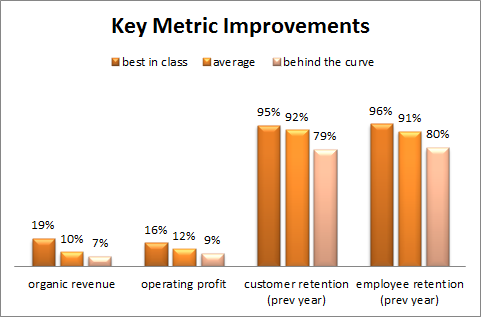
What’s the Proven Benefit?
source: article
The obvious benefit of business analysis is that business owners are provided with data to help them understand more about the business operational and financial performance. The real and proven benefit is that the information provides a basis for gaining insight into trends and conditions which impact performance, and which support making the necessary decisions which facilitate improvement in various business areas.
The highest level of proven benefit, according to the Aberdeen Group report, was achieved by those businesses who embraced the requirement to know more about the organization and operation, and who implemented a focused effort at building business intelligence.
Fast Facts: Best-in-Class SMBs Achieved 24% year over year increase in new customer accounts sold compared to 12% for the industry average, and 11% for the laggards.
These organizations which achieved the greatest improvement operated from real data rather than being guided by gut and emotion, enabled the entire organization to participate in the development of organizational and business intelligence, positioned themselves to identify and act on new business and market opportunities, and ensured that those who must make decisions have the information and insightful data to support making the right ones.
If you own and operate a business, you probably want to make it successful. Granted, success comes in many flavors, and there are also “degrees” of success, where maybe you do okay but not as well as you’d like (or not as well as your local competitor). Running a successful business, and crafting a business with sustainability and long-term value, takes information as well as know-how. Remember that information = power and you want to be as powerful as possible when it comes to running your business.
While today’s information technologies, mobile devices, and “everything as a service” have the capability to deliver way too much information for the average business owner to make sense of, there are a few areas of the business where investing in a little insight and reporting can make a big difference in the level of understanding you have about the business.
Rather than making decisions based on guesses or gut, business owners should use actual historic data relating to these are key areas (and key performance indicators) to help predict sales and order volumes, estimate cash flows, and forecast profitability.
Getting Customers
The “customer lifecycle” does not start when someone buys from you, it starts when they become a potential customer (often referred to as a target). Even before someone buys, your business may expend resources to expose your brand or product to them on websites, in advertisements, and through other marketing channels. These marketing efforts will (hopefully) result in the generation of qualified leads for the business to sell to. Unless the business understands the costs involved and the efficiency of the marketing and lead generation efforts, it cannot understand the actual cost of getting a new customer.
The next step in getting customers is turning a qualified lead into an actual paying customer. The business will want to keep track of conversion of leads into customers, along with sales data including total sales, number of items sold, and how items were priced. Powered by sales performance data, business owners can learn whether or not their lead qualification efforts are working, if their products are competitive, and if the pricing is in alignment with the industry.
Producing Work
When businesses operate, they essentially produce whatever work product their business model is designed to produce – whether it is a professional service, product, logistical support or whatever. Every business produces some type of work product. This is the operational aspect of the business, and business owners should want to know as much as possible about how well operations are running and how effective the operation is. This isn’t just the cost of production, (the yield expected for a given investment in materials or equipment), it is also about the quality of the product (customer satisfaction) and the quality and value of the service behind it (customer retention).
Keeping Money
Money (more specifically, cash and the availability of it) is the metric that most small business owners tend to focus on. It makes sense, too, given that most small businesses survive based on what they have in their bank accounts. Then again, looking at the accounts receivable and payable won’t tell the entire story, either. Business owners need to know how quickly their customers generally pay, and they need to know how much capacity or inventory they have before needing to buy or develop more.
The message underlying this entire discussion is that fact that you can’t analyze what you can’t quantify (no information = no power), so it is essential that systems be in place to capture information from the business and its activities. Further, recognize that it takes some skill and experience – perhaps from your trusted accounting professional – to put the information together so that it makes sense and is useful.
Make Sense?
J Measure, Manage and Succeed. It’s all about knowing how to speak the language of finance
Lean and Mean – Improving Sales and Distribution Performance
It is surprising that, even in this world of Internet marketing and online commerce, many businesses are operating at levels far below their potential. Reliant upon people rather than information and process, these businesses are weighted down by their legacy approach to getting things done. They throw money and personnel at the problem, adding more “fat” to the business and making sustainability just that much harder to achieve. The right approach, and the mantra of all manufacturers and distributors, should be to work “lean and mean”, applying technology and business principles which support agility and improved process efficiency.
The center of lean business is in operations, and includes all aspects of the “order” processing and support systems. From the point where an order is sought, to the point of order entry, and through to delivery and service – all aspects of the operation must be addressed for the business to achieve maximum success. Innovating in operational areas, such as in order management and distribution, can help the business rise above others in the market and create a significant competitive advantage.
What becomes challenging for many businesses is the fact that years of working in established “silos” often makes it difficult to introduce the cross-functionality necessary to support lean operations. It is not sufficient to simply suggest that the organization work collaboratively to streamline processes from order through to service and support. Work groups and team members must work together and adapt to delivering process improvements, following through with the actions necessary to turn the philosophy into bottom line results. Good support is required to keep customers, and a good product is necessary to support increased sales. No aspect of the operation stands alone, so each is necessary to participate in making end-to-end improvement. Additionally, back-office processes must be aligned to work collaboratively where required, supporting efficient operations rather than creating unnecessary bottlenecks or delays.
The key to developing a lean and mean, high performance operation is applying the technology and principles which translate into improved profitability and customer retention. In many cases, the same solutions which create customer “self-help” capabilities are also solutions which can address similar needs for internal business users. Ultimately, the goals are elimination of redundant or error-prone processes, establishing the sharing and secure collaboration of information throughout the organization, implementing integrated systems which allow users to efficiently perform their particular tasks, and working cooperatively with others in the supply chain to maximize the real-time capability and efficiency.
Rather than continuing to utilize basic record keeping solutions, or accounting products which aren’t prepared to address the specific operational aspects of the business, owners and managers should be looking to the tools and solutions which will help them develop the framework to support improving operational performance, turning people knowledge into sustainable business profitability.
Make Sense?
J
Accountants and Small Manufacturers: Getting in Front of the Ball
There’s a lot more to accountability in a manufacturing or inventory-based business than simply keeping track of money in and money out. Particularly in an economy when nobody can afford to build or stock products too far ahead of demand, it is essential that these businesses have a means to not only track and manage purchasing, manufacturing, distribution and stocking activities, but to understand conditions or trends which impact the flow of materials and cash through the business. Read more…
Business Owners to Accountants – Tell Me in Real Time
Business accounting is defined as the system of recording and summarizing business and financial transactions and analyzing, verifying, and reporting the results. It sounds pretty dull, and to most small business owners it is the last thing they want to think about. “Accounting” is what happens at the end of the month, quarter or year – or when any type of taxes are due. What matters to the small business owner is their cash flow and cash availability to meet immediate operational demands, and how they will get past today’s problems to reach their future goal of comfortable retirement, leaving a legacy for the kids, or selling the business at a high value. It may even be that, during periodic visits to deliver the monthly paperwork to the accountant, business owners express interest in discussing their ability to meet future business goals, yet these conversations often take a back-burner to simply getting the work processed and reports and returns completed.
Accounting has traditionally been approached as an after-the-fact activity, recording transactions for things that were already done in the business. While this may be a handy approach to getting an annual tax return completed, it really does nothing for the small business owner in terms of providing them with information to run the business. Further, it does nothing toward helping the business owner get to where they want to go with the business, reaching whatever goals they had in mind when they first got started.
Cloud solutions and Internet-based applications have emerged which provide a high level of capability and information to small business owners, much like the E*Trade tools which enabled any user to “take control of their financial futures by providing the products, tools and services they need to meet their near- and long-term investing goals”. Where E*Trade delivered simplicity, insight, and guidance for investors in real-time, so do many of the new business analysis and financial dashboard solutions, but in a business financial context.
Individuals who are focused on meeting their financial or investment goals are very interested in monitoring their progress toward reaching those goals, and guidance often suggests that making adjustments in strategy or approach at certain points along the way may be required. Similarly, business owners have a great interest in monitoring the progress and status of their businesses, and many are taking steps to gain that insight and obtain guidance through the use of online banking solutions and other real-time reporting tools.
By simply connecting financial systems to some of these online reporting tools, business owners are able to gain a significant level of insight into their business operations, including bank balances, cash coming in and going out, and other information which supports making daily business decisions. Unlike a static financial statement or annual report, these dynamic tools can provide business owners with real-time information about their businesses, which is what the business owner is looking for. But guess what? It’s not happening like it ought to.
Business owners are becoming increasingly impatient with their accounting professionals, and are demanding higher levels of service at more competitive rates than ever. Further, many business clients of accounting professionals are gaining a belief that the value their accountant delivers is diminishing as do-it-yourself tools are gaining in popularity due to ease of use and well-stated value propositions. If accounting professionals would only take a proactive, rather than a reactive, approach to working with their clients, this question of value would be much less of a question.
The biggest problem facing these accounting professionals is that they rely upon the client to deliver the work. Waiting around for clients to bring in information for processing, or traveling around to client offices to pick up materials when they say it’s ready, is creating a divide between the client and the accountant which is difficult to overcome. This divide – the lag in time between when business things happen and when they are accounted for – eliminates any possibility for the business owner to operate with all the information they need.
Accounting professionals must become proactive in their relationships with business clients, establishing the initial groundwork for how each will perform in order to achieve the desired result – real-time information for real time decision support. The accountant has a responsibility to not only ensure that the information is processed appropriately and accurately, but also to ensure that it is obtained and processed in a regular, timely manner. Increasing the frequency of capturing and processing data is necessary in order to provide information when it is most useful. This means that accountants must not only organize their workflows to adjust to the new frequency and timeframe for processing, but that they must also be far more proactive in obtaining the source information from clients on a regular and recurring basis.
It has always been a problem to get information from client businesses so that it can be processed and reported on. Now, with the demand for more timely data and “instant insight”, business owners are expecting faster returns on the processing of accounting information even as they continue to be the bottleneck in providing the source data. Accounting professionals and the tools they use will have to adjust to this reality, creating a stronger focus on the organization of work and turning notification and exception handling processes around so that they drive the workflow rather than simply result from it.


 Make Sense?
 Doing more with less is the mantra of today’s business. Hiring more people or throwing money at a problem is almost never the best way to solve it… even if there are people and dollars to throw. Businesses are feeling the crunch today more than ever, in some part due to advancements in technology and the emergence of retail and “self-service” service. Once upon a time it was OK to be a fat dumb and happy business, but those days are long gone. With competitive pressures increasing – and emerging from new sources – just about every business is feeling the need to trim some fat – cutting costs and streamlining processes even as customer demand increases.
 Make Sense?


 Cooper Mann Consulting