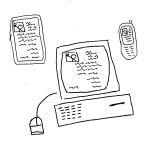
Taking a Hybrid Technology Approach is Most Advantageous for Many Small Businesses

When discussing technology and cloud, most IT resellers and MSPs serving small businesses equate “cloud” with web-based applications (SAAS) and web-based file sharing and assume that any talk of cloud desktops means desktop-as-a-service (DAAS). Unfortunately, web applications and file sharing services, and especially DAAS, are often NOT the best or most advantageous solutions available to the SMB/SME organization.

Rather than taking an “all or nothing” approach to cloud, small businesses benefit more from a strategic combination of cloud servers and desktop software, a hybrid model where the business gains the best of both worlds.

It is sometimes frustrating that small business IT personnel are the drivers behind migrating businesses from desktop applications to their web-based counterparts.

Most SMB software purchases are solely handled by IT, disregarding other important stakeholders.

Capterra’s 2023 SMB Software Buying Trends Survey

These non-business users pave the way for moving the business to cloud-based applications rather than modernizing the platform for existing applications to enable improved processes and workflows. This is especially challenging for accounting and finance operations where the businesses are being encouraged to migrate without first considering the underlying business processes or the accessibility of the impacted and associated data.

Businesses have developed an appreciation for the stability and predictability of desktop applications, along with the recognition of the challenges of transitioning from a system that is deeply integrated into existing workflows. Training users and adapting the work while migrating to cloud applications can be complex and costly without delivering significantly new or increased business benefits.

Data control and security are also large considerations. Most desktop applications allow businesses to retain direct access to and control over their data. Sensitive information remains within their reach rather than under the direct control of a 3rd party SAAS provider from whom they must gain permission and access to retrieve their data.

Rather than pushing the business towards web-based application services, a hybrid approach that modernizes the server and network platform as well as the user working environment may make more sense and provide the organization with greater advantage. This allows businesses to leverage their investments in desktop software, processes, training, and data and still make significant operational improvements and transformations.

Even more, some businesses rely on specialized software that isn’t easily replicated in a web-based environment. Existing desktop applications, especially industry-specific or custom-built tools, may not have cloud equivalents. Migrating these to the cloud server platform allows for uninterrupted productivity even as the business transitions from local to cloud-based platform and operations. Employees comfortable with existing software can maintain productivity without significant adjustments.

Using a cloud server to replace on-premises servers and user desktops, and keeping desktop and network applications working more securely, with improved access and management is the hybrid approach most advantageous for small and medium size businesses.

Noobeh works with Microsoft Azure, providing cloud servers that are scalable so small businesses can adjust their computing resources based on demand. Whether it’s expanding during peak seasons or downsizing during quieter periods, cloud servers offer flexibility that on-premises machines can’t.

Businesses can continue to use the critical desktop application tools they rely on and retain direct control over their data at the same time. Sensitive information remains within their cloud network, but users can access it from anywhere.

This hybrid model combines the benefits of cloud servers, including scalability, cost-effectiveness, agility, and security, with the benefits of keeping existing desktop software, including functionality, stability, data investment and control.

A hybrid approach to modernization allows small businesses to leverage the advantages of both cloud servers and desktop software, tailoring their technology stack to the unique needs of their businesses and in a way that is most advantageous to the business.

jm bunny feetMake Sense?

J

How Accounting Professionals Can Improve the Profitability of Their Existing Business Using Cloud

Working Closer with Business Clients

Accounting professionals are increasingly asked to provide more meaning behind the numbers they report on. Small business owners care about the bank balance and their tax bill, but they care far more about how profitable and productive the business is operating. And small business owners care about how they can improve performance – earn more profits and keep more of it. Accounting professionals can help their small business clients do this more efficiently using cloud and hosting technologies.

Small businesses need their accounting professionals to take a more direct level of involvement in support of daily processes than larger companies do.

For small and mid-size businesses, the accounting office may be asked to handle bookkeeping, payroll processing, bank account reconciliations, paying bills and invoicing customers and more. In order to have close access to the information and applications supporting these processes, it becomes necessary for accounting pros to be able to connect remotely to client systems. This isn’t a new requirement, but the technology available today to make it work allows for closer and more immediate interaction between the client and the accounting professional.

When a small and growing business runs their applications on a cloud platform, the variety of users that need to work with the information are able to access it regardless of where they are located because the Internet becomes the network.  This model doesn’t in any way require that businesses adopt web-based applications instead of the desktop applications they have come to rely on.  Desktop applications like QuickBooks, Sage50, Microsoft Office and more can be hosted on cloud platforms, allowing business users to login and use the software they are familiar with and that supports their various processes.

With a cloud hosting model for running business applications and storing business data companies can take advantage of fully-managed deployments of their software and systems without having to employ the IT staff to implement and manage it all. This allows small businesses to have the advantage of high performance IT without the typically high-cost budgets required to support it. The other advantage is that the accounting professionals working with the business are able to access the systems in real time from their offices or other locations, enabling the close working relationship the business needs.

The key value proposition for the accounting professional is the improved profitability to be found in existing client engagements.

Whether it is through an increase in the number and type of services offered to the client or through an improved level of efficiency found with operating on the hosted system, professionals can increase revenues and reduce costs of supporting existing clients. That’s the secret to success in working with the small clients: earn enough working for them while at the same time keeping their costs down so they can grow into larger more profitable business clients.

Make Sense?

J

Mobile IT for Contractors and Builders (for every business, actually)

The Trend Is Up For Single-Family Housing Market

Even as lot and labor shortages and other supply side constraints continue to impact builders, and while the cost of building materials continues to rise, the demand for housing continues to increase at a fairly consistent rate. “November’s builder confidence reading is close to a post-recession high-..” NAHB Chairman Granger MacDonald said in a recent release.

Supported by rising homeownership rates and a reduced number of available homes for sale, the trend up is expected to continue.

Increased competition for new business opportunities in the building market require that home builders and developers leverage available technologies and IT resources to improve operational performance and increase the profitability of every project. Applications for better estimating, project and cost management and accounting represent the foundations for information management and supporting the flow of work.Extending workflows to embrace mobile workers and remote offices is the next step to developing an efficient anytime/anywhere business. 92 percent of U.S. construction executives believe that technology will fundamentally change their businesses, and help them bridge the performance gap, according to KPMG’s Make it, or break it – Global Construction Survey 2017 report.

Collaborating while on the go and exchanging ideas and concepts quickly helps businesses be more agile and better-able to meet changing customer needs. Remote and mobile access provides businesses with mobile office options that allow users to get their jobs done no matter where they happen to be.

Business moves at a fast pace and working smarter means implementing the right IT to keep moving up with the demand and creating sustainability for leaner times.

Make Sense?

J

Everything Old is New Again: Big Fat Phones and Desktop QuickBooks in the Cloud

anywhere-anydeviceEvery year that passes leaves some reminder of the time – some person or occurrence which touches us and creates a lasting memory.  2014 delivered its share of memorable people and moments and proved again that social platforms such as Twitter and Instagram have become increasingly significant as people across the world organize, march or call for change.  Yet even as change is demanded from us and often forced upon us, it is wise to remember that the pendulum eventually swings both ways.  We want to have our cake and eat it, too, which is the ultimate no-win situation and causes us to constantly and consistently seek out the alternative.  Like the puppy chasing his tail, we end up going round in circles.  Harem pants and jeans torn from knee to thigh have come back in fashion, and even though they didn’t really work the first time, here they are again. It is inevitable.

Information technology trends follow similar patterns, and what was once in high fashion may now be considered as “legacy”.  Perhaps the better word is “classic”, as these legacy solutions often represent the standards by which new solutions will be measured.  Eventually, the properties of the classic or legacy solution wind up in the new breed, because this is what the market has come to expect and/or demand.  Even when entirely new standards are believed to be adopted, the truth is that years of learning and experience will often find the path previously traveled by others to be the right path.

It seems like so long ago when some said “the desktop is dead” and that all applications would be used by every device via the web, but not run on the device.  Well, there are quite a number of web-based applications and services delivered in just that manner, but there are also lots and lots of computers out there with software still installed on them, happily working away for their users (there’s an app for that, right?).  The desktop isn’t dead at all, it seems, and what’s more – there are trends to extend the capability and reach of the desktop to the web rather than replacing the desktop with the web.  Application integration, process integration, interoperability, functionality and modality – all these factors and more have become the underlying drivers for extension of and hosting for desktop applications, and are the areas where SaaS and web-based application service has not delivered as expected.

The idea of having no software on the computing device is kind of silly, when you think about it.  Computers continue to get more powerful and have more capability than ever.  Heck, even phones are getting fatter and bigger again.  The best phones these days are the ones that rival tablets and laptops in size and have lots of apps to run.

Microsoft Office, too, hasn’t gone anywhere, really.  It’s still firmly attached to most workstations whether they’re iPads or Macs or Windows systems.  Web-based productivity tools are certainly gaining in use, but not nearly as widely as some would believe.  Office productivity continues to live on the desktop, and ties many users to desktop computing for that very reason.  Use CRM in the cloud?  I’ll bet you still export data to Excel or Word on the PC.  Use accounting in the cloud?  A lot of reporting still goes through Excel, trial balance systems and the like.  The universe of web-based and SaaS apps is getting larger, but it hasn’t yet become the center of the universe for most established businesses.  Net-new customers and smaller businesses are adopting SaaS due largely to cost and to the success of the marketing message, but use and direct experience with the product applied in the business setting often demonstrates that adoption of a more flexible (malleable) or functionally rich solution is indicated. The business likes the mobility, remote access and managed service, but not the actual SaaS application.  So, hosting becomes the better alternative and the business is able to use the software that works for the business, and use it in a manner that allows the business to take advantage of remote and mobile capability, subscription service, and more.

I really have no gripes with web-based and SaaS solutions.  In fact, some of my best friends use SaaS  🙂  The message I’m trying to convey is simply that, regardless of what the media and marketing may tell you, things don’t always change as quickly as it seems.  Yes, there is a movement towards cloud solutions and online working models.  Yes, there is change in how information technology is obtained and used.  And equally true is the reality that only a portion of the market has adopted these changes and new philosophies.  By the time there is “complete” adoption, there will be a new standard or approach being marketed and we will be in this place once again.  Is there wide recognition of the benefit for mobility and remote capability? Sure there is, but it is also accompanied by the understanding that tried and true solutions will continue to deliver the functionality and capability businesses rely upon, even as new models for delivering them come about.

jmbunnyfeetMake Sense?

J

Here are some of the most popular articles from CooperMann.com in 2014.  Surprisingly enough, the most popular were articles about QuickBooks and the Cloud, a subject I’ve been writing about for many years.  In fact, some of the most popular of my QuickBooks/cloud articles are from 2013 and they remain among the most frequently viewed even today. Search and view metrics indicate that the topic’s popularity is not likely to diminish soon, so plan to hear more about how businesses are using QuickBooks (and other desktop and network applications) in the cloud, but aren’t using Online editions to make it work really well.

 The concert hall at the Sydney Opera House holds 2,700 people. CooperMann.com blog was viewed about 19,000 times in 2014. If it were a concert at Sydney Opera House, it would take about 7 sold-out performances for that many people to see it.

  1. The 2 Most Popular Models for Working with QuickBooks Desktop Editions and the Cloud
  2. Hosted QuickBooks and Office 365 a Complicated Technical and Licensing Model (until now)
  3. Intuit Introduces Changes to Authorized Commercial Host for QuickBooks Program, Introduces QuickBooks Enterprise Rental Licensing
  4. Managed Applications, Cloudpaging, and a New Flavor of Hosted QuickBooks
  5. QuickBooks and Dropbox? Yeah… no.
  6. Intuit Ends QuickBooks Remote Access Service: The Time to Host is Now


Retaining Productivity while Empowering the Remote and Mobile Workforce

Retaining Productivity while Empowering the Remote and Mobile Workforce

anywhere-anydevicehttp://wp.me/p2hGOJ-J7

A lot of the marketing and discussion around why businesses should use the cloud for IT service is focusing on creating anytime, anywhere access to business data and improving overall IT performance.  By deploying applications to remote desktops and hosted systems, business owners are recognizing the benefits of outsourcing IT service management to professionals who can spend their time actually managing IT.  Focus is able to remain on the business operation and not the technology supporting it; the main office and remote locations are able to work with the same systems and information, and users are able to access information while at home or on the road. Bringing workers together with the same applications and data means new levels of productivity can be achieved regardless of where the work gets done.

Yet the perceived value of “working in the cloud” and the reality remain somewhat disconnected for many mobile business users. The confusion and frustration many users experience with connected, online working models has quite a lot to do with the realization that they don’t simply need remote access or virtual office solutions to bring them together.  Users want solutions that help them get their work done even when they aren’t working on a traditional computer.  When a computer is available, that’s great.  But users want to be able to work from their tablets and smartphones, too.  Have you ever tried to login to a remote desktop from your phone, or to see a full screen of data when the keyboard takes up more than half of the view?  It may technically function, but there’s no way to get anything useful done with that little teeny weeny screen, and that’s a problem.

It is this new multi-mode working environment which is testing the boundaries of usability for software developers and service providers alike.  No longer may the assumption be that users will perform their job functions using a desktop or laptop computer, just as it is no longer assumed that a mobile phone will be used just for phone calls.  Users want (and sometimes need) to be able to get their work done using their smartphones, iPads, Kindles, or other types of tablet, pad or surface computers.  Applications designed to run on full size screens and desktop computers often don’t work well for users accessing them with other types of devices, even when the device is connecting to a remote desktop service.

Mobile device users are starting to face these usability barriers somewhat less frequently when visiting various websites.  If you look at many reasonably modern business websites, you’ll find there is a “mobile” counterpart.  The mobile website is often somewhat less functional than the full website, providing only essential information for the mobile viewer rather than the expanded content and functionality available on the full site.  Yet the mobile site delivers a more pleasant and usable resource for the mobile device user, encouraging the user to visit the site more often.

Application software development can be approached in a similar manner, where essential functionality is presented for mobile users in a format usable by mobile devices, and where the full functionality and rich feature set might be available only in the full application interface.  Even where legacy applications are concerned – those firmly tied to the desktop and network – there are likely options for extending some manner of functionality and access to remote and mobile devices, perhaps by using 3rd party integrated or connected solutions.

Many commercial software developers are successfully viewing this “web and mobile enabled” approach as a means to capture Software-as-a-Service buyers by providing some web-based and mobile functionality with attachments back to the data and applications residing on the LAN or hosting platform.  This hybrid approach may actually present better and more options for businesses, as it embraces the concepts of mobility and device independence while at the same time retaining the features, functionality and productivity-enhancing working mode that only desktop applications have to-date fully proven… and the businesses can keep their own data to take with them and not be relegated to list-only extractions if they wish to change solutions.

This idea is not really new – the idea of providing users with the specific functionality they need (and not more) to accomplish their tasks and get their jobs done.  The concept of Service Oriented Architecture has always spoken to this philosophy, advocating that the right approach to software is the one which orients the application, functionality and view specifically and directly towards the user and their role.

The new twist on SOA is that the orientation of the application should be based not only on roles and functionality.  Modern business applications must also address device and modality, not assuming a particular form factor or platform of access, and having an understanding of the particular mode in which the solution exists or is experienced by the user.  Mobile users want a useful experience on their  mobile devices, and remote and  local desktop users want the features, functionality and performance of desktop applications.

Website designers have figured out that visitors may access the website using any variety of computing devices, including smartphones, tablets, laptops and desktops.  Understanding that each device has a different capability in terms of displaying and interacting with content, site developers have begun to include mobile site designs as a standard offering with business website services.  Users accessing the site with smartphones and tablets are able to effectively navigate and view information on the site because it’s been formatted to fit the screen, and navigation and other action options are accessible from smart menus that are sized and placed for touch screen access.  This approach is now finding its way in many business applications now that the applications are also “living” on the web.

The growing number of web and SaaS products on the market clearly demonstrate that mobility is a big consideration in modern application design.  Unfortunately, productivity losses due to sluggish interfaces or complicated operating processes often offset the benefits of the solution, even though it may be both desktop and mobile “friendly”. Software companies rolling out new SaaS models to their existing desktop product user bases are finding that the desirability of the subscription model web-based solution may be somewhat less than expected.  This may be attributed to the fact that users have become not simply accustomed to how they can make the desktop software work for them – they’ve become reliant upon that ability.  Initial experiences with transitioning from desktop applications to SaaS has left many businesses with frustrations founded in overall productivity loss.  I’ve even heard the term “productivity-sucking”, which I don’t think describes either a feature or a benefit.

There must be a balance found, where productivity is enhanced for both desktop and mobile users and where critical functionality is not sacrificed in order to facilitate a mobile capability.  The goal is to empower the remote and mobile user to be as productive as the non-mobile user, and to do it without forcing changes which may impede rather than improve productivity of the overall organization.

Make Sense?

J

Read more about:

QuickBooks online, or QuickBooks Online? Use Software on the web without using Web-based software

Bringing Order to Inefficient Business Processes: Give people easy to use tools that make sense, and they’ll use them.