In every corner of the franchise world, businesses are talking about growing value. Customers are pursuing lower prices and are spending less, and the competitive marketplace often pushes businesses into a race to the bottom. With pressures coming from all sides – rising labor and supply costs, inflation and the cost of capital, changes in consumer spending habits – franchise operations are looking for ways to differentiate themselves and delight customers while supporting profitability and growth.
Value is not simply a discounted price on an item. To the buyer, value is often found in the quality of the product or service, and fast friction-free transactions made without errors. New bundles of products and offering new add-ons may also improve the customer’s value perception. The introduction of online and mobile ordering and partnering with third-party delivery services is not only an enhancement to the customer experience but can open new revenue streams by reaching new customers and serving current customers better.
Understanding where changes might be made to not only improve value to the customer, but also to the business and stakeholders, is the challenge. Only through close monitoring of operational and financial data will businesses understand what adjustments are needed to achieve the desired results. Yet the complexities of data collection, integration and reporting often pose barriers to exposing the information needed to fully inform stakeholders.
Mendelson Consulting and Noobeh Cloud Services understand that many franchise organizations are faced with challenges in identifying, collecting, combining and reporting on their operational and financial data. Working with Microsoft Azure and having team members and partners experienced in working with a wide variety of financial and operational systems, Mendelson Consulting and Noobeh help businesses create the foundations for flexible, agile and massively scalable data collection, storage and analysis.
From standardizing accounting systems and processes to establishing data lakes and foundations for data analysis and reporting, Mendelson Consulting and Noobeh have the range of services and solutions and partners to help support new, established and fast-growing franchise operations. Its about delivering more value… to our clients and to theirs.
Analysis, forecasts and modeling: What’s the point?
In today’s business world, risk, uncertainty and volatility are just par for the course – everyday realities of simply being in business. Nothing is certain, they say, except death and taxes. Yet there is a fine art to driving profitable growth in a business, and adapting to existing and emerging risk takes a great deal of experience, information and agility. While planning and process development may occur at many levels within the organization, it is the FP&A (financial planning and analysis) capability which helps top performing businesses be top performers.
Financial planning and analysis are activities central to enterprise performance management (EPM) and must necessarily extend beyond finance. Integrating various functional domains in the business (financial, operational and strategic), FP&A should bring data together from the various facets of the business and use the information to help structure and guide the organization toward meeting short-term and long-term goals. Among the most critical of the duties of FP&A is calculating the financial impact, the monetary effects, of potential business decisions. Everything in business means money, so there is always an impact to a decision. With the right information supporting the decision, it is far more likely to have a positive impact and a level of sustainability.
While many CFOs may recognize the importance of performance measurement, planning and forecasting, a great many also believe the process isn’t very effective. The cause is frequently the divide between the various domains in the business and the information systems supporting them. Operational data are distilled into summary financial information and fed to finance systems, losing much of the underlying intelligence that might be gained from analysis of the details. Strategic development and planning may overlook certain volatile elements in the market, or may base successful outcomes on an expectation that conditions within the business will not change. Finding ways to integrate the data from the respective domains into a comprehensive model is essential to developing a better and more robust forecasting and scenario-playing capability. With the right information, analytics may be applied to all facets of management decision-making, anticipating and shaping business outcomes far more effectively than could be done without the insight.
Small business owners may believe that things like “predictive modeling” and “enterprise performance management” aren’t things they need to worry about, but the small business could use this information just as beneficially as a larger enterprise – perhaps even more as the insight could be the key to small business survival and growth.
Using analytics, the owner is able to adjust and re-align strategy in real-time to keep on the right path and goals clearly in sight. Analytics can also help a business better understand what really drives revenue, working capital and profits. Analytics can even help managers align compensation and strategy with business objectives, preventing compensation issues from outpacing business benefit.
There is a cost to growing a business, and some strategies might be more sustainable than others. Time will tell, but it is great if the business owner has some business intelligence that might indicate what’s going to happen before it actually does.
Lease Accounting Rules, Small Business Financing and the Cloud
There are changes in lease accounting rules that may have broader implications than expected. Lease accounting, or accounting in general, isn’t exactly an exciting topic and generally doesn’t come up in conversation. But the changes to how business equipment and other leases are accounted for and reported could become additional fuel for cloud adoption by businesses – small business looking for financing, in particular (= lots).
First, what does accounting for leases have to do with small business financing? Quite a bit, actually. The balance sheet is one of the things a lender will look at when considering a small business for a loan, and if lease obligations and leased assets are on the balance sheet, they’re going to want to talk about them. They’ll also possibly look at asset turnover – trying to understand exactly how much in assets it takes for the business to make “x” amount of money. Banks and other lenders like to know they’re loaning money to a business that is going to pay it back, and in a reasonable amount of time. They will limit their risk potential as much as possible, and they do it by looking through the financials and related information.
Business value is generating sustainable cash flow. If you run a highly efficient business, the more top-line growth you deliver, the more cash flow you enjoy. For capital-intensive businesses (either through the need for capital equipment or working capital), growth can actually lower your cash flow and diminish your business value. To understand which side of the equation your business resides, accounting professionals will often look at the return on total assets calculated over time, dividing the operating income for each period from the P&L by the appropriate period values of total assets from the balance sheet. The resulting metric describes how efficiently assets are applied to creating earnings.
This can be a difficult conversation with the banker for new businesses, as they have little to go on in terms of historic data to show the bank. The P&L (profit & loss, or Income Statement) only reflects current business performance, not what it can do in a few months or years. By putting leases on the balance sheet, businesses are now reflecting a more realistic view of things, but are also introducing additional items for scrutiny and question by the lender; things which are often described more in terms of business strategy than in proveable numbers. That makes getting the loan just that much tougher.
Previous rules relating to business leases didn’t necessarily require that the business recognize operating leases (leased items and lease obligations) as assets and liabilities on the balance sheet. This is among the reasons why businesses lease equipment – they are able to obtain the item without having to record a single large capital expenditure.
The FASB changes demand that accounting for leases should be standardized, forcing the lesees to report all leases on the balance sheet, reflecting both the benefit (asset) and the cost (liability) associated with the lease. Stated in a press release on the subject: “The new guidance responds to requests from investors and other financial statement users for a more faithful representation of an organization’s leasing activities,” stated FASB Chair Russell G. Golden. “It ends what the U.S. Securities and Exchange Commission and other stakeholders have identified as one of the largest forms of off-balance sheet accounting, while requiring more disclosures related to leasing transactions.”
“a capital lease creates a tangible right where you own the equipment; the liability in a capital lease is true debt…”
By understanding how these changes in accounting for leases impact businesses, cloud solutions providers now have an additional lever to use with prospective customers: leasing equipment isn’t necessarily the way to keep capex off the balance sheet any longer.
One of the big value propositions offered by many cloud solution providers is that their service is paid for as a monthly business expense rather than a large up-front capital expenditure and investment. Businesses are able to use the solution and benefit from it without actually “buying” anything, it’s just subscribed instead. All of this is really a fancy way of saying “renting but not owning”, but the result to financial reporting is the same: it’s not on the balance sheet, it’s on the P&L in chewy chunks. This used to be a preferred treatment for leases, too, allowing businesses to reflect the usage and payment in little parts rather than a big one. It was “gentler” on the balance sheet. But leasing equipment and software for on-premises use won’t be competing with the cloud and subscription service any longer, closing off the “impact to the balance sheet” conversation entirely and making cloud IT just that much more important to small businesses who need cash to fuel business growth.
Innovation and Disruption: Challenging the Professional Accountant’s Value
It’s tough, being a professional accountant or bookkeeper for small businesses and it’s not getting any easier. Yes, there have always been challenges to the relationship, particularly with the perceived value of performing the work being fairly low yet the value of the work product being quite high. But professionals are facing new competition – competition in more areas and delivered in more ways – than ever before. This competition and the advantage it often represents is founded in the disruption of traditional IT created through cloud computing services, and the innovative use of technology, people and process to craft entirely new service models. Accounting professionals must recognize and leverage these elements to improve client service levels and differentiate offerings, or they risk losing revenue, business value, and relevance to their clients and markets.
Accounting and finance technology has, for many years, been necessarily focused on managing the ever-increasing volume of paper-based information. This paperwork provided the basis for financial transactions and had to be collected, translated and normalized, keyed into the system as data, and finally summarized for various reporting purposes. It makes sense that the simple fact of “document and paper handling logistics” have resulted in a variety of approaches and computerized tools designed to deal with all that paper. The “reality of paper” is firmly entrenched in business, and has been for so long that accounting solutions and financial systems have been developed to make working with supporting documents easier, yet continue to approach the use of those documents simply as support for data entered after-the-fact.
But there are new participants in the world of small business accounting and bookkeeping, and this entirely new generation of solutions does not carry with them the weight of years of paperwork and paper-based processes. Rather, this generation of online application solutions is developed with innovation in mind, and is seeking to develop a new approach to what are generally referred to as “best practices” for accounting for small business. Bear in mind that the term “best practices” describes something well-known and
There are two very important aspects of these “new generation” solutions and the services they provide, and which represent the challenge to the old rules of doing business. Based on early adoption and usage of many of these solutions, they will be successful. How they fit into the profile of today’s accounting or bookkeeping practice remains to be fully exposed.
1. Real-time information
It was always broke, and now we can fix it. When most of the business and accounting information was paper based, it meant that accounting and bookkeeping would always be performed after-the-fact. It takes time to gather the information, and even more time to organize it and turn it into useful digital data. The new approach is not to provide a better way to manage paper or to turn it into data more quickly. The disruptive and innovative approach introduced is the belief that information should originate as data and not as a document.
2. Consumer-oriented service
DIY is fundamental to many of today’s small business solutions and services. While the term Software as a Service describes how software and systems are being sold in the form of subscription services, the reality of many of these solutions is Service through Software, where the work product is the service rather than the software and systems (and people) performing it.Customers subscribe to a supporting business service, and it’s delivered through a software-based interface. The innovation delivered is the simplicity and affordability of getting the work done for the business owner, and the disruption is the further-diminished perceived value of the accounting or bookkeeping professional and the fundamental services they provide.
Accounting and bookkeeping service providers have difficult decisions to make regarding how they will address these very immediate challenges to the value of the services they provide. Professionals who learn to understand and appropriately select and apply this new generation of technology-supported services are likely to find that the competencies they develop – which represent differentiation – serve to make them as valuable to their own enterprises as those of their clients.
Creating and keeping a competitive edge is critical to building a successful business. Developing a plan, monitoring the plan to make sure the business remains on target, and setting goals for growth and profitability are foundations of business success. But great strategy and detailed planning cannot ensure success because the economy and business environments are unpredictable; no amount of planning is a guarantee that bad things won’t happen and the business won’t experience challenges. On the other hand, regularly monitoring small business performance data can reveal trends and indications that things are not going as expected, and provide a basis for making the decisions necessary to get the business back on track and regain the competitive edge.
Business owners must be prepared to make adjustments as conditions change, acting on decisions made based on business performance data. Whilebusiness analytics are more important than ever, with businesses facing volatility in financial markets and increasingly globalized competition, finding a way to approach the matter is often the biggest barrier. The growing difficulty – the increasingly expanding problem facing business owners and their advisors – can be distilled down to three particularly noticeable trends.
The volume of data flowing into organizations is already high and is increasing.
The data is complex
The data lacks similarity (data is disparate)
The volume of information flowing in to businesses is already high, and is increasing steadily. With all the data collection applications and tools available, and as the business seeks to gain more information and intelligence from more sources, the volume of information gathered by businesses has increased at astounding rates. Technology has adapted to this need, allowing businesses to gather than store vast amounts of data. To be of value, however, the data must be analyzed tofind the answers to questions posed. What technology is only now beginning to address is the complex and disparate nature of the collected data. Coming from varying sources and in equally varying formats, data must be “normalized” and related for it to make much sense.
More Users
More business decision makers in more job roles and functions are getting involved
More people approaching the problem with their own “brand” of analysis
In a very small business, decisions are generally made by the owner. This is most often due to the fact that the owner is the person who not only knows what’s going on in the business, but is generally the one doing a lot of the work. As businesses grow and bring in personnel to manage various functions, these managers become decision-makers. Decisions are made in businesses at all levels, and as management layers are compressed, those “closer to the action” are being handed more responsibility for the decisions impacting their areas. Without a comprehensive and company-wide framework for data analysis and reporting, these individuals and workgroups find ways to capture and analyze the data they feel is pertinent to their requirement and within their own realm.
Less Time
Timeframe for making decisions is shrinking, and is shrinking at an “alarming” rate
The “velocity” (rapidity of motion) of business is increasing
It may be that, in some businesses and markets, certain decisions don’t have to be made with any great speed. Businesses or markets of this type are tough to find these days because the Internet, information technology and connected systems have all but eliminated the effects of time and distance. Just about everything in business today moves at a rapid pace, and that means that business decisions are often demanded on-the-spot, providing little time for detailed consideration and working through the problem. Without the tools and data providing meaningful real-time visibility into business performance, decision-makers may be able to act fast but not wisely, and are most frequently guided by their “gut feel” as to what the right move is.
Driving Small Business Analytics
Business decision makers are now recognizing the need to know more about the business and how it is operating and competing in order to effectively address the choices and decisions faced each day. The cause for this recognition may be due to variable elements, but the conclusion reached was the same: good business decisions require business analytics to support them.
Not surprising was the report finding – that the majority of small business owners felt pressured to adopt a business analytics solution primarily due to the fact that “critical business decisions rely too much on “gut feel”. Surprise! Other drivers listed were lack of visibility into operational metrics, the growing number of people in the business who want analytical capability, the business’s inability to identify and act upon business opportunities, and having less time to make decisions.
Steps to Get There
As with any business project, there are “degrees of success”, and the ultimate success of a business initiative requires that all parties be on board with it. Businesses who recognize a need to improve their analytical capability, but who do not then empower their systems, processes and people, will not achieve the same result as those who do.
Focusing on the business data, it is important to address both the volume and disparity by creating formal data management practices and policies, and implementing systems and processes which assist with the intelligent capture and storage of business information. Simply retaining the data is not useful; it must be presented and applied in a meaningful manner for it to become useful as decision-supporting information. The value of the information increases dramatically when it becomes truly useful to the business. Additionally, by empowering a broader framework for data collection and analysis, businesses extend the “intelligence” to others in the organization, supporting individual and workgroup efforts to make better decisions for their respective areas of responsibility. Of course, if the information is not provided in a timely manner, its value is reduced if not eliminated (hindsight may be 20/20, but that doesn’t help you see where you going to step next). Any approach to building business intelligence should leverage connectivity and integration to provide a timely delivery of complete information how and when it is needed.
What’s the Proven Benefit?
source: article
The obvious benefit of business analysis is that business owners are provided with data to help them understand more about the business operational and financial performance. The real and proven benefit is that the information provides a basis for gaining insight into trends and conditions which impact performance, and which support making the necessary decisions which facilitate improvement in various business areas.
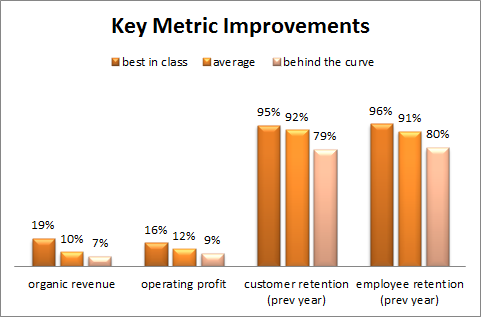
The highest level of proven benefit, according to the Aberdeen Group report, was achieved by those businesses who embraced the requirement to know more about the organization and operation, and who implemented a focused effort at building business intelligence.
Fast Facts: Best-in-Class SMBs Achieved 24% year over year increase in new customer accounts sold compared to 12% for the industry average, and 11% for the laggards.
These organizations which achieved the greatest improvement operated from real data rather than being guided by gut and emotion, enabled the entire organization to participate in the development of organizational and business intelligence, positioned themselves to identify and act on new business and market opportunities, and ensured that those who must make decisions have the information and insightful data to support making the right ones.
Philosophy of Process Improvement: Today’s CFO Focusing on Operations
There are a great many methodologies and approaches to “making businesses better” through process improvement. From SixSigma to Continuous Process Improvement to Total Quality Management – all describe methods of measuring performance and outcomes to return intelligence oriented towards improvement. Many of these approaches are generally applied in manufacturing businesses, because in manufacturing it’s easier to see where processes may be flawed because the process works with tangible elements. Making corrections in a process can improve the performance of that process by reducing errors or increasing efficiency. The truth of the matter is that every business is like a manufacturing business, and applying measurements to the various processes the business performs can reveal the secrets to improving not only process performance and product quality, but resultant profitability.
A recent article on CFO.com titled Operations Take Center Stage, author David McCann discusses how some CFOs are improving business profitability and performance by delving deeper into operational areas of the business, and not remaining focused squarely on accounting and finance issues.
“Operations is the key to everything,” says Larry Litowitz, finance chief at SECNAP Network Security, a secure Internet-services provider. “That orientation is found most at manufacturers, but it should be at every company.”
Fiscal and financial matters are important to every business, but focusing on accounting for the end-result of business activities assumes that the work leading to the result is useful and effective. As more attention is paid to conservation of cash, reduction of expenses, and overall profit improvement, CFOs are necessarily moving deeper into the operational aspects of the business to uncover potential not previously addressed. In some cases, the move is more a function of self-defense and necessity than desire, as businesses increasingly compress spending on management, merging the functional roles of CIO, COO and CFO.
Increasingly, CFOs may find themselves taking on operational tasks whether they want to or not. At larger companies, the steady waning of the chief operating officer position has resulted in more operational responsibility for CFOs, recruiters say. In 2000, 47% of the 669 companies included in either the Fortune 500 or S&P 500 had COOs; in 2012, only 35% did, according to executive-recruiting firm Crist Kolder’s 2012 “Volatility Report of America’s Leading Companies.”
Some accounting professionals may believe that they don’t have the skills and experience to suggest changes in operational areas of their client businesses. I would suggest that logic and reason are generally the prevailing factors supporting process improvement – reasoning that is often developed through simple observation. Taking the time to understand what the business is doing at each level, and then actually observing those activities and accounting for their effectiveness and error rate, is how professionals can spend quality time in the business and uncover hidden profit potential.
Litowitz says CFOs can influence operations at a range of companies, including service-oriented businesses. “It’s really no different. The work is a set of activities,” he insists… “All these activities can be analyzed, controlled, and measured against a predetermined standard,” says Litowitz. And just as on a manufacturing floor, efficiency generates profit, justifying the CFO’s involvement.


 Make Sense?
 In today’s business world, risk, uncertainty and volatility are just par for the course – everyday realities of simply being in business. Nothing is certain, they say, except death and taxes. Yet there is a fine art to driving profitable growth in a business, and adapting to existing and emerging risk takes a great deal of experience, information and agility. While planning and process development may occur at many levels within the organization, it is the FP&A (financial planning and analysis) capability which helps top performing businesses be top performers.

 There are changes in lease accounting rules that may have broader implications than expected. Lease accounting, or accounting in general, isn’t exactly an exciting topic and generally doesn’t come up in conversation. But the changes to how business equipment and other leases are accounted for and reported could become additional fuel for cloud adoption by businesses – small business looking for financing, in particular (= lots).





 Cooper Mann Consulting