Enterprise Functionality for Small Business | Relating to Customer Data

Enterprise Functionality for Small Business | Relating to Customer Data

handshake

Many small business owners are under the impression that most powerful business process management solutions are just for big businesses. A common misconception, for example, is that robust CRM products with turn-key functionality are too complicated and expensive.  This misconception leaves most small business owners to frequently turn to inexpensive online solutions or to their favorite email client in order to store and manage customer information. In today’s competitive business environment, the intelligent and innovative use of technology and business information is often the determining factor between success and failure. Now more than ever, small businesses must leverage tools with the same capabilities as their enterprise counterparts in order to help the business perform at levels necessary to drive growth and maintain profitability.

The data developed within the solutions supporting various business processes is the key which unlocks business intelligence. This data may only be captured and used if the systems and tools in place allow for it. With far too many small business CRM solutions, the assumption is that simplicity of use is the equivalent of less functionality. Approaching the problem from the standpoint of what most small business owners KNOW they need to know, developers have sometimes failed in delivering the capability (and resultant data) small business owners didn’t know they needed or would benefit from. What business owners need to know about is the customer.

Customer Relationship Management (CRM) solutions help businesses identify, acquire and retain customers. Almost any business relationship or interaction represents a customer opportunity. Present customers are customers now, past customers are not just past customers but prospects and everyone else is a prospective future customer. Consider that vendors or resellers are different types of customers, too.  Even employees and coworkers can be seen as “internal” customers. Keeping useful and relevant information about these various “customers” and documenting how the business interacts with them is essential to understanding the entire relationship lifecycle, which is a step towards understanding the business better.

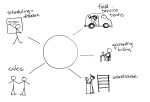
When a small business elects to use a software solution to handle the various interactions with customers, it is often approach in pieces rather than in a comprehensive manner.   Traditionally, Contact Management solutions are applied to sales efforts, providing tools for communicating with leads and prospects as well as current customers. However, related information is also often stored in accounting systems, which handle billing and payment processes involving customers (clients, suppliers, employees, etc.). Some businesses also may use other systems for time management, service or work order management, project management and to archive related documents and emails at various levels of the relationship, where customer information is used and data is created.  With segmented pieces of information in numerous databases, it is hard to achieve true Business Intelligence and a comprehensive view of the entire operation.  Smaller companies can easily miss out on the benefits that their enterprise counterparts possess.

It’s not really unusual for businesses to store some of the same information in several systems, generally in order to support specific job functions for workers in those areas, and delivering data on the equivalent of a “need to know” basis.  For most small businesses, though, an integrated Business Management system that provides CRM as a component of its overall offering could be the answer to providing a single comprehensive solution for all departments.  An integrated solution of this sort would seamlessly integrate with the accounting, email, and document management products Small Businesses use every day.  Examples of such solutions include, but are not limited to, Results CRM, Method CRM and LeGrand CRM.

Beware, however, that not all integrated CRM solutions are created equally. If your organization delivers billable services, make sure that the integrated CRM system that you select can take a billable appointment that was scheduled in the CRM system and automatically place that on an invoice for you – without duplicate data entry and manual tracking of timesheets – so you’re not leaving money on the table. If you manage projects, make sure that the CRM system has the cohesiveness to include project and resource management functionality so that the full business relationship – from sales to the delivery of services to billing – can be managed and tracked in one system without duplicated data entry.

When systems are not tightly and intelligently integrated, sharing data between them becomes very problematic.  Without the ability to check for duplicate records or properly map data points and related fields between systems, there is a great potential for errors in or duplication of data. The result could be a large amount of unrelated and unusable information, which is often what happens when list or transaction data is simply copied between applications without the necessary logic to understand changes in various records, record types, or record states.

There’s a reason why “legacy” integrated software solutions made sense for businesses, and why many enterprises continue to hold on to their solutions – they include the wide variety of tightly integrated functionality and logical data sharing that has been a benefit to the business for years. As organizations seek to start up or reassess their software and systems, they would be wise to keep in mind that generating “big” data with a bunch of loosely connected applications isn’t enough. The data must be intelligently related – just like the business and the customer. 

A tightly integrated and well-managed CRM and Business Management solution, whether in-the-cloud or on premises, is not out of financial reach for small business.  While a solution of this type is not free, the reasonable investment in a quality solution will provide the Business Intelligence necessary to build and maintain a competitive advantage.

Joanie Mann Bunny FeetMake Sense?

J

Licensing the Cloud: Software Distribution and Use in a Remote Access World

Licensing the Cloud: Software Distribution and Use in a Remote Access World

Whether we like it or not, and whether we agree or not – software developers have a right to decide how and where their licensed products are run.  There have always been arguments in this area, where software license purchasers take the position that they should be able to do what they want with their licenses, and where commercial software developers believe they have the rights to dictate authorized usage.  Truly, when it comes down to the legalities of it all, the software companies will win because they have the legal footing to fall back on  – the EULA containing use rights and terms which licensed users have agreed to.

The problem has been ongoing, with software developers constantly and consistently seeking methods to reduce unauthorized software distribution and unsupported use, and users spending amazing amounts of time and resources finding ways to break the rule.  Copy protection, “phone home” license validation models and all sorts of approaches have been developed to prevent software theft and unauthorized distribution.  But it happens anyway – a lot – and the cloud is turning into a great facilitator.  Surprisingly, it’s an “in your face” approach, too, where the previous iteration of web-enabled software theft (unauthorized digital downloads and license cracking) was fairly quiet and tried to be secretive to stay out of the gun sights of the developer.  Today’s “flavor” is right out there, being marketed to any and all who care to view the ads.

With businesses more frequently turning to “cloud” server providers to run business applications, it is no wonder that the IaaS and PaaS companies would want to make their services easier and more valuable to acquire than the next guy’s.  Aside from a groovy control panel and great networking and VM pricing, the added value from these providers is in the applications they are able to service.  More frequently, hosting service providers are marketing their solutions in the context of the applications customers run on the service (which makes sense, because the application’s what really matters).  Leveraging the brand value and recognition of popular commercial software products makes sense, as it improves overall visibility and increases the potential of the “right” kind of prospect engaging and becoming a customer.

The problem arises when these service providers sell hosting services for, or which support, applications they are not authorized or licensed to deliver, and this is where the argument comes full circle.  The hosting provider wants to host applications customers use, customers have licenses for those applications, but not a right to have them hosted.  The host deploys the application anyway, because that’s what the customer wants.  “What’s the risk?” they ask… “the customer has the software license”.

The risk is, unfortunately, greater for the service provider than for the customer.  Even if the customer has a license for the software product, that license may not actually be eligible to run on a hosted server.  “Businesses lease computer equipment all the time, and they can run the software on those systems” is the next argument generally offered by the service provider.  But, in the eyes of the software developer, there may be a big difference between leased equipment run in-house versus subscribed platform services deployed via a commercial hosting provider.  Even Microsoft recognizes the benefit and value of providing “mobility” of application licensing, and has specific licensing models to allow commercial hosts to deploy customer-owned licenses.  While many service providers understand and recognize the requirements to ensure that customer applications are properly licensed for hosted delivery, there are a great many who think the rules simply do not apply to them.  These folks are introducing a great deal of risk into their hosting businesses, even if they are not willing to recognize it.

When a customer runs their software in an unauthorized manner, they risk losing the rights and benefits associated with their software license.  When a commercial hosting company runs software on their servers that they have no right to install and run… they are potentially guilty of unauthorized software distribution and copyright theft.

Actions against facilitators of unauthorized content distribution – you can equate “software” with “content” – have received much press in past months, yet much of the discussion centers on music and video content (as in the Megaupload story).  Actions involving commercial software products tend to be somewhat less visible, probably due to reluctance by commercial developers to have what could be perceived as negative press flowing through social media venues.  It’s popular to protect music and videos, but hosting providers aren’t seeing the wisdom of preserving the integrity of a commercial software product license.  Instead, they’re relying on the customer to indemnify them (the customer has a license, remember?).   But the customer can’t protect the host; the host must protect the host – it’s the prudent business approach.

Infrastructure providers, platform providers and businesses operating as application hosting companies should pay close attention to the content living on their servers.  Taking a position that the customer has the right to do whatever they want with the system is not a viable position; the precedent has been set that the hosting provider is responsible for the content on their systems.  In the case of hosts offering service for small business applications like Microsoft Office and Intuit QuickBooks, for example, it is essential that a service model which conforms to and supports proper license usage be in place, and that any required authorizations are, too.

Software is just another form of content, and the cloud makes distribution of and access to content a lot easier, even when it shouldn’t be.

Make sense?

J

Better QuickBooks Access, Management and Security – QuickBooks Licensing and Hosting Models

Whether hosted in-house or offsite, licensing models for hosting QuickBooks can be very confusing.

driving1-ANIMATIONThe demand for solutions to address user mobility, better collaboration and improved information security is increasing as connectivity improves and cloud services and threats evolve. Server-based computing models and application hosting are increasingly popular as businesses seek to embrace teleworking and telecommuting models for their entrenched applications and systems, creating a foundation for improved productivity and work/life balancing (or integration).  On the technical side, the benefits of centralizing applications and data include improved efficiency in managing, maintaining and securing systems. For many small businesses, this means centralizing the installation and maintenance of core business applications like Intuit QuickBooks Pro, Premier or Enterprise.

Whether it be offsite with a commercial hosting provider or on a co-located server somewhere, or an onsite installation on the in-house server, hosting Intuit QuickBooks licenses can be straightforward or complicated depending on what you are trying to do with them. Because QuickBooks was designed as a standalone single-user application, there are a number of challenges when it comes to preparing it for server-based use.  The primary issue is often simply understanding the QuickBooks licensing model, which is not particularly INTUITive (sorry).

Licensing hosted QuickBooks applications comes with two different sets of implementation issues: the technical implementation (the installation and setup) and the logical allocation of licenses to users (the licensing rules).

When it comes to the technical implementation, many an experienced engineer has beaten their head against the wall trying to get QuickBooks to work properly in a workspace or session-based system (e.g., terminal server), all because they expect the product to implement like a “normal” client/server application. While QuickBooks may use the Sybase database manager guts to handle multi-user access to QuickBooks data files (I think it is still Sybase), the architecture required to properly service a networked QuickBooks installation does not necessarily mimic what would be used with, for example, a .NET desktop client application with an MS SQL back-end.   First, the QuickBooks data files cannot be remote to the application, meaning that both the client and the database manager (which is actually working as an adjunct to the client) must exist on the local network; it will not work over a WAN connection, which is why so many folks get frustrated when they put their server “in the cloud” and attempt to connect from a local client using a VPN.  It just won’t work that way with QuickBooks; it all has to be on the local network – client, server, data… all of it.

It is notable that many businesses use Dropbox and other file sync solutions because they want to be able to get to their data from multiple locations, but the data they’re getting must be “local” to the apps that use it.  It doesn’t allow for simultaneous multi-user access, but it can be an effective way to share a file.  The caveat is that the file (at least in the case of a QuickBooks file, or Outlook PST file, etc.) should not actually be used from the sync folder.  Sync folder should contain copies of data files that users wish to sync or share with other devices.  But I digress…

With a server-based implementation of QuickBooks, technicians will install the QuickBooks desktop software on the server, and will determine whether or not that same machine will also handle the company data files.  The QuickBooks DB manager is part of the installation of QuickBooks, and the file system and drive where the QB files are to be managed must be recognized as a local drive on the server running the QBDB manager.  The overhead used by the database manager isn’t huge, but it can impact the performance of users on the server.  For this reason, some techs will decide to implement a separate file server to manage the QB data files, taking that load off the app server.

  • The QuickBooks software uses the database manager to “host” access to company files.  This simply means that a single server with the data on it is providing managed access to remote-desktop-sessionsQuickBooks application users.
  • When QuickBooks application software and data is installed and centrally managed on a server (instead of QuickBooks being installed on individual PCs), that means QuickBooks application is being “hosted” on that server.
  • When a 3rd party provider supplies the server, the QuickBooks installation, data storage, and your way of connecting to it all,  that provider is a “host” providing hosting services for your QuickBooks.

In a dedicated hosting environment, the data is often stored on the same server as the applications, whereas in a shared hosting environment, the data is often stored on central file servers which serve multiple customers. This is why, in some shared hosting situations, one bad data file can take down the database manager services for all the customers using that same file server.

Users open the QuickBooks application on the server instead of having the application installed on individual PCs.  The single server-based installation of the software is able to be used concurrently by all users logging in to that computer. With the database manager running, the file is essentially “hosted” on that machine, and the file may then be opened in multi-user mode.  OK so far.  The problem generally comes about when a second user on the same computer/server wants to open the same QB data file as the first user.

Because the QB database manager is looking at the license of the client application accessing the data file, it will recognize when two different users/sessions with the same license key attempt to open the company data file.  If that license key is a single-user key, then the database manager knows it should allow only 1 concurrent user in the file.  QuickBooks doesn’t get installed for each user on a computer or server; it is installed one time on the machine and each user on that machine runs from that single shared installation. Any particular version of the QuickBooks application may be installed only once on a single computer, but it is possible to install multiple editions, year versions, and “flavors” of QuickBooks on a single machine (cannot be more than one installation of each unique product). There will be more than a few annoyances when running a variety of QBs on the same computer, but it is technically possible.

In order to allow multiple users to simultaneously access the same data file from a central installation of QuickBooks, the license key installed on the computer must be a multi-user key.  QuickBooks Pro, for example, can be keyed to 3 concurrent users, meaning that the license will allow up to 3 users with that same license key to simultaneously access the same company file.  Technically (but not lawfully) this installation of QuickBooks on the machine could allow a virtually unlimited number of users to launch the QuickBooks application simultaneously, limited only by machine resources.  This is where the logical allocation of licensing comes in.. the rule of licensing QuickBooks.

The logical allocation of unique licenses for each QuickBooks user is a little easier to understand than the technical implementation.  The rule is simply that each user of QuickBooks is required to have a valid registered/activated license. That valid license is a license purchased and activated for that business.

total-businessMaking QuickBooks desktop editions more useful by adding secure remote access and centralized management makes a lot of sense.  For companies who rely on the functionality and features of the desktop products (QuickBooks Pro, Premier and Enterprise), a hosted approach is the only way to really address mobility and multi-location requirements.  Remember that hosting doesn’t necessarily mean offsite, although that could make sense for the business, too.

Centrally-managing QuickBooks applications and data creates greater efficiency and improves overall IT management capability for the business.  At the same time, a centralized model introduces a better strategy for mobilizing the workforce and connecting remote users and offices. The struggles of understanding and implementing proper QuickBooks licensing begin to seem very small when compared to the benefits of deploying a centralized system that’s easier to access, manage and secure.

Make sense?

J

Lease Accounting Rules, Small Business Financing and the Cloud

Lease Accounting Rules, Small Business Financing and the Cloud

Cloud Service FinancingThere are changes in lease accounting rules that may have broader implications than expected.  Lease accounting, or accounting in general, isn’t exactly an exciting topic and generally doesn’t come up in conversation.  But the changes to how business equipment and other leases are accounted for and reported could become additional fuel for cloud adoption by businesses – small business looking for financing, in particular (= lots).

First, what does accounting for leases have to do with small business financing?  Quite a bit, actually.  The balance sheet is one of the things a lender will look at when considering a small business for a loan, and if lease obligations and leased assets are on the balance sheet, they’re going to want to talk about them.  They’ll also possibly look at asset turnover – trying to understand exactly how much in assets it takes for the business to make “x” amount of money.  Banks and other lenders like to know they’re loaning money to a business that is going to pay it back, and in a reasonable amount of time.  They will limit their risk potential as much as possible, and they do it by looking through the financials and related information.

Business value is generating sustainable cash flow.  If you run a highly efficient business, the more top-line growth you deliver, the more cash flow you enjoy.  For capital-intensive businesses (either through the need for capital equipment or working capital), growth can actually lower your cash flow and diminish your business value.   To understand which side of the equation your business resides, accounting professionals will often look at the return on total assets calculated over time, dividing the operating income for each period from the P&L by the appropriate period values of total assets from the balance sheet.  The resulting metric describes how efficiently assets are applied to creating earnings.

https://coopermann.com/2013/01/22/why-is-asset-management-important-to-a-business/

This can be a difficult conversation with the banker for new businesses, as they have little to go on in terms of historic data to show the bank.  The P&L (profit & loss, or Income Statement) only reflects current business performance, not what it can do in a few months or years.  By putting leases on the balance sheet, businesses are now reflecting a more realistic view of things, but are also introducing additional items for scrutiny and question by the lender; things which are often described more in terms of business strategy than in proveable numbers.  That makes getting the loan just that much tougher.

Previous rules relating to business leases didn’t necessarily require that the business recognize operating leases (leased items and lease obligations) as assets and liabilities on the balance sheet.  This is among the reasons why businesses lease equipment – they are able to obtain the item without having to record a single large capital expenditure.

The FASB changes demand that accounting for leases should be standardized, forcing the lesees to report all leases on the balance sheet, reflecting both the benefit (asset) and the cost (liability) associated with the lease.  Stated in a press release on the subject: “The new guidance responds to requests from investors and other financial statement users for a more faithful representation of an organization’s leasing activities,” stated FASB Chair Russell G. Golden. “It ends what the U.S. Securities and Exchange Commission and other stakeholders have identified as one of the largest forms of off-balance sheet accounting, while requiring more disclosures related to leasing transactions.”

“a capital lease creates a tangible right where you own the equipment; the liability in a capital lease is true debt…”

http://www3.cfo.com/article/2013/9/gaap-ifrs_lease-accounting-elfa-fasb-iasb-global-convergence

By understanding how these changes in accounting for leases impact businesses, cloud solutions providers now have an additional lever to use with prospective customers: leasing equipment isn’t necessarily the way to keep capex off the balance sheet any longer.

One of the big value propositions offered by many cloud solution providers is that their service is paid for as a monthly business expense rather than a large up-front capital expenditure and investment.  Businesses are able to use the solution and benefit from it without actually “buying” anything, it’s just subscribed instead.  All of this is really a fancy way of saying “renting but not owning”, but the result to financial reporting is the same: it’s not on the balance sheet, it’s on the P&L in chewy chunks.  This used to be a preferred treatment for leases, too, allowing businesses to reflect the usage and payment in little parts rather than a big one.  It was “gentler” on the balance sheet.  But leasing equipment and software for on-premises use won’t be competing with the cloud and subscription service any longer, closing off the “impact to the balance sheet” conversation entirely and making cloud IT just that much more important to small businesses who need cash to fuel business growth.

Make Sense?

Joanie Mann Bunny FeetJ

Intuit QuickBooks 2014: Another Move Towards Unification of Features and Software as Service

Intuit QuickBooks 2014: Another Move Towards Unification of Features and Software as Service

qb2014Intuit QuickBooks is the recognized standard for small business accounting, and the introduction of the QuickBooks Online Edition was a testament to Intuit’s understanding that users are looking for SaaS solutions as well as traditional desktop products.  While it may seem that the entire market is moving to online applications and everything-as-a-service, the Intuit desktop products remain the leading business computerized accounting tools.  Intuit does seem to recognize that many things can be done better with a “software-as-service” model , and that the number of businesses seeking purely web-based solutions is growing, and this is evidenced by the fact that many features and presentation elements in the Online edition are making it into the desktop editions.  Creating consistency throughout the product line makes sense for users, and leveraging the benefits of shared service makes sense for Intuit.

In a previous blog article entitled Changing How We See Software: QuickBooks 2013 interface frustrates power users, I had suggested that many of the interface changes introduced with the 2013 QuickBooks desktop editions were a step towards unification of interfaces (to the degree possible) between desktop and Online editions.  Additionally, integrations with various connected services, Intuit payroll and payment solutions, and other online service elements clearly demonstrate that certain functionality and service offerings will be provided consistently through either solution set.  Another new “unified” feature announced for QuickBooks desktop is the Income Tracker, a feature that originated with the QB Online edition.

The Income Tracker provides you with a fast way to see the status of your unbilled and unpaid transactions, and provides you with features to improve billing/collections as well as perform a number of batch procedures… This feature was first developed in QuickBooks Online, and this year Intuit has brought it into QuickBooks Desktop

http://www.sleeter.com/blog/2013/09/quickbooks-2014-income-tracker/

The introduction of a purely subscription licensing model for the desktop products is yet another move towards enabling the pay-as-you-go subscription model for purchasing software.  Businesses are able to purchase “plus” subscriptions, which provide not only perpetual most current version software but also deliver support for the life of the subscription.  This is another change from the more traditional boxed software approach, where the product was a one-time purchase and came with short-term or limited support.

It seems that many of the changes introduced with 2014 indicate that online service and subscription pricing models will continue to introduce themselves into the QuickBooks desktop products, and users who change from one solution to another in the product family will find more familiarity and consistency in the attached Intuit services they also use.

Many independent software vendors and developers of business applications are recognizing the value of subscription service models and the benefits of leveraging web-based applications and shared services within their solutions.  For software companies, turning a one-time sale into a recurring revenue stream is highly desirable.  From a development perspective, one project could service the entire product line, rather than efforts being divided among multiple products.  From an operational perspective, infrastructure and personnel are able to centrally service the functional requirement, providing the same benefits of shared service that users of SaaS solutions experience (it may simply be internal rather than external customers being served).

The point of the discussion is that, while QuickBooks desktop editions may not be going away any time soon, there is wisdom (and business necessity) which is likely to drive even more subscription model SaaS inclusions in those products that were once purely and firmly planted on the desktop.  Even good old QuickBooks must change, and for the most part, users are seeing benefit in those changes.

Make Sense?

J

Hosted QuickBooks and Office 365 a Complicated Technical and Licensing Model (until now)

When Intuit acknowledged the ability for companies to host QuickBooks desktop editions, service providers were presented with the opportunity to offer hosting for the QuickBooks desktop editions from their host servers and infrastructure.  The benefits of using QuickBooks desktop products in a hosted environment are many, including the introduction of mobility, disaster recovery, remote access and other things now associated with cloud computing models.  But the evolution of application delivery technologies and software as subscription service models is challenging the “traditional” approaches used to deliver hosted QuickBooks services.  One of the greatest challenges facing these QuickBooks hosts is the changing landscape of Microsoft Office licensing, because QuickBooks is just no fun without Microsoft Office.

While the QuickBooks application handles a variety of essential business functions, it relies upon other software to accomplish certain important tasks, such as reporting.  Most of the QuickBooks reports can be exported to Excel worksheets, allowing users to refine and manipulate the document outside of QB;   QuickBooks Enterprise Edition uses Excel to handle consolidated reporting.  QuickBooks uses Word for writing customer letters, and Outlook as a tool to email invoices.  There is a lot of functionality in QuickBooks that relies on the MS Office products, so it is pretty typical for a QuickBooks user to also be an Office apps user.  In order for the applications to work together properly, they need to be installed on the same computer.  If QuickBooks is hosted “in the cloud” with a hosting provider, and Office 365 applications are installed on the local PC, the two applications don’t “talk”, and the integration isn’t seamless or even functional.

image credit: Microsoft Corp | Microsoft.com

When a small business subscribes to Office 365 (or Microsoft 365 now), they are provided with rights to install their Office applications on their devices (depending on the subscription level).  While this enables users to have Office apps on multiple computers they use at different times, it does not provide authorization for the application to be installed on a hosted server where it is accessed by those users.

What this means is that customers who purchase Office 365/Microsoft 365 subscriptions to get their MS Office productivity applications can’t generally use those licenses in a hosted environment.

But there is an answer for small businesses who want remote and mobile access to their QuickBooks desktop editions and who also have Office 365 application licenses. The answer is to deploy QuickBooks desktop on a Microsoft Azure cloud server. This solution allows users to run their QuickBooks software as well as their qualifying Microsoft Office (M365 Apps for Enterprise) licenses on the Azure cloud server. The cloud platform enables the anytime/anywhere access desired and keeps all the applications and data secure and available for those who need access.

There is almost never just one way to solve a problem, and the cloud is introducing new options – and challenges – at all levels.  As application licensing and delivery models continue to change, solution providers will come to recognize the value they provide in bringing the right selection of services and technology models together to benefit not just their customers, but their own revenue streams and profit potential.

Joanie Mann Bunny FeetMake Sense?

J