Managing Client Relationships in a Down Economy | Accounting and Business Technologies

Managing Client Relationships in a Down Economy

There is no question that the current economy is putting the squeeze on many professional practices. While most accountants aren’t in danger of going bankrupt, there is heightened anxiety throughout the industry as professionals grapple with flat or falling revenues and rising costs. You, too, are probably feeling the effects of the economic downturn, as your clients also look for ways to cut costs.

During tough economic times, a familiar pattern occurs in small business. As production drops, profits drop even faster. Even a slight drop in income sets off alarm bells in the minds of many owners. To stave off a serious decline in revenues, the small business owner will often feel compelled to offer services to customers that might previously have been referred out to “specialists”, or to substantially discount products or services in order to obtain business. Additionally, the business owner will certainly seek to cut business overhead.

This last point has a direct impact on the livelihood of the professional accountant, bookkeeper or business consultant. When businesses tighten their belts, they may not necessarily do it in a logical manner. They may procrastinate by stalling on purchases or putting projects on hold indefinitely. They may buy smaller quantities of supplies, even if this means ordering much more frequently. And they may cut back on their reliance on accounting or consulting professionals.

read more at Accounting and Business Technologies | Joanie Mann: Managing Client Relationships in a Down Economy.

Marketing and Sales Needs System and Process Automation

Marketing and Sales Needs System and Process Automation

Running a business means finding and keeping customers who will buy from you.  This isn’t necessarily easy, particularly with the number and variety of “impressions” people get throughout their day.  It used to be that simply locating a business in the right place would generate drive-by traffic, with location being the key to generating impressions and causing people to actually stop and shop.  Impressions – yes, those brief instances where your brand or service is viewed – count.

The entire lifecycle of the customer relationship starts with the first impression, so it needs to be a good one.   Marketing impressions expose your business and products to prospective customers, with efforts oriented towards the generation of sales leads.  A lead is a business or individual that may ultimately develop into a sales or business opportunity.  Rather than attempting to engage with businesses or individuals one at a time, businesses use marketing to target large groups in hopes of earning the permission to engage group members in more focused or individualized sales activities. When the business earns the ability to communicate directly with a prospective buyer, a sales lead is generated, and the business now has a prospective customer and the potential to make a sale.

Sales leads don’t stop becoming leads just because they purchase from you.  Every customer remains an ongoing opportunity to generate new business directly or indirectly via referrals or recommendations.  The best case scenario for your business is when you know when and why your customer buys from you, when the customer wants more, and that they will refer their friends or business associates to you.

Part of the problem with marketing and sales is that there are often too few people and/or resources to apply to the task.  Most businesses aren’t in the position of simply throwing money at a problem (which rarely actually solves the problem), so it becomes essential that you find a way to get the job done with the same or fewer people and resources.  The keys to solving this problem are systems and processes (automation).  Automation doesn’t always mean that there is an “automatic system” somewhere which performs all of the tasks for you.  In most cases, it simply means that the process is structured, efficient, and is able to be effectively repeated without significant deviation or loss.  Structured systems and processes, along with a strong commitment to capturing activity data and measuring results, is the foundation which will support growth.

Marketing Automation Explained (Infographic) | The automation of business function is set to be the new trend in 2014. There are already dozens of sales, marketing and finance automation options, and for good reason: The quantifiable returns they provide are undeniable. Here is a look at marketing automation and how it works. 

http://www.entrepreneur.com/article/227923#ixzz2ghHq9Qpn

From the very first impression through the conclusion of the sale and ongoing, it is essential to capture the data which describes the activities and events around doing business with your customers.  It is important to track unsuccessful efforts as well as those which are successful.  By understanding what does not work, you develop valuable insight which helps refine the process and the approach, resulting in fewer wasted efforts. The accumulated data tells the story of how you earn new business and how you create a customer relationship, which helps you understand how and where you are successful in earning new business and why you are able to retain loyal customers.

Joanie Mann Bunny FeetMake Sense?

J

Read more about Enterprise Functionality for Small Business | Relating to Customer Data

Giving Credit Where Credit Is Due | Accounting and Business Technologies

Giving Credit Where Credit Is Due

or – That was then, but this is now…

It constantly amazes me, seeing the number of conversations, forums, talkbacks, emails, etc. flurrying about the Internet that are focused on finding the way to “win” against Microsoft and Intuit – both companies, in certain circles, being referred to as “big brother”. Well, the 800lb gorillas, anyway.

There are the Linux community members, very appropriately using TCO (total cost of ownership) and security messages to get the attention of the market… you’ve got the Mac devotees who believe that computers can and should have good fashion sense… and then there are the Windows users who use it, but complain nonetheless.

With Intuit, you have a clear market-share leader in SMB accounting. As for the other market segments – it’s anybody’s guess who wins there. It’s arguable.

But what do these two companies have in common? In a word – success.

Let’s face it. Without them, there wouldn’t be a world of computer users representing a potential customer base for new products. Walk with me – let’s talk.

Computers were once quite expensive, unintuitive, and basically unavailable for most businesses. Then PCs emerged, Microsoft hit the market – and Windows opened across the world. (Yes, I realize the timeline here is seriously compressed, and DOS lived for a long time and we liked it).  First, businesses broadly became computer users. Then consumers became computer users. Then everyone became a computer user.   Granted, the guy at home playing “Flight Simulator” was a driving force in getting the mouse and better graphics into mainstream computing. But let’s remember that accounting and finance was among the first primary applications of general computing technology (the BETTER adding machine).

Changes in the accounting industry were also occurring at this point. Professional accounting practices began to move away from business bookkeeping, being a low-margin and labor intensive task. Intuit hit the market with QuickBooks, marketing based on the concept that “if you can write a check, you can do your own books”. While this was in direct opposition to the professional accountants’ belief that businesses need professional assistance with their accounting, it solved the dilemma of doing the books directly. So, many accounting practices at this point actually became focused on selling and supporting accounting software – looking at the technology as both a means to avoid direct bookkeeping as well as introducing additional revenue-earning services for the practice.

Both Microsoft and Intuit recognized a need in the market, and filled those needs quite nicely. They earned their market share largely based on useability and the concept of empowerment. This is what it took to build the size of market we see today. And let’s face it. They did it very well.

Today’s computer user is more savvy – more aware of the options and choices. But choice often seems like complexity. With Microsoft and Intuit being viewed by many as the defacto standards for small businesses, the choice seemed like it was already made and therefore the complexity of making the right purchasing decision was removed. This is not as true today as it once was.

There are other options available. Will they gain the same levels of adoption that their predecessors did? Doubt it. The concept of “one size fits all” isn’t true any more. People want tools that are specific to their requirements. Businesses want their computing platform and applications to do more for them than simply maintain status quo.

But we must always remember how we got here. Kudos to the big guys who built the market for the rest of us. We should revere these companies, and acknowledge the great thing they did – they created potential customers for all of us. Lots of ’em.

via Accounting and Business Technologies | Joanie Mann: Giving Credit Where Credit Is Due.

Banks and Small Business: Finding the “Just Right” Fit Isn’t Easy

Banks and Small Business: Finding the “Just Right” Fit Isn’t Easy

Banks need business customers because business accounts provide more profitability than consumer accounts.  By volume, there are more small businesses in the US than mid-size or enterprise businesses, which you would think would be a good thing for the banks – more business customers, right?  It seems not so much.

For many banks, the problem is that they don’t appear to really know how to service – or even identify – these small business customers.  The majority of small businesses in the US don’t have employees, so direct deposit and payroll solutions aren’t something they are looking for.  Many of these small businesses operate from the business owner’s home rather than an office, and don’t generate the revenues (=deposits) that bigger businesses do.

To a bank, most small businesses look like consumers.  These small businesses are treated like consumers – are offered consumer-level services and are not educated on what business banking services might be able to do for them.  In reality, the banks really don’t have much to say to these small business owners, because the services offered by the banks are simply not a great fit.  There are studies which suggest that the small business market is fairly evenly divided, with approximately 50% using consumer banking services rather than those designed for business use.  Given the inability of the banks to even identify those consumer banking customers who are actually small businesses, I would suggest that the percentage is even higher.

There are three primary elements tied to banking which should be better-positioned to assist small business owners in leveraging their banking relationships to the benefit of the business and not just the bank.   If the financial institutions can find a way to meet these three essential needs for smaller businesses, they would likely find that more small businesses would embrace business banking services, resulting in greater profitability for the bank.

e-Payments

Use of electronic payments services represents a growing trend in small businesses and needs to be better-addressed by the financial institutions rather than purely retail providers.  Small businesses are increasingly using the Internet and online technologies to service their various business needs, and payments processing is among the top sellers.  Providing SOLO/SOHO and other small businesses with the ability to process payments at any time and from anywhere has become a big driver for this type of solution.  The popularity of Pay Pal, Intuit GoPayment and Square payment solutions is a testament to the need for such services in the small business market, yet the broadest use continues to be within retail providers rather than directly via the financial institutions.

Entitlements

Security and access controls to account and transaction information (frequently referred to as “entitlements” attached to business accounts) are hugely valuable for small businesses.  Most small business owners engage bookkeeping or accounting professionals at some point, and the process of accounting for the business activities is improved dramatically when those professionals are able to access the information directly from the financial institution.  Unfortunately, it is only with the more expensive business class accounts that most banks provide the means for account holders to grant access to account and/or transaction information for accountants and bookkeepers, financial advisors, etc.  Allowing small businesses to benefit from this type of security and control of their accounts is tremendous, yet the overall costs of the associated business banking solutions are often simply too great for the small business to bear.  The result is either a lack of privacy, security and control, where the business owner must grant unfettered access to account information to a 3rd party bookkeeper or accountant, or the business owner simply continues to pay for manual bookkeeping transaction entry.

Cash Management

Most small businesses operate on cash, and expense and cash management is essential to maintaining operations.  Consumer banking solutions may offer limited capabilities for expense and cash reporting, but the services offered through many business banking portals would be far more beneficial for the business, reflecting trends and providing more insight relating to business financial activities and business behavior.  Unfortunately, many of these services designed for business customers are oriented towards the larger organization, and are far too complicated or expensive to provide real value to the owner of a small business.

Small businesses fuel the economy, yet remain a largely untapped market in terms of business banking and other services.  Small businesses run “under the radar” of many service providers because they have not reached the point where the obviously available business services (e.g, the more profitable banking solutions) seem attractive to them.  Banks need to recognize that serving the small business customer well – providing the services which help small businesses grow into bigger businesses – is ultimately the key to acquiring new customers for whom the big banking solutions fit.

jmbunnyfeetMake Sense?

J

Read more about small business banking and credit

Licensing the Cloud: Software Distribution and Use in a Remote Access World

Licensing the Cloud: Software Distribution and Use in a Remote Access World

Whether we like it or not, and whether we agree or not – software developers have a right to decide how and where their licensed products are run.  There have always been arguments in this area, where software license purchasers take the position that they should be able to do what they want with their licenses, and where commercial software developers believe they have the rights to dictate authorized usage.  Truly, when it comes down to the legalities of it all, the software companies will win because they have the legal footing to fall back on  – the EULA containing use rights and terms which licensed users have agreed to.

The problem has been ongoing, with software developers constantly and consistently seeking methods to reduce unauthorized software distribution and unsupported use, and users spending amazing amounts of time and resources finding ways to break the rule.  Copy protection, “phone home” license validation models and all sorts of approaches have been developed to prevent software theft and unauthorized distribution.  But it happens anyway – a lot – and the cloud is turning into a great facilitator.  Surprisingly, it’s an “in your face” approach, too, where the previous iteration of web-enabled software theft (unauthorized digital downloads and license cracking) was fairly quiet and tried to be secretive to stay out of the gun sights of the developer.  Today’s “flavor” is right out there, being marketed to any and all who care to view the ads.

With businesses more frequently turning to “cloud” server providers to run business applications, it is no wonder that the IaaS and PaaS companies would want to make their services easier and more valuable to acquire than the next guy’s.  Aside from a groovy control panel and great networking and VM pricing, the added value from these providers is in the applications they are able to service.  More frequently, hosting service providers are marketing their solutions in the context of the applications customers run on the service (which makes sense, because the application’s what really matters).  Leveraging the brand value and recognition of popular commercial software products makes sense, as it improves overall visibility and increases the potential of the “right” kind of prospect engaging and becoming a customer.

The problem arises when these service providers sell hosting services for, or which support, applications they are not authorized or licensed to deliver, and this is where the argument comes full circle.  The hosting provider wants to host applications customers use, customers have licenses for those applications, but not a right to have them hosted.  The host deploys the application anyway, because that’s what the customer wants.  “What’s the risk?” they ask… “the customer has the software license”.

The risk is, unfortunately, greater for the service provider than for the customer.  Even if the customer has a license for the software product, that license may not actually be eligible to run on a hosted server.  “Businesses lease computer equipment all the time, and they can run the software on those systems” is the next argument generally offered by the service provider.  But, in the eyes of the software developer, there may be a big difference between leased equipment run in-house versus subscribed platform services deployed via a commercial hosting provider.  Even Microsoft recognizes the benefit and value of providing “mobility” of application licensing, and has specific licensing models to allow commercial hosts to deploy customer-owned licenses.  While many service providers understand and recognize the requirements to ensure that customer applications are properly licensed for hosted delivery, there are a great many who think the rules simply do not apply to them.  These folks are introducing a great deal of risk into their hosting businesses, even if they are not willing to recognize it.

When a customer runs their software in an unauthorized manner, they risk losing the rights and benefits associated with their software license.  When a commercial hosting company runs software on their servers that they have no right to install and run… they are potentially guilty of unauthorized software distribution and copyright theft.

Actions against facilitators of unauthorized content distribution – you can equate “software” with “content” – have received much press in past months, yet much of the discussion centers on music and video content (as in the Megaupload story).  Actions involving commercial software products tend to be somewhat less visible, probably due to reluctance by commercial developers to have what could be perceived as negative press flowing through social media venues.  It’s popular to protect music and videos, but hosting providers aren’t seeing the wisdom of preserving the integrity of a commercial software product license.  Instead, they’re relying on the customer to indemnify them (the customer has a license, remember?).   But the customer can’t protect the host; the host must protect the host – it’s the prudent business approach.

Infrastructure providers, platform providers and businesses operating as application hosting companies should pay close attention to the content living on their servers.  Taking a position that the customer has the right to do whatever they want with the system is not a viable position; the precedent has been set that the hosting provider is responsible for the content on their systems.  In the case of hosts offering service for small business applications like Microsoft Office and Intuit QuickBooks, for example, it is essential that a service model which conforms to and supports proper license usage be in place, and that any required authorizations are, too.

Software is just another form of content, and the cloud makes distribution of and access to content a lot easier, even when it shouldn’t be.

Make sense?

J

Better QuickBooks Access, Management and Security – QuickBooks Licensing and Hosting Models

Whether hosted in-house or offsite, licensing models for hosting QuickBooks can be very confusing.

driving1-ANIMATIONThe demand for solutions to address user mobility, better collaboration and improved information security is increasing as connectivity improves and cloud services and threats evolve. Server-based computing models and application hosting are increasingly popular as businesses seek to embrace teleworking and telecommuting models for their entrenched applications and systems, creating a foundation for improved productivity and work/life balancing (or integration).  On the technical side, the benefits of centralizing applications and data include improved efficiency in managing, maintaining and securing systems. For many small businesses, this means centralizing the installation and maintenance of core business applications like Intuit QuickBooks Pro, Premier or Enterprise.

Whether it be offsite with a commercial hosting provider or on a co-located server somewhere, or an onsite installation on the in-house server, hosting Intuit QuickBooks licenses can be straightforward or complicated depending on what you are trying to do with them. Because QuickBooks was designed as a standalone single-user application, there are a number of challenges when it comes to preparing it for server-based use.  The primary issue is often simply understanding the QuickBooks licensing model, which is not particularly INTUITive (sorry).

Licensing hosted QuickBooks applications comes with two different sets of implementation issues: the technical implementation (the installation and setup) and the logical allocation of licenses to users (the licensing rules).

When it comes to the technical implementation, many an experienced engineer has beaten their head against the wall trying to get QuickBooks to work properly in a workspace or session-based system (e.g., terminal server), all because they expect the product to implement like a “normal” client/server application. While QuickBooks may use the Sybase database manager guts to handle multi-user access to QuickBooks data files (I think it is still Sybase), the architecture required to properly service a networked QuickBooks installation does not necessarily mimic what would be used with, for example, a .NET desktop client application with an MS SQL back-end.   First, the QuickBooks data files cannot be remote to the application, meaning that both the client and the database manager (which is actually working as an adjunct to the client) must exist on the local network; it will not work over a WAN connection, which is why so many folks get frustrated when they put their server “in the cloud” and attempt to connect from a local client using a VPN.  It just won’t work that way with QuickBooks; it all has to be on the local network – client, server, data… all of it.

It is notable that many businesses use Dropbox and other file sync solutions because they want to be able to get to their data from multiple locations, but the data they’re getting must be “local” to the apps that use it.  It doesn’t allow for simultaneous multi-user access, but it can be an effective way to share a file.  The caveat is that the file (at least in the case of a QuickBooks file, or Outlook PST file, etc.) should not actually be used from the sync folder.  Sync folder should contain copies of data files that users wish to sync or share with other devices.  But I digress…

With a server-based implementation of QuickBooks, technicians will install the QuickBooks desktop software on the server, and will determine whether or not that same machine will also handle the company data files.  The QuickBooks DB manager is part of the installation of QuickBooks, and the file system and drive where the QB files are to be managed must be recognized as a local drive on the server running the QBDB manager.  The overhead used by the database manager isn’t huge, but it can impact the performance of users on the server.  For this reason, some techs will decide to implement a separate file server to manage the QB data files, taking that load off the app server.

  • The QuickBooks software uses the database manager to “host” access to company files.  This simply means that a single server with the data on it is providing managed access to remote-desktop-sessionsQuickBooks application users.
  • When QuickBooks application software and data is installed and centrally managed on a server (instead of QuickBooks being installed on individual PCs), that means QuickBooks application is being “hosted” on that server.
  • When a 3rd party provider supplies the server, the QuickBooks installation, data storage, and your way of connecting to it all,  that provider is a “host” providing hosting services for your QuickBooks.

In a dedicated hosting environment, the data is often stored on the same server as the applications, whereas in a shared hosting environment, the data is often stored on central file servers which serve multiple customers. This is why, in some shared hosting situations, one bad data file can take down the database manager services for all the customers using that same file server.

Users open the QuickBooks application on the server instead of having the application installed on individual PCs.  The single server-based installation of the software is able to be used concurrently by all users logging in to that computer. With the database manager running, the file is essentially “hosted” on that machine, and the file may then be opened in multi-user mode.  OK so far.  The problem generally comes about when a second user on the same computer/server wants to open the same QB data file as the first user.

Because the QB database manager is looking at the license of the client application accessing the data file, it will recognize when two different users/sessions with the same license key attempt to open the company data file.  If that license key is a single-user key, then the database manager knows it should allow only 1 concurrent user in the file.  QuickBooks doesn’t get installed for each user on a computer or server; it is installed one time on the machine and each user on that machine runs from that single shared installation. Any particular version of the QuickBooks application may be installed only once on a single computer, but it is possible to install multiple editions, year versions, and “flavors” of QuickBooks on a single machine (cannot be more than one installation of each unique product). There will be more than a few annoyances when running a variety of QBs on the same computer, but it is technically possible.

In order to allow multiple users to simultaneously access the same data file from a central installation of QuickBooks, the license key installed on the computer must be a multi-user key.  QuickBooks Pro, for example, can be keyed to 3 concurrent users, meaning that the license will allow up to 3 users with that same license key to simultaneously access the same company file.  Technically (but not lawfully) this installation of QuickBooks on the machine could allow a virtually unlimited number of users to launch the QuickBooks application simultaneously, limited only by machine resources.  This is where the logical allocation of licensing comes in.. the rule of licensing QuickBooks.

The logical allocation of unique licenses for each QuickBooks user is a little easier to understand than the technical implementation.  The rule is simply that each user of QuickBooks is required to have a valid registered/activated license. That valid license is a license purchased and activated for that business.
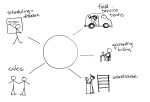
total-businessMaking QuickBooks desktop editions more useful by adding secure remote access and centralized management makes a lot of sense.  For companies who rely on the functionality and features of the desktop products (QuickBooks Pro, Premier and Enterprise), a hosted approach is the only way to really address mobility and multi-location requirements.  Remember that hosting doesn’t necessarily mean offsite, although that could make sense for the business, too.

Centrally-managing QuickBooks applications and data creates greater efficiency and improves overall IT management capability for the business.  At the same time, a centralized model introduces a better strategy for mobilizing the workforce and connecting remote users and offices. The struggles of understanding and implementing proper QuickBooks licensing begin to seem very small when compared to the benefits of deploying a centralized system that’s easier to access, manage and secure.

Make sense?

J


