

Why connected workflows and reliable data are essential to scalable growth
Financial models can project revenue growth, margin expansion, cash generation, and even a successful exit. But a spreadsheet cannot produce those outcomes. Value is created inside the business, through operational systems that make work repeatable and data integration that gives leaders a reliable view of performance.
From Financial Plan to Operations Reality
An integration plan for operations should address a practical question: What will the company be able to do consistently better after the integration that it cannot do today? The benefits are typically found with consistent approaches to pricing, structure and pipeline reporting for sales, streamlined and preferential purchasing capability, guardrails for and improvements in service delivery, creation of working capital, and analytical reporting with an AI capacity.
Those capabilities depend on systems. Pricing needs govern discount rules and margin visibility; sales needs a defined process and trustworthy pipeline data; and cash conversion requires billing, inventory, purchasing, and collections to work as one coordinated workflow.
Integration Turns Activity into Insight
Many companies have the necessary applications but still lack visibility of the relevant data. Customer, transaction, inventory, project, and financial data often remain in silos, use inconsistent definitions, and arrive too late to guide meaningful decision-making. Teams will try to compensate – using spreadsheets, manual reconciliations, and competing versions of the truth.
Data integration creates a shared view of how activity becomes revenue, profit margin, and cash. Leadership can see whether price increases are making a difference, which opportunities convert profitably, where purchasing savings are gained or lost, and why earnings aren’t getting to the bank account. This is not about simple data movement; it’s about having timely, trusted information to support business decisions as they are made.
Standardize Before You Automate
New software cannot repair an undefined process or inconsistent data. To standardize something, first establish ownership of a process or area, make sure everyone is using the same definitions, understand where decision rights exist, and identify the most meaningful measures first. From there you can move to stabilize critical workflows, standardize the master data, connect the systems supporting high-value decisions, and automate.
The key is to connect investments to operating outcomes, such as faster quoting, better sales forecasting, reduced inventory, fewer billing errors, and more efficient administration.
Build for Acquisitions and Scale
Acquisitions introduce more and different applications, customer structures, products and product codes, reporting practices and more. A repeatable integration capability defines what must be standardized, what can remain local or localized, how the data maps across systems, and when reporting comes together. This approach reduces operational disruption and accelerates time to value, capturing the synergy more quickly.
The Real Source of Durable Value
Long-lasting value does not come from having more technology. Extended value return comes from operational systems which employees can execute, integrated data that business leaders can trust, and a management mentality that turns information into action. When pricing, sales, procurement, delivery, and cash management use connected processes and consistent data, growth becomes more predictable and margins more defensible.
Turn Fragmented Operations into Measurable Results
Ready to connect your systems, improve data visibility, and build more scalable operations? Noobeh is ready to help!
Let’s start by identifying your highest-impact workflow and defining the business outcome, and then together we’ll create a practical integration roadmap. The sooner your applications, data and processes work together, the sooner your strategy can produce measurable results.
 Make Sense?
J



 Make Sense?

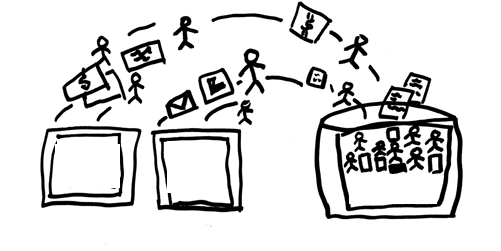 For example, with an installation of QuickBooks accounting the point-of-sale “master location” on the host, the core financial data is able to be secured and protected in the virtual environment without risking lost productivity (and lost sales!) due to connectivity failures at the retail locations. The end-of-day process at each location is to then copy the POS data to the host system where it is integrated with the accounting system. If the POS system is something other than QuickBooks POS, it simply means that there is another piece of software – the specific POS integration tool – required to transfer the POS data into the accounting software. QuickBooks desktop accounting integrations are available for most popular POS systems including Micros, POSiTouch, Aloha and others. The integration software (often just a QuickBooks plug-in) would be installed on the computer running QuickBooks, enabling the entry of the POS data into the QuickBooks accounting system.
 Make Sense?
 The market for home health care services is growing rapidly and is not likely to slow any time soon. The expanding need is due in large part to the aging of the baby boomers, those born between 1946 and ‘64. The boomers were once the nation’s largest living generation, defined by a notable increase in births in the United States following World War II. As this generation ages, it is creating a boom of sorts in the home health services industry.
 Make Sense?

