Licensing and Virtualization: Changes to SPLA May Impact Provider Cost Models

Licensing and Virtualization: Changes to SPLA May Impact Provider Cost Models

In many application hosting environments, machine and operating system virtualization provide the only realistic means for delivering services for applications which were never designed for high-volume multitenant implementation.  In these environments, providers rely upon technologies from Microsoft, VMWare, Citrix and Parallels to provide containment of application environments, creating frameworks where single-tenant applications and hosted infrastructure may be affordably offered to subscribing business customers.  Because many of the applications being hosted today do not conform to the various standards which exist for high-volume and multitenant delivery, providers have taken what we’ll call “creative” approaches to virtualized application and environment implementations.  Under certain licensing models, these approaches may be sustainable for a period of time.  However, recent adjustments to core licensing components and pricing from key providers, Microsoft in particular, may significantly impact the cost of service delivery for providers with less than optimized infrastructure.

One of the notable changes in the Microsoft SPLA (Service Provider License Agreement) is the treatment of Windows and RDS users in the “desktop as a service” model.  In previous editions of the SPLA, as was offered with 2008/R2 licensing and prior, providers could select from two different models when implementing service: the SAL-only (server access license) model, which applies on a per concurrent user basis to the infrastructure, or the PL (processor license) model, which applied to the processors installed in systems with Windows operating system and SQL server instances.

For high-density and multitenant environments, the per-processor approach is far more cost efficient to implement, as it allows the provider to create a scale economy with the infrastructure, leveraging hardware and resources across many subscribing tenants.  Reducing the cost model to a base infrastructure rate also introduced predictability and stability in recurring costs for the provider, even as subscriber numbers and subscription revenues increase.

The problem reveals itself with the providers deploying “not optimal” infrastructure, whether by design or due to legacy application requirements.  These providers rely upon the per-user pricing models to support access and usage to the infrastructure, largely due to the fact that the infrastructure has grown “out” and not “up”.  Deploying more servers and more VM instances allowed these providers to present legacy applications as part of a managed application service model.  While the management of the infrastructure is greatly complicated with this approach, it is often the only means to addressing the needs of popular “noncompliant” applications (such as Intuit QuickBooks and Sage 50).  With the SPLA changes introduced for Windows 2012, these service providers may be in a bit of a tough spot.  You see, the per-user option for licensing Windows server access is gone, and only the per-processor licensing model remains.

Microsoft is wisely addressing the needs of the market which is demanding more capability and affordability in terms of cloud-based access to applications.  These pricing adjustments are necessary to support the needs of service providers who are increasingly stretching their infrastructure investments to deliver higher user density at a lower per-user cost.  Further, application developers seeking new markets and delivery models are taking advantage of these virtualization approaches, creating hybrid and hosted solution models around their legacy application products.  The licensing approaches which support these higher density application deliveries introduce options for developers to optimize their applications for the hosted model rather than dealing with immediate comprehensive re-development (which isn’t an option for many ISVs – independent software vendors).

The IT world is forging ahead with cloud computing, high-capacity infrastructure, and heavily virtualized environments supporting larger numbers of users.  Software developers must take heed, and embrace these deployment models (or at least adjust to the point of supporting them) in order to have a chance at keeping pace in the anytime, anywhere world of today’s business technology.  This means working collaboratively with hosting service and infrastructure providers, crafting services which have the required scalability and incorporating a deployment model agile enough to take advantage of infrastructure licensing benefits as they are introduced.

What was a serviceable pricing structure yesterday may be an anchor holding your profitability down tomorrow.  Service providers – make sure you’re keeping a close eye on licensing requirements and delivery cost models, and consider that building up your infrastructure capability is often more cost efficient than building out.

Make sense?

J

BuildingUP.biz  |  CooperMann.com

Licensing for Hosted Application Services: Why it costs what it costs

read more about the confusion over hosted licensing on The Progressive Accountant http://www.theprogressiveaccountant.com/tech-tips/confusion-over-hosted-licensing.html

QuickBooks Accountant Niche Practice Specialties: Tools for Accountants Working With Contractors

QuickBooks Niche Practice Specialties:

Tools for Accountants Working With Contractors

For accounting and bookkeeping in a small business, Intuit QuickBooks is still the “go to” solution.  QuickBooks has functionality needed by most businesses, and some editions of QuickBooks offer more in-depth process support for specific industries and business types.  Accountants and bookkeepers working with QuickBooks may rely on essential bookkeeping and reporting features to get basic accounting done, but supporting the processes and offering the functionality business owners and managers need – processes and functions which are specific to the business type and how it operates – is essential to developing a solid business management and reporting system.

Accounting and bookkeeping professionals can be instrumental in developing these systems for their clients, and can use the data collected within these solutions to provide more detailed reporting and actionable advice relating to business activities and trends.  Creating a niche practice and specialty means knowing how to address the needs of the niche client and having the tools to make it happen, so accounting professionals working with QuickBooks clients should seek to leverage the Intuit partner network of developers and QuickBooks-connected solutions and extensions to orient their services to the needs of specific industries and client business types.

The most obvious example of applying an industry-specific orientation of QuickBooks is to use the Premier Industry offering of QuickBooks desktop edition.  With the Premier Industry editions, additional functionality and reporting for specific industries is addressed directly within the application.  Industry editions exist for non-profit, manufacturing, and contractors, among others.  A lot of practitioners have met the additional needs of their business clients by using these industry-specific editions.

With QuickBooks Premier Contractor edition, for example, businesses can go beyond general accounting and address specific needs of a contractor or construction business, including tracking and reporting on job costs and profitability, handling estimates and change orders, and billing clients by time and materials, job phase, or percentage completion.  Accountants and bookkeepers working with construction businesses can help their clients more accurately and efficiently address the unique requirements of this type of business by offering the user functionality which is relevant to their daily tasks, such as making deposits, entering and tracking bills, and reporting on the progress and status of jobs.

Contractors may also have unique payroll reporting requirements, most of which are not adequately addressed within the QuickBooks solution directly.  It is in this area of compliance and complex reporting where the accounting professional may be of particular value, ensuring that these additional business requirements are met and that the data is complete, accurate and timely.

By utilizing the Intuit partner-developed application from Sunburst Software Solutions to extend the functionality of QuickBooks, contractors and the accountants who support them are able to create comprehensive and accurate prevailing wage payroll reports, including the most frequently required WH-347 Payroll Certification Form and the WH-348 Statement of Compliance Form.  Further, the solution also provides reporting for nearly all municipal, state, and federal paper forms required in each state. The solution even includes electronic certified payroll submission, compatible with LCPtracker, Hill International {formerly TRS Consultants}, Elation Systems, and other agencies.

QuickBooks has the framework for holding information about customers and jobs, tracks estimates, progress invoicing from current accounts receivable and work complete, and a means to accurately record and track retainage payable and/or receivable.  To complete the requirement for AIA billing and other construction business-specific needs, Sunburst CAPS application for QuickBooks holds additional project information, architect information, retainage method data, and billing forms to print in linked records.  CAPS also provides a mechanism for percentage of completion calculations with full accounting for stored materials.  The information is then merged together from both programs to generate the final billings – ready for signature, notarization, and mailing.

Addressing this additional level of complexity and compliance for contractors is a critical element, and an essential benefit, of working with accounting professionals who understand the needs of construction businesses and employ the tools and applications to meet those needs well.  It is through specialization, and knowing how to address the unique requirements of (and to capitalize on the opportunities presented in) the client industry and business, that accountants and bookkeepers will demonstrate and retain their value in today’s challenging economy.

Make Sense?

J

Using Structured Workflow to Manage Offline Clients | Intuit Accountants News Central

Using Structured Workflow to Manage Offline Clients | Intuit Accountants News Central

The demand today requires that accounting professionals be more attentive and, yes, aggressive, in terms of “attacking” a regular flow of processing client information rather than batching it at period end. This drives a great need to structure and organize the work, and workflow, so that the repetitive and regularly performed processes may be streamlined and made easier to manage on an ongoing regular basis. It is no longer good enough to wait for clients to deliver the information and request the resultant reports. We must proactively request and gather the required information for processing, especially with offline clients, in order to get the work done more frequently.

Read the entire article at Intuit Accountants News Central

J

CooperMann 2012 in review

CooperMann 2012 in review

2012 Was an interesting year, to say the least.  Not that it wasn’t a good year, but it certainly brought its share of challenges as well as opportunities.  At CooperMann.com, we attempted to reflect upon these challenges and opportunities, discussing how they impact our views on accounting and technology and business in general.

While the economy continued to struggle and churn, business owners found that reducing operating costs and creating sustainability in the business were initiatives they could no longer afford to minimally address. As advancements in technology and the growing popularity of cloud computing models resulted in a number of solutions to help businesses meet those cost and continuity issues, they also introduced new and different challenges for accounting and finance professionals seeking to reinforce their relevance and value to the business.  They say that the only constant is change, so we should expect no fewer challenges (or opportunities!) in the new year.

Joanie Mann Bunny Feet

As for CooperMann.com, here’s how we did in 2012, our inaugural year

600 people reached the top of Mt. Everest in 2012. This blog got about 10,000 views in the latter part of 2012. If every person who reached the top of Mt. Everest viewed this blog, it would have taken 17 years to get that many views.

The busiest day of the year was October 2nd: The most popular post that day was

Attractions in 2012

These are the posts that got the most views on CooperMann in 2012.

Changing How We See Software: QuickBooks 2013 interface frustrates power users

Is This The End Of ERP?

In Bookkeeping, Accounting, and Information Technology: The Value of Outsourcing

Working With the Right Numbers: Financial Data Analysis Requires Accurate Financial Data

Not Everybody’s Accounting Online: Outsourced Bookkeeping and Accounting for “Offline” Clients

Top 3 Favorite posts for 2012

One-Write System Revolutionizes Accounting: These guys had the right idea, they just didn’t have the cloud.

The race to find the “secret sauce” of hosted application services for small business

Accounting Professionals: It’s Good To Be Sticky

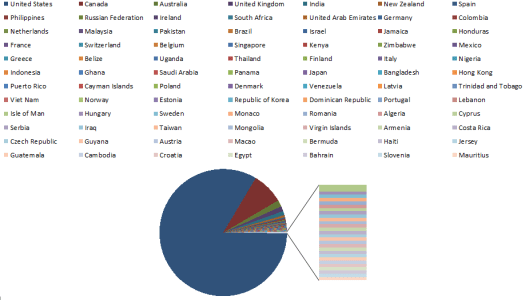
Where in the world is CooperMann viewed?

CMC2012-countries

buildingup-small-logoWhat’s coming up for 2013?  Keep watching CooperMann.com and BuildingUP.biz to stay on top of current issues and trends in accounting and business technology.

Business Owners to Accountants – Tell Me in Real Time

Business Owners to Accountants – Tell Me in Real Time

Business accounting is defined as the system of recording and summarizing business and financial transactions and analyzing, verifying, and reporting the results.  It sounds pretty dull, and to most small business owners it is the last thing they want to think about.  “Accounting” is what happens at the end of the month, quarter or year – or when any type of taxes are due.  What matters to the small business owner is their cash flow and cash availability to meet immediate operational demands, and how they will get past today’s problems to reach their future goal of comfortable retirement, leaving a legacy for the kids, or selling the business at a high value.  It may even be that, during periodic visits to deliver the monthly paperwork to the accountant, business owners express interest in discussing their ability to meet future business goals, yet these conversations often take a back-burner to simply getting the work processed and reports and returns completed.

Accounting has traditionally been approached as an after-the-fact activity, recording transactions for things that were already done in the business.  While this may be a handy approach to getting an annual tax return completed, it really does nothing for the small business owner in terms of providing them with information to run the business. Further, it does nothing toward helping the business owner get to where they want to go with the business, reaching whatever goals they had in mind when they first got started.

Cloud solutions and Internet-based applications have emerged which provide a high level of capability and information to small business owners, much like the E*Trade tools which enabled any user to “take control of their financial futures by providing the products, tools and services they need to meet their near- and long-term investing goals”.  Where E*Trade delivered simplicity, insight, and guidance for investors in real-time, so do many of the new business analysis and financial dashboard solutions, but in a business financial context.

Individuals who are focused on meeting their financial or investment goals are very interested in monitoring their progress toward reaching those goals, and guidance often suggests that making adjustments in strategy or approach at certain points along the way may be required.  Similarly, business owners have a great interest in monitoring the progress and status of their businesses, and many are taking steps to gain that insight and obtain guidance through the use of online banking solutions and other real-time reporting tools.

By simply connecting financial systems to some of these online reporting tools, business owners are able to gain a significant level of insight into their business operations, including bank balances, cash coming in and going out, and other information which supports making daily business decisions.  Unlike a static financial statement or annual report, these dynamic tools can provide business owners with real-time information about their businesses, which is what the business owner is looking for.  But guess what?  It’s not happening like it ought to.

Business owners are becoming increasingly impatient with their accounting professionals, and are demanding higher levels of service at more competitive rates than ever.  Further, many business clients of accounting professionals are gaining a belief that the value their accountant delivers is diminishing as do-it-yourself tools are gaining in popularity due to ease of use and well-stated value propositions.  If accounting professionals would only take a proactive, rather than a reactive, approach to working with their clients, this question of value would be much less of a question.

The biggest problem facing these accounting professionals is that they rely upon the client to deliver the work.  Waiting around for clients to bring in information for processing, or traveling around to client offices to pick up materials when they say it’s ready, is creating a divide between the client and the accountant which is difficult to overcome.  This divide – the lag in time between when business things happen and when they are accounted for – eliminates any possibility for the business owner to operate with all the information they need.

Accounting professionals must become proactive in their relationships with business clients, establishing the initial groundwork for how each will perform in order to achieve the desired result – real-time information for real time decision support.  The accountant has a responsibility to not only ensure that the information is processed appropriately and accurately, but also to ensure that it is obtained and processed in a regular, timely manner.  Increasing the frequency of capturing and processing data is necessary in order to provide information when it is most useful.  This means that accountants must not only organize their workflows to adjust to the new frequency and timeframe for processing, but that they must also be far more proactive in obtaining the source information from clients on a regular and recurring basis.

It has always been a problem to get information from client businesses so that it can be processed and reported on.  Now, with the demand for more timely data and “instant insight”, business owners are expecting faster returns on the processing of accounting information even as they continue to be the bottleneck in providing the source data.  Accounting professionals and the tools they use will have to adjust to this reality, creating a stronger focus on the organization of work and turning notification and exception handling processes around so that they drive the workflow rather than simply result from it.

Make Sense?

J

The True Cost of the Cloud

The True Cost of the Cloud

Excerpt from article on Intuit Accountants News Central: The True Cost of the Cloud

“Accounting professionals are strongly encouraged to adopt cloud computing models in their practices, and there can be little argument that mobility and access are driving the need. In concert with the messages supporting mobile access to business information – and the value of anytime, anywhere access – cloud service providers are strongly suggesting that the overall cost of purchasing and maintaining information technology (IT) in the business is much lower when a cloud computing approach is used.

Arguments over the total cost of IT and related services become somewhat subjective. Many business owners and managers fail to consider the value of their own time spent dealing with business technology issues, much less the time spent by in-house employees and remote workers. To further complicate the issue, dramatic changes in process support and delivery, connected service and cloud computing approaches are impacting business productivity and profitability in new and dramatic ways. As a result, every business should consider the costs and the benefits of this new connected and collaborative working model.

At the core, cloud computing is really just an outsourced IT service that addresses the various levels of application and computing infrastructure. From IaaS (infrastructure as a service) to SaaS (software as a service) and all things in between, a viable cloud computing approach for a business may encompass little more than co-location of physical server and network resources with a third-infrastructure provider to something much larger scale, such as offloading virtually every aspect of application management and delivery to a SaaS solution.

Because there is no single, correct definition of what makes up a “cloud” service model, attempting to compare costs directly to a more traditional IT approach is quite complicated.”

Read the entire article at Intuit Accountants News Central

http://blog.accountants.intuit.com/ways-to-grow-your-business/the-true-cost-of-the-cloud/