The CPA for Small Business: Proactive, Responsive, and Helps Paint a Beautiful Picture

chartI once read an article written by Doug Sleeter which describing the findings of a published report titled What SMBs Want from Their CPA.  The report was a summary of results from a study conducted by The Sleeter Group, and was intended to help accounting professionals understand the factors in the market which influence business use of professional accounting services.  While adoption and use of technology was not named as the top item on the list, capabilities which can be rendered only if such adoption occurs were.  In short, it’s not the technology that clients demand, but the level of service that professionals can only deliver by embracing advancements in technology and applying them to the client engagement.

The report and article placed a specific focus on trends relating to technology adoption and use in the professional practice, and establishes a foundation for firms to understand why technology is and always has been a key factor in the success of the CPA-client relationship.  It’s not that the accounting professional must become a skilled technologist and promote high technology to the client.  Rather, the success factor rests with the firm’s motivation to implement technologies and tools which will improve their ability to deliver more (and more valuable) service to the client in a more direct and timely manner.

The survey’s two critical questions posed to small business owners who use the services of a CPA were 1. What factors played a role in your decision to leave your former CPA?, and 2. What types of services would you like to receive from your CPA?   Both questions are pretty straightforward, and the top responses from surveyed SMBs were equally unambiguous.

To the first question (factors playing into a decision to leave former CPA), the top two answers indicated that reactive and/or unresponsive are the problems which ultimately cause a small business owner to change accounting professionals.  The top response was “Former CPA didn’t give proactive advice, only reactive”.  The close second response was “Former CPA had poor responsiveness”.

Unfortunately, these responses more than accurately describe many professional firms and their approach to client service.  These firms are perfectly content with waiting for clients to deliver after-the-fact information, delivering reports long after their relevance has past, and providing no sense of urgency in helping clients address business issues facing them here and now.  These firms are content to work with their write-up and trial balance solutions, depreciation and amortization and tax products – and give little consideration to how they could adjust their operation to a better, more relevant and rapid delivery of service and insight to the client.

The second question, “What services do SMBs want from their CPAs?”, was met with the same responses professionals have been hearing for years; small business owners need help with business planning and business strategy and they wish the help would come from their CPA.   It is surprising how many accounting professionals list business planning and strategy among the services they promote on their websites, and then just sit back and wait for clients to ask.  Communication with clients remains relegated to annual reminders for tax information, or maybe slightly more frequent notes about other tax or compliance work to be done.  It may be a bit unfair to place all the blame on the professional.  Regulatory and reporting impacts on business are increasing and are increasingly complicated.  Many professionals find it challenging enough simply to keep up with changes relating to the services they currently and regularly provide.

This is where practitioners should seriously take notice, and accept that the ability to meet changing market and customer demands is by intelligently leveraging technology to accomplish what people and process cannot do alone.

  • It takes information technology to speed up the bookkeeping, accounting and reporting processes; technology is required to help turn information into useful and relevant data;
  • technology facilitates the faster collection of information from and the delivery of information to clients;
  • technology is applied to reflecting numbers as pictures and helping users visualize the meaning of the data, and
  • technology enables the collection and analysis of “big data”, which leads to AI advancements and greater intelligence delivered through the applications businesses use.

The Sleeter Group report clearly demonstrated that small business owners continue to need and want more than just tax returns and post-facto reports from their accounting professionals, and that the lack of attention in these areas pose a direct threat to the small business/CPA relationship.  Professionals can remove the threat by working closer with their small business clients, applying technology and process controls to get better information in a more timely manner, and returning the result with greater insight.  Be proactive and be responsive, and apply the necessary technologies and business philosophy to get there before the client base looks for satisfaction elsewhere.

I’ve said before that small business owners don’t care about the numbers, they care about the picture the numbers paint, and they care about getting to a place where the picture is absolutely beautiful.  With the right tools in place, their CPA can help guide them there.

jmbunnyfeetMake Sense?

J

Just Getting Started: App Hosting for Small Business

Just Getting Started: Application Hosting for Small Business

acoustic couplerAccessing software applications and data from a remote system isn’t new stuff.  Starting with telephone modems, acoustic couplers (those things you’d put the phone handset into so that the modem could “hear” the data), green screen ASCII terminals and host computers, users have connected to remote systems to access applications and manipulate stored data for years.  As personal computers became viable for business use, applications and data moved from centralized hosts to local computer environments.

As complexity of local environments rises and broadband becomes truly affordable and accessible, application and data management services are moving back to the centralized system approach.  It’s an expand and contract model, where new capabilities empower the endpoint (the user device) and complexity and scale economies drive centralization of resources and management.  Computing paradigms have once again reached the point where centralization of resources, along with the management and administration of the resource, makes sense for even the smallest of business organizations.  This is the new push for small business IT service delivery, and we’re just getting started.

Application Service Providers (ASPs) were once thought to be the providers who would tip the scales towards server-based computing in the new era.  Rather than creating wide-spread adoption of hosted applications and “virtual” desktops, the ASP business model fell by the wayside as part of the dot-com bust.  It was the right idea, but the market wasn’t ready to accept it and promises of the demise of the desktop turned into the demise of the ASP.

With the successful introduction of SaaS solutions and web-based applications, interest in subscription based IT models has not only grown, but becomes the specific focus of the entire IT industry.  From OEMs to channel resellers, the supply chain for IT products and services is adopting cloud and subscription-based service and business models.  What’s interesting about this second go-around with Internet-based desktop and application services is that the adoption levels are real, the revenue potential is real, and customers are seeking out these solutions rather than being sold.  Managed applications and hosted virtual desktops have become accepted, if not preferred, models for delivering IT services to businesses.

Small businesses can benefit from enterprise-class technologies when a certain economy of scale is developed, and if the environment delivers services around the software and functionality those businesses already need and use.  Logic dictates that Intuit QuickBooks desktop products might be a focus for hosting service providers, as the solution is easily the most accepted financial application by small businesses.  Businesses don’t readily change their financial and accounting software, so addressing this need is a key aspect of adoption.  Also, with QuickBooks, it is as likely as not that the business has an outside accountant who will, at some point, need access to the application and data. Meeting this need and proving the viability of hosting applications such as QuickBooks – offering the solution in the form of subscription service to the customer – has been accomplished through many years of discovery and validation by some of the providers in what is now the Intuit Authorized Host for QuickBooks program.

With the validation of the service model and Intuit’s introduction of an Authorized Host for QuickBooks program, a great deal of opportunity has been created for value added resellers and their small business customers.  Some in the industry would suggest that Intuit’s focus on the Online edition of the product indicates that opportunities around selling or hosting the desktop products have diminished, and Intuit appears to be spending heftily on the promotion of QuickBooks Online.   Yet it remains true that many customers – whether they be existing QuickBooks desktop customers or new QuickBooks customers – want the functionality and the integrations available only with the desktop editions.

For these customers, a hosted/managed application service model is the only answer.  IT resellers working with small business customers are undoubtedly getting the requests, and a few are beginning to recognize the value and service potential associated with offering hosted application services for QuickBooks and other popular small business software products.

As the largest of software vendors (like Microsoft, Intuit, etc.) with small business solutions make their licensing models available to hosting providers, resellers and hosts alike can take advantage these programs and offer their customers the benefits of mobility and managed service around the applications already in use.  Business owners like the benefits to be gained by adopting cloud computing models, but are resistant to changing their software and restructuring their processes.  It is the ability to deliver the benefit without the disruption that makes these application hosting service models attractive.

There are millions of QuickBooks desktop users out there, and only a small fraction are being hosted by authorized providers.  Intuit continues to sell the desktop solutions and the number of QuickBooks users isn’t in decline, so the opportunity to serve those QuickBooks customers continues to grow.  When it comes to providing application hosting services for small businesses, we really are just getting started.

jmbunnyfeetMake Sense?

J

Go Ahead and Shoot the Server: End of Microsoft Small Business Server Inspires Cloud Adoption with Small Businesses

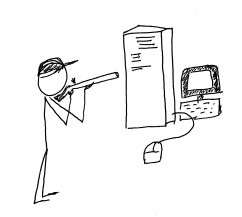
shoot_the_serverMicrosoft has made a decision to include more “cloud” capability in its offerings for small business, ending the life of the successful Small Business Server line and replacing it within the Windows Server 2012 family.  Some businesses are continuing with locally installed servers and are upgrading to Windows 2012 Essentials (or other editions) for in-house use, but more businesses every day are electing to deploy their servers and systems in the cloud instead.

Back when Microsoft introduced the Small Business Server, small business owners found that it was now really easy to implement way more technology in the business than they could directly support.  In one happy little package the SMB could get Windows Server, Exchange, SQL, SharePoint, Remote Web Access, an internal Company Website and more.  Information technology service companies, on the other hand, found it to be a big driver for delivering equipment and services to small business customers, and the product line’s adoption and implementation numbers grew.  Even the smallest of businesses could enjoy enterprise-class email, file and document sharing, client-server applications and remote access for a (relatively) affordable price.  It was this type of offering which created opportunity for server virtualization technologies to be used in small business, as the various server types each benefitted from their own “sandbox”, and IT providers recognized another opportunity to leverage their expertise at the customer location.

Business use of technology continues to expand rapidly so it makes sense that the Small Business Server offering from Microsoft is pretty popular.  In fact, Foresitetech.com says in an article on the subject that “The overwhelming majority of small businesses (80%) with less than 75 employees use Microsoft’s Small Business Server (SBS) software.”

But this fast-paced world of technology continues to move along, and Microsoft has ended the life of the SBS 2011 product.  In its place, small business customers are encouraged to upgrade to one of the editions of Windows Server 2012 as a replacement for their beloved SBS and hopefully they can find an edition which (affordably) delivers the functionality and features the business has come to rely on.  Unfortunately, there isn’t an edition of Windows Server 2012 that offers quite what SBS did, so now there is a big buying decision for the customer.  As the Clash sang it: “do I stay or do I go?”

Microsoft’s elimination of the feature-rich and friendly-sounding Small Business Server has created a lot of opportunity for VARs and IT service providers to move their customers to cloud services, SaaS solutions and hosted environments.  Particularly as information technology continues to become more complex, small businesses (well, businesses of all sizes) are recognizing that they may be better off focusing on running the business operation and managing the company as opposed to spending a lot of focus on IT system purchasing, installation, administration and management.  They have come to understand that IT services are critical to the business, but the server doesn’t have to be under the front desk or in a back closet in order to function for the business.  There is simply too much evidence in the market for these business owners to ignore;  shooting the server is now a viable option.

Every day more business owners are being inspired to [shoot their servers] seek out the services that will allow them to continue to benefit from innovations in technology while relieving them of the direct responsibilities of equipment purchasing, implementation, administration and lifecycle management.  Cloud services deliver this capability, and channel partners and Value Added Resellers should recognize their opportunity to get inspired as well, and to start offering cloud-based and hosted services to their customers and capture the “buying decision” opportunity that Microsoft has created.

Ready. Aim. Fire.

jmbunnyfeetMake Sense?

J

Why #Accountants Should Implement #Cloud Services | QuickBooks and Beyond

Why Accountants Should Implement Cloud Services

Most professional accounting service providers, accounting pros included, are recognizing that customers are increasingly demanding lower costs for service but want more flexible methods for obtaining the service. Where the business value of the service provided used to be enough, providers are now expected to deliver their services how and when clients want them delivered.

Evidence of the mobile and social impacts of technology is visible everywhere, and no business is immune to the requirement to adapt or perish. Rather than viewing the shift in technology application and use as a threat to previous well-rehearsed process models, wise practitioners are finding opportunity to change things around a bit, facilitating workflow and process improvements and creating new opportunities where they didn’t previously exist.

Breaking Down Time and Distance Barriers

via Why Accountants Should Implement Cloud Services | QuickBooks and Beyond.

Small #NonProfits, Crummy Computers and the #Cloud

Small NonProfits, Crummy Computers and the Cloud

There are many benefits included in the “value proposition” for cloud computing models, but there are some hidden gems in terms of how these outsourced IT models can specifically and directly address one of the biggest problems facing many smaller nonprofit organizations: they have to use old, outdated, and often just pretty crummy equipment. But now it’s OK, because even crummy old PCs can work just fine when the applications are hosted in the cloud.

picture-pcSmall nonprofit organizations often rely exclusively on donations to keep the business running.  Donations don’t always come in the form of dollars; sometimes donations include used computer equipment.  For many nonprofits, using donated equipment is the only option they have due to various budgeting constraints, and nonprofits need computers just as badly as any other business. Not only do these underfunded businesses have to try to operate with what most users would consider to be sub-par equipment, they frequently operate their systems and networks without the aid of skilled or experienced technicians.  For a small nonprofit organization, keeping up with business is tough when the computers and software aren’t able to fully meet the need.

To complicate things even more, many people working in smaller nonprofit organizations are mobile workers – functioning either as part-time participants or users who simply need to work from a variety of possible locations.  And they almost always have to use their own mobile devices.  Supporting a remote or mobile workforce is particularly challenging when even the most basic of computing requirements are barely met, so addressing the variables of everyone having their own mobile devices and remote computers is frightful at best.

With the introduction of cloud computing, affordable broadband access, and value-priced application hosting services, small nonprofit organizations finally have a workable answer.  Working with an application hosting provider, the business can move applications and data to outsourced infrastructure, where the solution is effectively delivered back in the form of a subscription service.

Accessing applications and data on central servers, and using those applications from a “virtual” or hosted desktop, can allow these small businesses to use current versions of business applications without having to purchase the powerful desktop or portable computers necessary to run them.  The applications run from the host’s servers, reducing the local PC’s involvement to handling the display, keyboard and mouse inputs, and printer outputs.  Even older computers which would be incapable of running current versions of applications like Microsoft Office or QuickBooks are generally able to access and run those applications from the cloud.

Predicting costs of operations is essential for any business but is crucial for the nonprofit.  Budgeting around a limited financial resource, small nonprofits are hard hit when unplanned failures in computer systems occur.  In many cases, there simply isn’t room in the budget to recover from these events, and productivity and performance suffers because of it.

Approaching IT services from an outsourced perspective, these small businesses can build a significant level of predictability into their business technology costs – and get higher levels of fault tolerance and disaster recovery capability along with it.  The hosting service is responsible for maintaining the operating environment, securing the systems, backing up the data, and keeping things running.  The costs associated with server hardware failures, and even regular server and system maintenance, are covered in the subscription service.  This means that unexpected break/fix, update and maintenance costs are no longer of concern.

Every small business, not just the nonprofit, should explore the options available to them with cloud and application hosting services.  Performance within any organization depends on the systems and tools available to get work done.  Owning the problem of managing and maintaining the information technology platforms and systems makes little sense these days; better to outsource the problems to a professional service provider.  Not only can this type of service introduce predictable costs for business IT services, it makes working with crummy old donated equipment a workable situation.

Joanie Mann Bunny FeetMake Sense?

J

Why Accounting in the Cloud?

Why Accounting in the Cloud?

Business owners and managers need to keep close control of their financial data.  They need to know where they stand at all times, and having information available to make business decisions is essential.  When the financial information is in the office but the owner isn’t, how can wise decisions be made without access to supporting data?  They can’t, and that’s a problem.  The solution is simple: work in the cloud.

A cloud computing model properly applied to accounting and bookkeeping systems helps businesses of any size keep their financial data and accounting applications in a safe a secure environment, yet accessible to those who need it.  By locating the business applications and data in a protected central location, access to programs and data sets can be provided to authorized users regardless of location or computing platform.  For a small business owner, this means that working from home or on vacation can be as productive as working in the office.  In larger businesses, cloud-based accounting means the accounting department, CFO and financial advisers might all access the same financial records and applications no matter where they work from.

Cloud computing and hosted application models applied to accounting and bookkeeping represent a viable option for managing, securing and providing access to critical financial information.  Businesses outsourcing their accounting or bookkeeping work find that cloud based approaches offer workflow and process efficiencies to help get the necessary information in the hands of those who need it, quickly and efficiently.

Keeping accounting and bookkeeping systems safe yet available, providing business decision makers with the flexibility of accessing their financial data from anywhere and at any time is a highly valuable service. Accounting and finance professionals can act as the trusted adviser to their clients, providing important business insight and information, with guidance in developing cloud computing and online accounting approaches being among the benefits the firm offers.   Working closer with clients allows professionals to produce better, more accurate and insightful results.   Cloud computing models remove distance barriers and allow professionals and their clients to work more collaboratively with applications and data than ever before.

Many firms are just recently discovering the relationship between technology adoption and business competitiveness.  Those that embrace new computing paradigms gain the ability to meet client requirements in innovative, efficient and timely ways while those that do not adopt these new models continue to struggle, unable to communicate value and differentiation in their service offerings.

There are some recognized truths in business, and one is that is isn’t what you know but who you know.  Another truth, an understanding that is just now being fully recognized, is that it’s not what you do, but how you do it that matters.  Accounting and bookkeeping for business is absolutely an area where cloud computing and the wise application of technology and service can improve cost efficiency, accuracy and turnaround times, allowing the firm to provide a higher level of service to clients.  Accounting in the cloud is a technology-enabled approach which propels the firm into an entirely new range of capabilities and potential service offerings, reaching higher levels of performance and profitability.

Joanie Mann Bunny FeetMake Sense?

J