Write it Once – The Value of Integration

It’s amazing how much time and energy continues to be spent on duplicate data entry and re-keying information generated by one system into another.  Human-based data entry is prone to errors, takes time, and carries with it the burdens of employee costs and resources.  It is a problem that businesses of all types have battled for years even though enabling solutions have been around for a while. 

Methods of integrating applications and data have existed for quite some time, and in recent years these methods have expanded to include a wide variety of platforms and more open standards-based approaches.  Even in the small business world, business owners using traditionally limited software products can enjoy sophisticated extensions and integration of their applications and business data.

To provide a simple example of the problem: when an individual writes a check, that check must be recorded for several purposes including the recording of the cost or expense as well as the reduction of funds in the bank account.  When a product is sold to a customer, inventory is relieved, sales are increased, accounts receivable or cash is increased, costs of goods sold are experienced, and customer activity is captured.  All of this information must be recorded, and the activity accounted for throughout the financial and operational systems and can represent a tremendous burden if not automated. This also means that data exists in a variety of places, increasing the challenges of information collecting and reporting.

 Cloud-based integration and infrastructure services such as DBSync and Microsoft Azure enable seamless collection, transformation, aggregation and storage of business data. Whether linking accounting with sales CRM or pushing financial and operational data to an Azure data warehouse for analytics, Noobeh and DBSync provide the data engine and the infrastructure to put it all together.

A small business owner’s situation offers a direct illustration. He sells computer parts through an ecommerce website.  Orders from this website are emailed to his order operators, who then turn around and re-key the orders into their accounting system where the inventory is also tracked.  Because of the increasing number of sales orders and product purchase orders to enter on a regular basis, there were three operators working in the department responsible for making sure website orders make it into the accounting system. Orders were frequently missed or misplaced, entry errors caused problems in accounting and product delivery, customer satisfaction went down, and the cost of handling web orders was increasing.

By implementing a single software solution, the company was able to not just address the current problem, but was set up to seamlessly increase business without increasing headcount. The solution was a system which takes transaction data from the ecommerce system and imports it into the accounting/ERP system. This single step allowed the business to reduce and redirect personnel costs, improve accuracy and timeliness of data entry, and increase customer satisfaction as well as overall business performance.

In even a small company, one piece of information may be used in a variety of ways and in a variety of systems. This complexity is found in simple business models as well as larger and more complex enterprises, revealing the value of integration solutions and automation tools at every level of operation.

Mendelson Consulting and Noobeh cloud services recognize that every business needs the right information at the right time to operate effectively. Our expert teams help businesses implement the solutions which bring business data together, empowering workers to be more productive and giving stakeholders the decision-support tools they need.

jm bunny feetMake Sense?

J

Cloud and Digital are Transforming Business

Businesses, whether small or large, must change how they operate. They need to find ways to leverage the technologies and influences shaping society. Transformation is essential for companies to face today’s rapidly changing environment and embrace the opportunities it provides. This means mapping out a strategy and prioritizing activities which will fundamentally shift the operation towards greater intelligence and agility.

Digital transformation is about changing how businesses operate at a foundational level. It involves transforming processes and capabilities. This is done to leverage digital technologies across all strata of the business. 

Change in business is an ongoing process and not a one-time activity.

Transformational change is enabled in large part by cloud technologies. Cloud computing solutions are in high demand. They allow businesses to scale easily and affordably. They also provide the mobility and remote access that workers require. 

More fundamentally, cloud computing services improve collaboration by users. They also enhance collaboration by applications. This improvement enables seamless integration of functionality and data from various sources.

Microsoft Azure platform provides infrastructure and services previously available only to larger businesses and enterprise IT departments. Noobeh, Mendelson’s cloud services team, uses Microsoft Azure to deliver SQL data warehouses for structured data. It provides data lakes for the storage of unstructured and different data types. The Azure Data Factory and Microsoft Fabric are used to transport, transform, and weave it all together.

Converged wired and wireless networks and smarter telephony solutions deliver location and usage data that were not previously available to most IT departments. Today’s imaging technology can easily reduce a picture to searchable and identifiable metadata. The introduction of IoT brings an even further integration of data from virtual and physical realms. This enhances potentials for intelligence. It also improves understanding and interaction.

Mendelson Consulting recognizes that true transformation is guided by the vision and objective but is supported through operational efforts.

The collection of data for inspection and analysis is the first requirement. Only through the proper establishment of processes and workflow is the required information developed.

Mendelson Consulting partners with businesses to define the scope and strategy for advancing into the digital future. They take fundamental steps to introduce greater agility in platforms and services. These platforms and services support an ever-changing business environment. They also ensure visibility, which drives greater business intelligence and operational insight.

jm bunny feetMake Sense?

J

Are You Prepared for SQL Server 2008 End of Support?


Everything gets old eventually, and now it is official for SQL Server 2008.

03-2012sean-phone-328-e1377042261105On July 9, 2019, support for SQL Server 2008 and 2008 R2 will end. That means the end of regular security updates and general support for the product. Are you ready?

It took more than 10 years for Microsoft to end support for our beloved SQL 2005 and version 2008 has enjoyed a similarly long reign. But it’s over and you need to get used to the idea. Even more, you need to get upgraded to a new version of SQL so your systems can still be patched, updated and supported. With all the nasty exploits out there, letting your software get out of date is more of a business risk than ever.

With cyberattacks becoming more sophisticated and frequent, running apps and data on unsupported versions can create significant security and compliance risks. The 2008 family of products was great for its time, but we highly recommend upgrading to the most current versions for better performance, efficiency, and regular security updates.

Now is a Good Time to Consider Azure

Microsoft is giving a present to businesses that want to migrate their workloads to Azure. For those customers that elect to take this as an opportunity to move to the Azure cloud, extended security updates will be available for free in Azure for 2008 and 2008 R2 versions of SQL Server and Windows Server to help secure workloads for three more years after the end of support deadline. Moving existing systems to the Azure cloud is a natural step in modernizing the business infrastructure and makes the next step of upgrading to managed database services and/or migrating to new Azure servers a lot easier.

Upgrading isn’t simply a matter of maintaining status quo, either.

Moving to new versions can be a foundation for new strategic capability and increasing overall business potential, powering new decision-making processes fueled by analytics and business intelligence.

The Microsoft Lifecycle Policy offers 10 years of support (5 years of regular support and another 5 years of extended support) for the 2008 and 2008 R2 versions of SQL Server and Windows Server. When the extended support period ends, there will be no patches or security updates, which always creates security risk.

If your business is going to remain competitive, you can’t rely on outdated systems.

Your business is tough enough to manage without having your systems work against you.  Software that prevents you from keeping up with demand, creates risk in compliance and security, and reduces operational performance is not what you need. Collecting, storing and rationalizing data takes power and speed, and securing your growing information warehouse requires vigilance in security and update management.

Use this opportunity to review your platforms and applications, and consider moving your on-premises or co-located systems to the cloud. The upcoming milestone is a great opportunity to transform applications and infrastructure to take advantage of cloud computing and the latest versions of SQL Server and Windows Server.

jmbunnyfeetMake Sense?

J

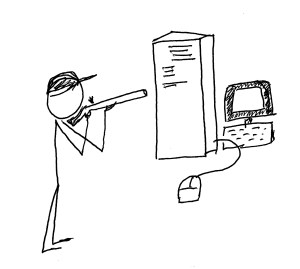
Go Ahead and Shoot the Server: End of Microsoft Small Business Server Inspires Cloud Adoption with Small Businesses

shoot_the_serverMicrosoft has made a decision to include more “cloud” capability in its offerings for small business, ending the life of the successful Small Business Server line and replacing it within the Windows Server 2012 family.  Some businesses are continuing with locally installed servers and are upgrading to Windows 2012 Essentials (or other editions) for in-house use, but more businesses every day are electing to deploy their servers and systems in the cloud instead.

Back when Microsoft introduced the Small Business Server, small business owners found that it was now really easy to implement way more technology in the business than they could directly support.  In one happy little package the SMB could get Windows Server, Exchange, SQL, SharePoint, Remote Web Access, an internal Company Website and more.  Information technology service companies, on the other hand, found it to be a big driver for delivering equipment and services to small business customers, and the product line’s adoption and implementation numbers grew.  Even the smallest of businesses could enjoy enterprise-class email, file and document sharing, client-server applications and remote access for a (relatively) affordable price.  It was this type of offering which created opportunity for server virtualization technologies to be used in small business, as the various server types each benefitted from their own “sandbox”, and IT providers recognized another opportunity to leverage their expertise at the customer location.

Business use of technology continues to expand rapidly so it makes sense that the Small Business Server offering from Microsoft is pretty popular.  In fact, Foresitetech.com says in an article on the subject that “The overwhelming majority of small businesses (80%) with less than 75 employees use Microsoft’s Small Business Server (SBS) software.”

But this fast-paced world of technology continues to move along, and Microsoft has ended the life of the SBS 2011 product.  In its place, small business customers are encouraged to upgrade to one of the editions of Windows Server 2012 as a replacement for their beloved SBS and hopefully they can find an edition which (affordably) delivers the functionality and features the business has come to rely on.  Unfortunately, there isn’t an edition of Windows Server 2012 that offers quite what SBS did, so now there is a big buying decision for the customer.  As the Clash sang it: “do I stay or do I go?”

Microsoft’s elimination of the feature-rich and friendly-sounding Small Business Server has created a lot of opportunity for VARs and IT service providers to move their customers to cloud services, SaaS solutions and hosted environments.  Particularly as information technology continues to become more complex, small businesses (well, businesses of all sizes) are recognizing that they may be better off focusing on running the business operation and managing the company as opposed to spending a lot of focus on IT system purchasing, installation, administration and management.  They have come to understand that IT services are critical to the business, but the server doesn’t have to be under the front desk or in a back closet in order to function for the business.  There is simply too much evidence in the market for these business owners to ignore;  shooting the server is now a viable option.

Every day more business owners are being inspired to [shoot their servers] seek out the services that will allow them to continue to benefit from innovations in technology while relieving them of the direct responsibilities of equipment purchasing, implementation, administration and lifecycle management.  Cloud services deliver this capability, and channel partners and Value Added Resellers should recognize their opportunity to get inspired as well, and to start offering cloud-based and hosted services to their customers and capture the “buying decision” opportunity that Microsoft has created.

Ready. Aim. Fire.

jmbunnyfeetMake Sense?

J