Preparing Your Business for Exploding Growth

Preparing for exploding growth in a business requires careful planning and strategic decision-making. To develop the information necessary to support these activities, businesses must implement their processes and systems to properly collect the data required. Unfortunately, many organizations fail to develop the systems which will support increased activity and business growth, only recognizing after the fact that the process support and the data they need isn’t there. To prevent being caught off guard with more business demand and not enough organization to support it, follow these recommendations to set the business up for success over the long run.

Set clear goals and adjust as required. You need to know what the business purpose is… the objective you hope to achieve with all this activity. Establish SMART goals – specific, measurable, achievable, relevant, and time-bound. With a set of smart goals and a well-defined objective, the business has a clear direction and a guide to assist in decision-making.

Build infrastructure that is scalable. If the business infrastructure can’t handle increased demand, the business can’t grow effectively. Scalable information technology and software systems, robust production capabilities with adequate human resource availability, and increased efficiency in supply chains will help the business meet increasing demand, while improved reporting and business intelligence helps to anticipate potential bottlenecks, allowing for plans to be developed to address them.

Make sure finance and accounting are set for growth. Strengthen overall financial management and review your financial processes to ensure they can accommodate growth. Implementing the right systems and software is necessary to not just optimize production and operations, but to provide a foundation for establishing sound accounting and financial practices which will help the business secure funding and manage cash flow effectively. A good way to evaluate your preparedness for growth is to prepare financial forecasts and stress tests to gauge your business’s financial resilience under various growth scenarios.

Streamline operations and automate where it makes sense. Evaluation of businesses processes is an ongoing task if your business is to continuously work to improve efficiency and effectiveness. Where opportunities for optimization and improvement exist, consider using automation and technology solutions to help streamline operations and reduce manual effort while remaining focused on enhancing customer experience and satisfaction through streamlined processes and improved service delivery.

Plan for Risk and Contingencies. You should try to identify potential risks and challenges associated with rapid growth, such as increased competition, supply chain disruptions, or changes in customer preferences. Develop contingency plans to mitigate these risks and ensure continuity of the business and operation. It may even make sense to consider diversifying your revenue streams to reduce dependency on a single market or product.

Monitor, adjust and adapt as needed. Key performance indicators (KPIs) should be regularly monitored, as should market trends, to stay informed about your business’s progress and to stay on top of industry developments. Use data analytics and reporting tools to gain insights and make data-driven decisions instead of operating on emotion. The business that plans for growth must remain agile and adaptable, adjusting strategies and operations as needed to accommodate changes in demand as they occur.

Preparation for rapid growth requires a proactive approach and continuous evaluation of your business’s readiness. Regularly reassess your strategies, make necessary adjustments, and stay focused on delivering value to customers as you scale.

Mendelson Consulting and the Noobeh cloud services teams are advisors and consultants with expertise in scaling businesses, and can provide valuable insights, guidance, and support throughout the growth process and beyond.

jm bunny feetMake Sense?

J

Good and Proper Accounting for Small Business

There are many reasons why a small business needs to have quality accounting, and it isn’t just about the cash. Especially when a business is small or growing, a strong financial management and reporting process will benefit the business in a number of important ways. Managing the cashflow and keeping money in the bank to cover payroll and inventory is critical, but good accounting data helps support better decision-making for more than just cash management.

Accounting and financial systems help small businesses keep track of their financial performance. This includes monitoring income and expenses (money in and money out) and creating financial statements. By having accurate and up-to-date financial information, small businesses can make informed decisions about how to allocate resources and grow the business.

Tax compliance is another area where good accounting data is essential. Small businesses are required to file taxes just like larger ones, and proper recordkeeping helps small businesses stay compliant with tax laws and regulations and to avoid penalties and fines.
Securing funding for operations and growth is another area where quality accounting data is critical. Banks and investors usually require financial statements and other financial information before providing any funding. By having accurate and well-organized financial records, small businesses can demonstrate their financial health and increase their chances of securing funding.

Knowing more about the business is always helpful, but being able to look at trends and understand what the numbers indicate is the real power. From budgeting and forecasting to identifying and reducing areas of risk, accounting data is the foundation for developing a true understanding of business activity and performance and finding ways to improve.

Track business performance, remain compliant with taxes, and get funding or investment when it’s needed. With good and proper accounting supporting management decisions, decisions become more informed and relevant and are likely to bring a better result.

jm bunny feetMake Sense?

J

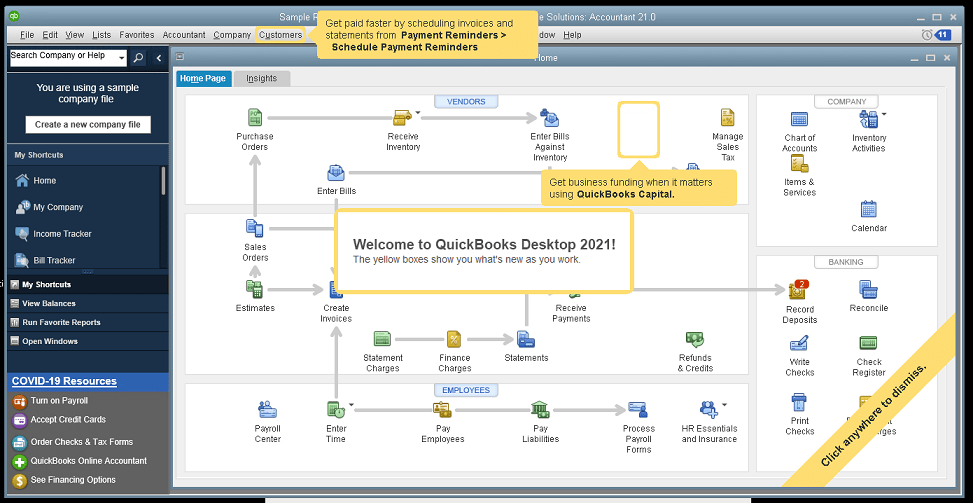
QuickBooks Desktop 2021: Getting Paid Faster, Being More Efficient, and Improving Data Security

The new QuickBooks Desktop 2021 editions have new and improved features that help businesses get paid faster and secure data more effectively, making the software work even better for your company.

Many of the improvements center on automation and workflow, enabling users to get more done with fewer keystrokes and setting up automatic activities so that items don’t have to be handled manually.

Other improvements center on data and information access, allowing admins to get granular with setting user permissions and access to certain types of information, even down to the record.

Intuit has also delivered several enhancements to existing functionality in QuickBooks desktop, especially in the Enterprise edition and where inventory is involved.

Here is a brief summary of the main changes or additions introduced with QuickBooks 2021 editions.

Improved Bank Feeds
Review bank transactions and match them to existing ones in your books or quickly add new transactions using the advanced bank feeds capability. You can automatically categorize or batch-edit bank transactions by payees, accounts and classes. This can dramatically reduce the time and complexity of reconciling entered transactions with the items the bank processes.

Automated Payment Reminders and Statements
Now you can send statements automatically to customers, with each statement tailored to the customer’s needs or preferences. Set automatic reminders for customers when their invoices are due and schedule statements for your customers to let them know when they have invoices they still need to pay you for. Timely communications with customers regarding their invoices and activity is more likely to keep a customer coming back for more. It also reduces the time required to communicate individually with customers, making AR management and collection activities more efficient.

Customized Payment Receipts
Want to send certain customers a customized message on their receipts? You can use custom templates for forms like invoices, sales receipts, estimates, statements, and purchase orders so each form has the right look and information. Then use the new customer groups capability to get the right form for the right customer every time.

PDF preview
It is always a good idea to preview a document before you send it via email, but that wasn’t always a convenient thing to do in QuickBooks. Now QuickBooks lets you automatically preview attachments before emailing them to customers. You can even preview multiple attachments at once without having to manually open each one outside of QuickBooks, saving huge time and effort and smoothing out a previously-clunky workflow.

Receipt Management
Receipt management in QuickBooks desktop is a new feature that makes entering expense receipts easier and faster. You can give users access to upload expense receipts to QuickBooks using the mobile app or directly from your computer. Automate creating categorized receipt expense entries using the QuickBooks Desktop Mobile App, an option available only with the Plus subscriptions (not the one-time purchase option).

Create Customer Groups
Improve customer communication with rule-based customer groups based on fields like customer type, location, or balance. Creating customer groups allows you to find all customers that match certain criteria. Then you can create automated statements, send payment reminders or create mailing lists for specific groups of customers.
In QuickBooks Desktop Enterprise, you can even use customer groups to define permissions and access at customer and vendor group level.

Data Level Permission
Data level permissions is a new feature in QuickBooks Enterprise 21.0 that gives you more control regarding restricting access for users and roles. This makes it so the admin can create users and roles with access permissions all the way down to the record level for customers and vendors.

With data level permissions you can improve security and confidentiality of information by assigning users access only to the specific data, transactions and reports that they are responsible for. Users will only be able view, edit, or delete specific customers, vendors, or data with the permissions you delegate to them.

NOTE: Data level permissions don’t appear to be available in QuickBooks Enterprise Accountant, nor are they available with a Silver or Gold subscription. To get this feature, you have to go Platinum or Diamond, so it’ll cost you.

Add prices to barcode labels
Wouldn’t it be great if you could print barcode labels with pricing information as well as the item name and description? Now you can! Barcode labels help you accurately identify and manage inventory, providing the information most often needed by employees and customers.

Landed cost
Gain more control and flexibility over how you calculate and share landed inventory costs. Set up landed cost accounts as “COGS” (Cost of Goods sold) or “Other current assets”, and accurately calculate landed cost for old item bills from closed accounting periods. You can also print bills with or without landed cost, allowing you to better control the information you present.

Alternate vendor reports
Key inventory reports can now include alternate vendor information, improving visibility into vendor information on inventory stock status by item, inventory valuation summary and other reports. Linking to alternate vendors via these reports simplifies and streamlines the process of reordering from alternate vendors.

QuickBooks desktop software continues to be the cornerstone of small business accounting. From very small business to the growing enterprise, QuickBooks delivers the functionality that every company needs to manage their income and outgo, customers and vendors, and all their banking activities.

Starting with the early 1999 version to the current 2021 release, Intuit has continued to add capability and enhance features and usability to keep QuickBooks as the most popular small business accounting product on the market. Remember the motto “if you can write a check, you can do your own books“? That’s QuickBooks.

jm bunny feetMake Sense?

J

For Accounting Professionals: Private Hosted Solutions and Helping Clients Cope with the New Normal

Accounting professionals have an opportunity right now to help their business clients through the difficulties presented by the COVID-19 pandemic. With work-from-home mandates and increasingly fluid reporting requirements to support grants, loans and loan forgiveness, business owners need all the support and good advice they can get.

The global pandemic is changing the landscape of business worldwide. Many small businesses in the US have either closed or are on the brink, looking for ways to keep the doors open and employees paid. Supply chains are strained, distribution has slowed, and workers are being asked to work from home if possible.

These are challenging times, but the guidance and support you can provide to your business clients can be just what they need to help keep the doors open and workers producing. Remote access, cloud hosted applications and data, and real-time accounting support and management reporting are the weapons you and your clients will use to fight the conditions that are currently working against you both.

Help your clients deploy cloud hosting services for their entire business.

Running applications and storing data on an in-house network increases the cost and complexity of supporting a remote or mobile workforce, for you and for your clients.

Remote access and supporting work from home requires that users have the means to communicate with each other and to collaborate on the work. Tools to support communication and collaboration are critical when the workforce is distributed, operating from a variety of locations and with whatever device is available. Yet business owners, operators and managers may find that collaboration apps and other online tools don’t provide access to the applications and data required to do all their work.

To address the problem of working on client data, some accountants may install the client software and copy the data to their own in-house networks. This creates a situation where the accountant is paying for computing resources, space and management of client applications and data in addition to their own. This increases the cost of internal operations for the accounting firm and can impact internal system performance while also reducing overall productivity.

More to the point, this model only supports doing after-the-fact work for the client, which results in the data and reporting being outdated and far less useful to the client in supporting daily decision-making. This model also does nothing to help the firm with their own possible work-from-home needs even as IT support and on-site service becomes more limited.

Accounting professionals wanting to provide services to clients proactively rather than reactively must have real time access to the same applications and data that the client uses. The old fallback to remote control solutions is one approach, yet it is not really an optimum solution to the problem.

Remote control, like PCAnywhere, GoToMyPC or LogMeIn expose the professional to more of the client computing environment than is necessary, introducing risk and the potential for blame if something goes wrong. And remote-control solutions are single user, reducing productivity because the client can’t use their system while the accountant controls the computer. RC solutions also rely on the availability and function of the on-premises systems. If the on-prem systems aren’t turned on, up and running and accessible, then the remote user can’t connect.

It may be that online or web-based applications are an option, but for many businesses they aren’t really a viable solution. QuickBooks Online is simplified software and is not appropriate or usable for many businesses. The QBO subscription model is per-company, limiting options and reducing cost-efficiency for businesses with multiple entities. And QBO doesn’t address other business needs, such as working with documents and reports, and it can’t provide any access or support for other business applications. Even the ability to backup and preserve data is very limited without specialized services and tools.

Shared hosting service might be closer to the right answer, yet shared hosting is generally only useful for very small organizations and supports only core QuickBooks functions, so it can be as restrictive QBO. Shared infrastructure used by the shared hosting platforms can also introduce significant risk to every business on the platform because ransomware and malware can easily move through connected file systems and servers.

Compare shared services to a public pool where it is very easy to transmit from one person to another; in these networks an intrusion can end up spreading malware to the entire network and platform, resulting in days or even weeks of outages. Unfortunately, disaster recovery is often limited to recovery of the provider hosting platform and does not always include recovery of all customer data.

The best solution for business is private, managed cloud hosting service delivered on a trusted and proven platform like Microsoft Azure.

Hosting service that takes advantage of the Microsoft Azure cloud  platform allows the business to centralize access to all their important applications and data, making it possible to provide complete application functionality for all users no matter where they are located.

Using the Azure platforms means that security, fault tolerance, scalability and agility are designed into the solution rather than being extras from the hosting provider. Microsoft-managed datacenters and Microsoft-managed hardware means the experts in systems and security are handling the big stuff while the service provider focuses on what the client needs.

The virtualization technology enables the agility to meet changing business needs, scaling systems up or down if necessary. Massively scalable platform allows services to be right sized now without concern for future resource requirements (no buying ahead based on possible future needs). There are no arbitrary limitations placed on the applications or services the business needs to run on the cloud platform, and no fees for running more apps.

Making all the applications and data available to workers, when and where they need them, is the key to promoting higher levels of productivity while delivering the data management needs to support daily decision-making.

Now that you have access, provide pro-active support and help business owners and managers make the right decisions.

Better data and reporting to support business and finance management is more important than ever, especially when having the right information can mean the difference between keeping the doors open and closing shop for good. Whether the goal is to shore up finances to keep employees on staff or to create a cushion to help weather supply chain disruptions, businesses owners need quality financial and performance data in order to make the right decisions for the company.

Once the accounting professional has real-time access to client systems, they can work cooperatively in the data to ensure that the right information is available when it is needed. As business owners seek to take advantage of grants and loan programs available due to the pandemic, the financial and other performance data becomes even more essential in terms of developing qualification and eventually forgivability of the loan.

With timely access, proper reporting tools and regular support and oversight, business owners benefit from a closer working relationship with their accounting professionals. The additional support and proactive service is more necessary now than ever. For the accounting pro, an elevated relationship with client is being developed, where the services provided become more meaningful and the value of those services more evident.

Make sense?

J

More Than Expenses: Manage the Purchase Process

For many business owners, just hearing the term “expense management” brings about visions of traveling employees with piles of receipts and vouchers to be organized, accounted and reimbursed for. The images are often fleeting, however – gone out of mind with no lingering thought because these business owners don’t have personnel who travel frequently, and they don’t have to deal with volumes of expense reports from employees. Expense management solutions aren’t anything these business owners are looking for.

Yet, what does happen every day is that equipment, materials, supplies and services are purchased to keep the business operation going. Calls are made to vendors; price quotes are developed, and purchase requests are typed up in Excel spreadsheets and piled on the owner’s desk for approval. The business owner rifles through the various requests and brings in the bookkeeper to help work through the decision of which items to authorize based on current cash availability.

Because the availability of working capital changes frequently with billings being sent out and receipts being deposited daily, the owner and the bookkeeper spend much of their time together figuring out which purchases to make and when. It is a continual and ongoing process, taking a lot of time and attention away from other important business matters.

Too often, thoughts of managing these efforts with more structure addresses only half of the issue – the purchase. Perhaps there are systems for planning for materials requirements and predicting when parts or supplies will be needed, but that is still just one side of the problem. The other side is paying for it. Factoring those purchasing plans into the cash requirements of the business and having a meaningful and effective way to monitor current cash and expected receipts as well as purchase requirements is essential. Resource and materials planning takes purchase planning, and purchase planning takes visibility into receivables, cash flow and cash availability.

Expense and purchase management processes generally involve three main steps: planning, tracking, and reporting.

As the process involves planning, it suggests a proactive rather than a reactive approach to cash management and purchasing activities. By bringing together all the critical data which describes inflows and outflows, the business owner can have the information necessary to not only forecast (plan) cash requirements but to also understand the availability of working capital.

Knowing ahead of time that traditionally slow paying contracts aren’t factored into immediately available cash is important and being able to adjust purchase schedules based on availability of funds is essential.

Where expense management may not be a big part of the business, managing cash flow and purchasing goods and services is, even in the smallest of enterprises. Make sure the business has the tools in place to help bring an additional level of intelligence to purchasing activities, and that those tools deliver the benefits of a structured (but not time consuming) purchasing approvals and proactive cash flow management process.

This aspect of business – expense management and purchasing processes – is an area where accounting professionals can be of great service to their business clients.  Providing high-value solutions that increase cash efficiency and facilitate cash and purchase planning helps the business function even as conditions change.

Make Sense?

J

QuickBooks changes and enhancements for 2020: My 2 Favorite Fixes and Let’s Talk Cloud Hosting

Accounting professionals and small businesses worldwide use QuickBooks software to manage business finances. Launching Basic and Pro versions in 2000 and increasing market share from 74% in 2004 to boasting more than 94% in 2008, Intuit continues to successfully serve the needs of small and growing businesses.

Over the past few years, Intuit has focused quite a bit on SaaS and online services, promoting QuickBooks Online Edition, mobile payments and full service payroll as solutions that can meet specific business needs and which drive new customer adoption of the products. While customers may initially attach to QuickBooks because of one of these capabilities, it is the richer functionality found in Pro, Premier and Enterprise which often causes the business to run the desktop editions.

Intuit knows that the desktop editions remain hugely popular, which is why they continue to be updated and supported. And this is also why payments, payroll and other functions supported by the product are handled as integrated service rather than software; It’s a great way to make sure customers upgrade their QuickBooks software regularly, even when it sits on the desktop.

qbwordle

The changes in QuickBooks for 2020 aren’t amazing… it seems like they are more tweaks and adjustments than real feature releases. I’ll list a few of the changes below, but first I’d like to point out the 2 changes that I think might make a big difference.

These are my 2 favorite changes with QB 2020

1. QuickBooks Enterprise 2020:  Landed cost

How did you get along without this before? Manual calculation, that’s how. Landed cost capability gives visibility to actual, complete product costs because it adds freight, duties, insurance and whatever other expenses relate to the purchase. Allocate the costs to item bills and you now have a complete view and tracking of the real cost of bringing in the product.

2. It is Now Easier to Reset the Admin Password

Yay! No more 20 questions! The Admin password for a company file may now be reset without having to enter a bunch of information and answer a lot of questions to verify identity.  The process now asks that the user pick their email address from a drop down list of emails registered with the QuickBooks license. A token is emailed to the address to use in resetting the Admin password.  The key here is to make sure your QuickBooks registration information remains up to date so that an email you can get to is used for this process.

Here’s the list of changes in QB 2020.

You can see more on Intuit’s website.

QuickBooks Desktop Pro, Premier, and Accountant

  • Automated Payment Reminders
  • Automatically add customer PO# to Invoice emails
  • Combine all invoices meant for a single customer into one email
  • Find and open your company files with the addition of a file search option
  • Enhanced Accessibility to improve usability for vision-challenged users
  • Collapse columns in reports
  • View detailed status of direct deposit payroll
  • Smart Help: Press F1 for improved content and search experience

QuickBooks Enterprise Solutions 20.0

Here are the changes specific to QB Enterprise

  • Complete picking and packing operations as part of single workflow
  • Track product landed cost
  • Manage product vendors with primary and alternate vendor selections

Intuit continues to do a fine job of making QuickBooks desktop the most useful and easy-to-use solution for small business finance, and we make it run best in the cloud.

Where QBO (the online edition) might work for very small businesses and those with very limited requirements, the real work gets done in the desktop editions. My team helps make running the QuickBooks desktop editions easier and even more useful in the cloud.

A quality cloud hosting approach can deliver anytime/anywhere access, greater IT resiliency and faster disaster recovery, but only if done properly (note my favor for private tenant hosting rather than multi-tenant or shared hosting). The wrong platform introduces poor performance, limitations on applications and breaks in processes and workflows, and may even compromise security and complicate recovery when something does go wrong.

QuickBooks desktop solutions are the right fit for many small businesses, and these businesses demand mobility, security and flexibility in their IT systems. Providing this is our way of helping make QuickBooks desktop a little bit better.

jmbunnyfeetMake Sense?

J