Better QuickBooks Hosting with Noobeh

QuickBooks hosting is a type of service that allows small businesses to access their QuickBooks Desktop accounting software and data from anywhere with an internet connection. QuickBooks hosting fits into the modern cloud computing world by providing small businesses with a flexible and cost-effective way to manage their accounting and financial operations.

In the past, small businesses would need to install QuickBooks software on their own computers and maintain their own IT infrastructure to manage their accounting and financial data. This requires a significant investment in hardware, software, and IT staff, and makes it difficult for the business to scale their accounting operations as their business grows.

With QuickBooks hosting, small businesses can avoid these challenges by moving their accounting operations to the cloud. Yet not all QuickBooks hosting providers offer the same level of service or protection for your data.

Most QuickBooks hosting providers run the QuickBooks software and store the QuickBooks data on their own servers, renting space on the servers to its business customers. In most cases, many businesses will share the servers, which increases risk.

Noobeh works only with private environments where customers do not share servers or other resources. Each customer has their own private account and environment which is accessible to only their users via the Internet. This eliminates the need for small businesses to maintain their own IT infrastructure and allows them to scale their accounting and business operations up or down as needed.

QuickBooks hosting from Noobeh provides businesses with a number of other benefits, including:

Increased Security: Noobeh’s QuickBooks on Azure deliveries have advanced security measures in place to protect customer data from unauthorized access, data breaches, and other security threats.

Enhanced Collaboration: Noobeh’s QuickBooks on Azure allows multiple users to access and work on the same QuickBooks data at the same time, which can improve collaboration and productivity.

Automatic Backups: Noobeh’s QuickBooks on Azure performs regular backups of customer data, which can help ensure that important financial data is not lost in the event of a disaster or system failure.

Anytime, Anywhere Access: Noobeh’s QuickBooks on Azure allows small businesses to access their accounting data from anywhere with an internet connection, which can be especially useful for remote or distributed teams.

Totally Private: Noobeh’s QuickBooks on Azure runs on the Microsoft Azure platform and uses private Microsoft accounts, keeping things absolutely private for your business.

Noobeh’s QuickBooks on Azure hosting is a modern cloud computing solution that can help small businesses streamline their accounting and financial operations, reduce costs, and improve their overall efficiency.

jm bunny feetMake Sense?

J

QuickBooks 2022 Boasts Modernized Foundation

Every year, businesses around the world anxiously await the release of the new versions of QuickBooks desktop software. While that may sound a bit silly, the truth is that QuickBooks is widely used in numerous countries around the world and when Intuit makes big changes to QuickBooks it impacts a lot of businesses.

While the focus for Intuit, like most software companies, is online subscription service, the fact remains that the desktop products and the ecosystem around them continues to grow.

Over the past few years, the company has invested in artificial intelligence and platform solutions that extend and add value to the desktop and online products. Some of these investments are becoming clearer with the launch of QuickBooks desktop 2022 editions.

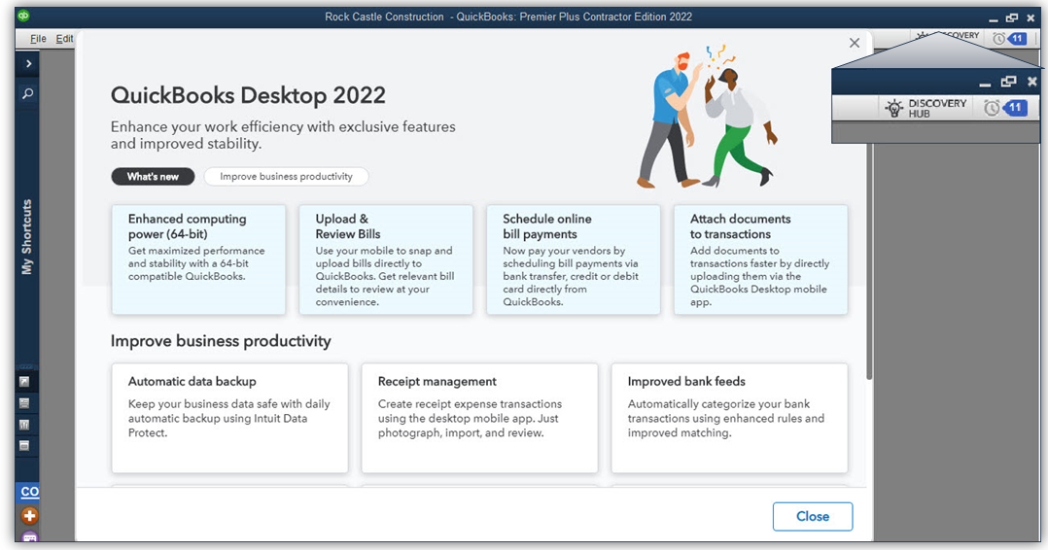
64-bit QuickBooks [1]

The “guts” of QuickBooks was elderly and wasn’t up to current processing standards. Now, QuickBooks has a 64-bit foundation and the full capability of 64-bit processors can be used. This typically means faster application and data load times, faster report generation and an ability to handle larger data sets more efficiently. Beware of QB 2022 until you verify that your computers are all 64-bit machines, because QB 2022 can’t be installed on 32-bit systems. If you’re working with a hosting platform, you’ll need to make sure your host has modern infrastructure and up-to-date operating systems.

E-commerce for QuickBooks with Webgility [2]

Need to track your revenue from different selling platforms like Amazon, eBay, and Shopify, and sync the data directly with QuickBooks? There are a lot of e-commerce integrations for QuickBooks desktop, but Webgility wins when it comes to working with QuickBooks. There’s now a bundle that makes it easier to get the Webgility e-commerce integration for QuickBooks. Customers still must sign up with Webgility to get the service but purchasing the bundle package makes that quite a bit easier. Webgility uses a database to keep track of orders, so you’ll want to make sure your system is able to handle the extra load. If you’re on a hosting platform (other than NOOBEH), be ready to pay additional fees to support running Webgility.

Bill payment approval process

Improve your accounts payable process by creating a structured approval process so that only the right bills get paid. AP workflows can help businesses manage cash flow and improve transparency. Working in conjunction with the user’s Intuit.com account, the company can set up rules for QuickBooks to check which bills need approval for entry and payment. Users are then prompted to send bills for approval

Pay and schedule bills faster with Melio payments

Some subscription holders of QuickBooks Desktop Pro Plus, Premier Plus, or Enterprise are working with the new feature (from Melio Payments) that allows businesses to use QuickBooks to schedule and pay bills using a bank transfer, credit card or debit card. The vendor doesn’t have to have a Melio account; they can receive their payments either as ACH or paper check.

Bill entry automation and customized bill payment stubs

Save time and have QuickBooks automate bill entries from the QuickBooks Desktop mobile app (iOS or Android versions) or from bills sent via email. Review the bill data once it’s uploaded and match it to existing transactions in QB. Bill payment stubs are now on the list of customizable forms, so you can set up and email formal payment confirmations to vendors.

Upload documents [3]

Instead of scanning files on your PC to attach to QuickBooks transactions, you can now use the QuickBooks Desktop mobile app to attach documents to transactions. The attached documents feature of QuickBooks is awesome because it lets you use QB as kind of a document management solution where you can store original copies of bills, receipts, contracts, or other documents that associate with financial transactions or entities in your QB files. This new feature that allows documents to be uploaded via the QuickBooks Desktop mobile app is a great solution for businesses operating on some hosted platforms that can’t or won’t support scanning. One “gotcha” with attached documents is that many businesses forget that they have them, and when they go to migrate their QB data to another platform or computer, the file attachments either get forgotten or are so voluminous that it makes the migration difficult.

Choose from multiple customer contacts

Only available with Plus and Enterprise subscriptions is the ability to add multiple customer contacts to batch email runs. The program now lets you send emails more quickly by choosing batch mail recipients from a list of customer or vendor contacts, reducing the chances of email troubles caused by manual entry of addresses.

Instant deposit

When you use QuickBooks Payments (or any other payment service), it generally takes a few days for the money to wind up in your bank account. With a QuickBooks Payments account and for an additional fee, Intuit is now letting you get your money faster when customers pay. Instant Deposit is a service that works with a VISA or debit card to deposit the money into your checking account – any processing or other fees will continue to be debited from your regular payments bank account.

Payment links

Now you can do in QuickBooks what you can do with PayPal, Zelle and other money transfer apps. Businesses can use simple Payment links to collect payments before work is performed and even before an invoice is created. As with all other payments features, you need a QuickBooks Payments account to use this one.

Changes to software purchasing options

QuickBooks Desktop 2022 is only available as a subscription purchase. There is no outright purchase option for QuickBooks desktop any longer. For businesses that need only the most basic features of QB, Intuit is hoping the QBO platform will work, and changing the software from purchase to subscription is just one more step in moving users to adopt the web application. QuickBooks Pro and Premier are still widely used so they will be available for some time to come, but Intuit is clearly making moves to try to push smaller edition desktop users to the web.

[1] NOOBEH deploys only modern architecture, 64-bit systems for QB on Azure and other hosted solutions

[2] NOOBEH doesn’t charge extra to have Webgility or any other applications installed in your QB on Azure service

[3] NOOBEH QB on Azure  and other cloud hosting solutions support scanning directly from your local PC to QuickBooks, using specialty 3rd party tools. Whether you use QuickBooks mobile or scan directly to QB using the Attached Documents feature, NOOBEH supports it.

jm bunny feetMake Sense?

J

Connecting Your Web Store to QuickBooks on Azure

If you sell products via the Internet using a web store or shopping cart application, then you are probably facing the problem of getting your order and sales activities into QuickBooks and then getting shipping and product information back into the web store. For some, the additional need is to mirror the products and pricing information between the inventory management or financial system and the web store. In many businesses, this is a big chore and requires literally hours of redundant data entry and updating.

As with any manual process, there are many opportunities for errors and mistakes which ultimately cost the business both time and money.

Online selling is a dynamic business, and the sale is made when the customer is ready and willing to buy and the seller has the item available at the right price. The web store (ecommerce system) exists to process this sale in order to meet the immediacy of customer demand. If the system is not up to date with current product or pricing information, then the customer may not find what they want, and the sale is lost.

This means that the connectivity between the online selling system and the inventory/accounting system is of paramount importance in the ability to do business.

Synchronizing inventory information between the web store and the inventory/accounting system ensures that product and quantity information is updated on the web as product is sold and shipped (or received in). At the same time, importing invoices and sales receipts into the accounting system helps to ensure proper and accurate recording of sales and payment information and improves tracking of accounts receivable, shipping charges, and sales taxes.

cloud-small-business

To make this connection between the Web store and the inventory/accounting software, an integration solution or connector is generally required. The connector gets installed on the same systems as the inventory/accounting solution (on the same systems as QuickBooks, in this case) and provides the mechanism to synchronize data between the web store and the accounting system.

Integrating an always-on web store with an on-site accounting solution can be a challenge, even for the most tech savvy business owner.

Creating seamless processes for exchanging data between these remote systems requires that both solutions be operating in a secure and accessible platform. While the web store is accessible via the Internet, getting to data in accounting and other systems residing on local PCs or networks is more problematic.

An option that many successful online businesses have adopted is NOOBEH‘s QuickBooks on Azure service, which provides centralized hosting and management for the QuickBooks desktop and any connected inventory or warehouse management applications as well as the integration to the web store.

Enabling the accounting and operational systems to be online and always on, like the web store, allows them to exchange data when and where it is required.

Connecting services in a secure and managed environment introduces new efficiencies and eliminates risk due to data entry errors or lost transactions. The QuickBooks on Azure cloud hosting service provides the system management, platform security and uptime required to ensure that the inventory and accounting systems supporting the always-on web store are also always on.

jm bunny feetMake Sense?

J

Where in The World is Your Data?

Where in the World is Your Data? Even better.. where would you like it to be? In a datacenter near you? In a datacenter far away from you? Maybe you’d like your production system nearby, but backups stored on the other side of the country. Or perhaps you want redundant systems on each coast as well as something somewhere in the middle.
With Microsoft Azure as your platform, you have all the choices in the world, literally.

Microsoft Azure is the platform of choice for businesses of all sizes, offering virtualized infrastructure and services that can be tailored and tuned to meet the unique needs of any organization. No longer tied to on-premises infrastructure, companies find that they can implement better and more comprehensive solutions because they have the agility to adapt systems to immediate needs while retaining the ability to adjust as conditions change.

With Microsoft Azure and Microsoft 365 Services, NOOBEH enables businesses to focus on transformation and improving efficiency, not the IT that supports it.

NOOBEH cloud services, part of the Mendelson Consulting team, sets up Azure infrastructure and manages it for their clients. Business users focus on getting their work done, not on the IT supporting it. NOOBEH QuickBooks on Azure services give small and medium size businesses the most flexible and resilient infrastructure available to run all their desktop and network applications.

Because QuickBooks is rarely a standalone solution, NOOBEH QuickBooks on Azure services have no limitations on what add-ons, extensions, integrations or other applications the business may need to use. All the software a business needs can be deployed on the platform, allowing the company to keep its information systems and assets secure, fully-managed and available when and where they are needed.

While NOOBEH uses Azure platform and Microsoft 365 services to continue to deliver new capability for private sector users, Microsoft is advancing innovation in the delivery of connected services and computing power for private and government sector users wherever it is needed. Azure Modular Datacenters represent a partnership that delivers computing and communications capacity anywhere in the world… and beyond.

Microsoft Azure Modular Datacenters and SpaceX

The Azure modular datacenter is basically a “data center in a box”. It comes with everything needed to deliver computing capacity anywhere in the world.

“We designed the Azure Modular Datacenter (MDC) for customers who need cloud computing capabilities in hybrid or challenging environments, including remote areas. This announcement is complemented by our Azure Space offerings and partnerships that can extend satellite connectivity anywhere in the world. Scenarios range from mobile command centers, humanitarian assistance, military mission needs, mineral exploration, and other use cases requiring high intensity, secure computing on Azure.”

https://azure.microsoft.com/en-us/blog/introducing-the-microsoft-azure-modular-datacenter/

It has power and everything else it needs, and now it also has the connectivity needed, even when there is no (zip, zero) infrastructure. Microsoft has partnered with SpaceX, using SES satellites to bring Internet connectivity to remote areas.

“We can connect via satellite links any element on the Earth to another point on the Earth..”

https://arstechnica.com/information-technology/2020/10/microsofts-new-data-center-in-a-box-will-use-spacex-starlink-broadband/

They’re calling it part of “a multi-orbit, multi-band, multi-vendor” approach to connectivity. That’s pretty cool, if you ask me.

It takes the whole bookkeeping in bunny slippers philosophy of “work when and where it works for you” to an entirely new level.

Make Sense?

jm bunny feet

J

Office 2013 Loses Support for Commercial Office 365 Services

If you’re not on a subscription for your Office desktop applications, you may lose access to your email box and other services.  Why? Because Microsoft announced that, effective October 13th, 2020, Office 365 services (like OneDrive, Hosted Exchange and more) will only support client connectivity from subscription clients or perpetual clients with mainstream support.

Basically this means that Office 2013 is about to be no fun any more.

You won’t be able to use Office 2013 Outlook to connect to your Microsoft-hosted Exchange mailbox, and your Word and Excel won’t connect to OneDrive.  If you are with a hosting provider who supplies your Office licenses as part of the service, cross your fingers and hope that it isn’t Office 2013. It will be pretty frustrating if your Outlook suddenly has problems accessing your Microsoft-hosted mailbox.

Like many other products, a lot of the functionality in the desktop software has been turned into web service and the Microsoft Office applications are a great example. With cloud connectivity being the focus, desktop solutions are more frequently leveraging online resources to extend and expand their capabilities. This also means they’re more frequently turning from one-time software purchases to subscription service.

After October, Microsoft’s ongoing investments in the Office 365 cloud services – including Exchange Online, SharePoint Online, and OneDrive for Business – will be made based on “post-Office 2013 requirements”.  Now is the time to migrate your Office 2013 to Microsoft 365 Apps (formerly Office 365 ProPlus). We highly recommend this move anyway, so businesses can take advantage of using their Office applications seamlessly on Azure servers as well as their local PC desktops and mobile devices.

Users of Office 2016 and Office 2019 have a little more time before their software no longer supports the cloud services. That end date is currently October 2023. You can find the support lifecycle site for Office mainstream support dates here.

It isn’t that Microsoft plans to actively block older Office clients from connecting to Office 365 services. It’s just that older applications may have performance or reliability issues when they try to connect to the constantly-updated cloud services.  Increased security risks are certain and users may even find that they are no longer compliant with certain requirements. The big thing is that Microsoft support will likely not be able to resolve issues related to unsupported connections.

The days of buying software once and running it forever are just about over.

Developers have recognized that cloud services can expand and enhance their solutions in ways that static local installation can’t. For many businesses, it becomes easier and ultimately more efficient to migrate to subscription service for IT platform and software. Azure cloud servers, for example, allow businesses to always have modern infrastructure that is more fault tolerant and agile than on-premises hardware.

Combing these benefits with software that is cloud-connected and always up to date means the business never faces lost productivity or revenues due to outdated systems or lost compatibility with newer solutions.

Make Sense?

J

For Accounting Professionals: Private Hosted Solutions and Helping Clients Cope with the New Normal

Accounting professionals have an opportunity right now to help their business clients through the difficulties presented by the COVID-19 pandemic. With work-from-home mandates and increasingly fluid reporting requirements to support grants, loans and loan forgiveness, business owners need all the support and good advice they can get.

The global pandemic is changing the landscape of business worldwide. Many small businesses in the US have either closed or are on the brink, looking for ways to keep the doors open and employees paid. Supply chains are strained, distribution has slowed, and workers are being asked to work from home if possible.

These are challenging times, but the guidance and support you can provide to your business clients can be just what they need to help keep the doors open and workers producing. Remote access, cloud hosted applications and data, and real-time accounting support and management reporting are the weapons you and your clients will use to fight the conditions that are currently working against you both.

Help your clients deploy cloud hosting services for their entire business.

Running applications and storing data on an in-house network increases the cost and complexity of supporting a remote or mobile workforce, for you and for your clients.

Remote access and supporting work from home requires that users have the means to communicate with each other and to collaborate on the work. Tools to support communication and collaboration are critical when the workforce is distributed, operating from a variety of locations and with whatever device is available. Yet business owners, operators and managers may find that collaboration apps and other online tools don’t provide access to the applications and data required to do all their work.

To address the problem of working on client data, some accountants may install the client software and copy the data to their own in-house networks. This creates a situation where the accountant is paying for computing resources, space and management of client applications and data in addition to their own. This increases the cost of internal operations for the accounting firm and can impact internal system performance while also reducing overall productivity.

More to the point, this model only supports doing after-the-fact work for the client, which results in the data and reporting being outdated and far less useful to the client in supporting daily decision-making. This model also does nothing to help the firm with their own possible work-from-home needs even as IT support and on-site service becomes more limited.

Accounting professionals wanting to provide services to clients proactively rather than reactively must have real time access to the same applications and data that the client uses. The old fallback to remote control solutions is one approach, yet it is not really an optimum solution to the problem.

Remote control, like PCAnywhere, GoToMyPC or LogMeIn expose the professional to more of the client computing environment than is necessary, introducing risk and the potential for blame if something goes wrong. And remote-control solutions are single user, reducing productivity because the client can’t use their system while the accountant controls the computer. RC solutions also rely on the availability and function of the on-premises systems. If the on-prem systems aren’t turned on, up and running and accessible, then the remote user can’t connect.

It may be that online or web-based applications are an option, but for many businesses they aren’t really a viable solution. QuickBooks Online is simplified software and is not appropriate or usable for many businesses. The QBO subscription model is per-company, limiting options and reducing cost-efficiency for businesses with multiple entities. And QBO doesn’t address other business needs, such as working with documents and reports, and it can’t provide any access or support for other business applications. Even the ability to backup and preserve data is very limited without specialized services and tools.

Shared hosting service might be closer to the right answer, yet shared hosting is generally only useful for very small organizations and supports only core QuickBooks functions, so it can be as restrictive QBO. Shared infrastructure used by the shared hosting platforms can also introduce significant risk to every business on the platform because ransomware and malware can easily move through connected file systems and servers.

Compare shared services to a public pool where it is very easy to transmit from one person to another; in these networks an intrusion can end up spreading malware to the entire network and platform, resulting in days or even weeks of outages. Unfortunately, disaster recovery is often limited to recovery of the provider hosting platform and does not always include recovery of all customer data.

The best solution for business is private, managed cloud hosting service delivered on a trusted and proven platform like Microsoft Azure.

Hosting service that takes advantage of the Microsoft Azure cloud  platform allows the business to centralize access to all their important applications and data, making it possible to provide complete application functionality for all users no matter where they are located.

Using the Azure platforms means that security, fault tolerance, scalability and agility are designed into the solution rather than being extras from the hosting provider. Microsoft-managed datacenters and Microsoft-managed hardware means the experts in systems and security are handling the big stuff while the service provider focuses on what the client needs.

The virtualization technology enables the agility to meet changing business needs, scaling systems up or down if necessary. Massively scalable platform allows services to be right sized now without concern for future resource requirements (no buying ahead based on possible future needs). There are no arbitrary limitations placed on the applications or services the business needs to run on the cloud platform, and no fees for running more apps.

Making all the applications and data available to workers, when and where they need them, is the key to promoting higher levels of productivity while delivering the data management needs to support daily decision-making.

Now that you have access, provide pro-active support and help business owners and managers make the right decisions.

Better data and reporting to support business and finance management is more important than ever, especially when having the right information can mean the difference between keeping the doors open and closing shop for good. Whether the goal is to shore up finances to keep employees on staff or to create a cushion to help weather supply chain disruptions, businesses owners need quality financial and performance data in order to make the right decisions for the company.

Once the accounting professional has real-time access to client systems, they can work cooperatively in the data to ensure that the right information is available when it is needed. As business owners seek to take advantage of grants and loan programs available due to the pandemic, the financial and other performance data becomes even more essential in terms of developing qualification and eventually forgivability of the loan.

With timely access, proper reporting tools and regular support and oversight, business owners benefit from a closer working relationship with their accounting professionals. The additional support and proactive service is more necessary now than ever. For the accounting pro, an elevated relationship with client is being developed, where the services provided become more meaningful and the value of those services more evident.

Make sense?

J