Are You Prepared for SQL Server 2008 End of Support?


Everything gets old eventually, and now it is official for SQL Server 2008.

03-2012sean-phone-328-e1377042261105On July 9, 2019, support for SQL Server 2008 and 2008 R2 will end. That means the end of regular security updates and general support for the product. Are you ready?

It took more than 10 years for Microsoft to end support for our beloved SQL 2005 and version 2008 has enjoyed a similarly long reign. But it’s over and you need to get used to the idea. Even more, you need to get upgraded to a new version of SQL so your systems can still be patched, updated and supported. With all the nasty exploits out there, letting your software get out of date is more of a business risk than ever.

With cyberattacks becoming more sophisticated and frequent, running apps and data on unsupported versions can create significant security and compliance risks. The 2008 family of products was great for its time, but we highly recommend upgrading to the most current versions for better performance, efficiency, and regular security updates.

Now is a Good Time to Consider Azure

Microsoft is giving a present to businesses that want to migrate their workloads to Azure. For those customers that elect to take this as an opportunity to move to the Azure cloud, extended security updates will be available for free in Azure for 2008 and 2008 R2 versions of SQL Server and Windows Server to help secure workloads for three more years after the end of support deadline. Moving existing systems to the Azure cloud is a natural step in modernizing the business infrastructure and makes the next step of upgrading to managed database services and/or migrating to new Azure servers a lot easier.

Upgrading isn’t simply a matter of maintaining status quo, either.

Moving to new versions can be a foundation for new strategic capability and increasing overall business potential, powering new decision-making processes fueled by analytics and business intelligence.

The Microsoft Lifecycle Policy offers 10 years of support (5 years of regular support and another 5 years of extended support) for the 2008 and 2008 R2 versions of SQL Server and Windows Server. When the extended support period ends, there will be no patches or security updates, which always creates security risk.

If your business is going to remain competitive, you can’t rely on outdated systems.

Your business is tough enough to manage without having your systems work against you.  Software that prevents you from keeping up with demand, creates risk in compliance and security, and reduces operational performance is not what you need. Collecting, storing and rationalizing data takes power and speed, and securing your growing information warehouse requires vigilance in security and update management.

Use this opportunity to review your platforms and applications, and consider moving your on-premises or co-located systems to the cloud. The upcoming milestone is a great opportunity to transform applications and infrastructure to take advantage of cloud computing and the latest versions of SQL Server and Windows Server.

jmbunnyfeetMake Sense?

J

Contrary to What You Learned in Grade School… Sharing is Bad, Okay?

There is a place and time for sharing. Share your color crayons, share your toys… share your feelings with those you love. But when it comes to business technology and infrastructure, sharing isn’t always the best approach. Some things you should just keep for yourself… like the servers you use for hosting business desktops, desktop applications and business data.

When we first began the journey of bringing small business desktops and applications like QuickBooks to the Internet, the “cloud” was not yet a thing. Hosting providers put up servers in racks in data centers, installed software and stored data on behalf of customers, and did their best to find ways of making the service affordable. Elastic resources, massive scalability and built-in redundancy (which are benefits of a real cloud fabric) were not generally available nor were they even remotely affordable. Because the hardware, networking and other resources that make up the hosting infrastructure is costly, it is important for the hosting service provider to be able to spread those costs across the entire customer base.

In most cases, this meant creating shared servers where many customers run their applications and store their data. Even when a provider suggests that a customer has a “private” server, there is still a good chance the server is using shared storage and/or networking resources made accessible in the environment.

Sharing can be a good thing or a bad thing, and it often depends on the behavior of those involved. In shared application hosting environments, particularly desktop hosting environments, there is a lot of potential for intentionally and unintentionally causing problems that can and will impact other users and customers on the platform.

A simple provisioning error might allow a user to see data belonging to another company or have access to applications or services they should not.

With shared resources, bad actors and intruders can often escape permission boundaries, attaching to network shares and other computers on the platform.

Malware accidentally introduced by an innocent user from one company could easily penetrate the entire system, following paths to data storage locations and other servers, spreading the problem to many customers and systems and even data centers.

If you are operating on the compromised system you are at risk, even if the compromise wasn’t initiated by one of  your users or from within one of your applications.

In the realm of QuickBooks hosting providers, the issues around sharing infrastructure and resources have created some very difficult situations for hosts and for their customers alike – especially when it comes to dealing with computer viruses, malware and ransomware. A few high-profile events, as well as numerous incidents which have flown under the radar, have revealed just how damaging the shared approach can be.

With the IRS, AICPA and other agencies issuing increasingly strong guidance for tax and accounting professionals to protect client information, finance professionals should strongly consider the risk introduced through shared hosting service arrangements and evaluate if it is greater than the costs of having a more private system.

Cloud platforms available today are fully matured, delivering scalability and agility at price levels that are affordable even for very small businesses.  No longer solely for enterprise enjoyment, real cloud solutions and delivery models can be used by small businesses for desktop and application hosting without compromise. Every business deserves their own cloud, and we know how to make that affordable.

Cooper Mann works with teams deploying on the Microsoft Azure platform, offering an agility in design not previously available with legacy computing approaches. Because every delivery is absolutely private to each customer, the solution can be scaled up (or down!) on demand to suit the specific needs of the individual business. More important is the fact that each customer operates separately, so any bad behavior the system may suffer from is their own.

jmbunnyfeetMake Sense?

J

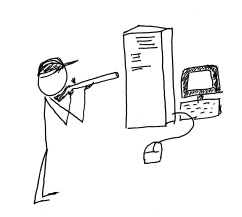
Go Ahead and Shoot the Server: End of Microsoft Small Business Server Inspires Cloud Adoption with Small Businesses

shoot_the_serverMicrosoft has made a decision to include more “cloud” capability in its offerings for small business, ending the life of the successful Small Business Server line and replacing it within the Windows Server 2012 family.  Some businesses are continuing with locally installed servers and are upgrading to Windows 2012 Essentials (or other editions) for in-house use, but more businesses every day are electing to deploy their servers and systems in the cloud instead.

Back when Microsoft introduced the Small Business Server, small business owners found that it was now really easy to implement way more technology in the business than they could directly support.  In one happy little package the SMB could get Windows Server, Exchange, SQL, SharePoint, Remote Web Access, an internal Company Website and more.  Information technology service companies, on the other hand, found it to be a big driver for delivering equipment and services to small business customers, and the product line’s adoption and implementation numbers grew.  Even the smallest of businesses could enjoy enterprise-class email, file and document sharing, client-server applications and remote access for a (relatively) affordable price.  It was this type of offering which created opportunity for server virtualization technologies to be used in small business, as the various server types each benefitted from their own “sandbox”, and IT providers recognized another opportunity to leverage their expertise at the customer location.

Business use of technology continues to expand rapidly so it makes sense that the Small Business Server offering from Microsoft is pretty popular.  In fact, Foresitetech.com says in an article on the subject that “The overwhelming majority of small businesses (80%) with less than 75 employees use Microsoft’s Small Business Server (SBS) software.”

But this fast-paced world of technology continues to move along, and Microsoft has ended the life of the SBS 2011 product.  In its place, small business customers are encouraged to upgrade to one of the editions of Windows Server 2012 as a replacement for their beloved SBS and hopefully they can find an edition which (affordably) delivers the functionality and features the business has come to rely on.  Unfortunately, there isn’t an edition of Windows Server 2012 that offers quite what SBS did, so now there is a big buying decision for the customer.  As the Clash sang it: “do I stay or do I go?”

Microsoft’s elimination of the feature-rich and friendly-sounding Small Business Server has created a lot of opportunity for VARs and IT service providers to move their customers to cloud services, SaaS solutions and hosted environments.  Particularly as information technology continues to become more complex, small businesses (well, businesses of all sizes) are recognizing that they may be better off focusing on running the business operation and managing the company as opposed to spending a lot of focus on IT system purchasing, installation, administration and management.  They have come to understand that IT services are critical to the business, but the server doesn’t have to be under the front desk or in a back closet in order to function for the business.  There is simply too much evidence in the market for these business owners to ignore;  shooting the server is now a viable option.

Every day more business owners are being inspired to [shoot their servers] seek out the services that will allow them to continue to benefit from innovations in technology while relieving them of the direct responsibilities of equipment purchasing, implementation, administration and lifecycle management.  Cloud services deliver this capability, and channel partners and Value Added Resellers should recognize their opportunity to get inspired as well, and to start offering cloud-based and hosted services to their customers and capture the “buying decision” opportunity that Microsoft has created.

Ready. Aim. Fire.

jmbunnyfeetMake Sense?

J

Giving Credit Where Credit Is Due | Accounting and Business Technologies

Giving Credit Where Credit Is Due

or – That was then, but this is now…

It constantly amazes me, seeing the number of conversations, forums, talkbacks, emails, etc. flurrying about the Internet that are focused on finding the way to “win” against Microsoft and Intuit – both companies, in certain circles, being referred to as “big brother”. Well, the 800lb gorillas, anyway.

There are the Linux community members, very appropriately using TCO (total cost of ownership) and security messages to get the attention of the market… you’ve got the Mac devotees who believe that computers can and should have good fashion sense… and then there are the Windows users who use it, but complain nonetheless.

With Intuit, you have a clear market-share leader in SMB accounting. As for the other market segments – it’s anybody’s guess who wins there. It’s arguable.

But what do these two companies have in common? In a word – success.

Let’s face it. Without them, there wouldn’t be a world of computer users representing a potential customer base for new products. Walk with me – let’s talk.

Computers were once quite expensive, unintuitive, and basically unavailable for most businesses. Then PCs emerged, Microsoft hit the market – and Windows opened across the world. (Yes, I realize the timeline here is seriously compressed, and DOS lived for a long time and we liked it).  First, businesses broadly became computer users. Then consumers became computer users. Then everyone became a computer user.   Granted, the guy at home playing “Flight Simulator” was a driving force in getting the mouse and better graphics into mainstream computing. But let’s remember that accounting and finance was among the first primary applications of general computing technology (the BETTER adding machine).

Changes in the accounting industry were also occurring at this point. Professional accounting practices began to move away from business bookkeeping, being a low-margin and labor intensive task. Intuit hit the market with QuickBooks, marketing based on the concept that “if you can write a check, you can do your own books”. While this was in direct opposition to the professional accountants’ belief that businesses need professional assistance with their accounting, it solved the dilemma of doing the books directly. So, many accounting practices at this point actually became focused on selling and supporting accounting software – looking at the technology as both a means to avoid direct bookkeeping as well as introducing additional revenue-earning services for the practice.

Both Microsoft and Intuit recognized a need in the market, and filled those needs quite nicely. They earned their market share largely based on useability and the concept of empowerment. This is what it took to build the size of market we see today. And let’s face it. They did it very well.

Today’s computer user is more savvy – more aware of the options and choices. But choice often seems like complexity. With Microsoft and Intuit being viewed by many as the defacto standards for small businesses, the choice seemed like it was already made and therefore the complexity of making the right purchasing decision was removed. This is not as true today as it once was.

There are other options available. Will they gain the same levels of adoption that their predecessors did? Doubt it. The concept of “one size fits all” isn’t true any more. People want tools that are specific to their requirements. Businesses want their computing platform and applications to do more for them than simply maintain status quo.

But we must always remember how we got here. Kudos to the big guys who built the market for the rest of us. We should revere these companies, and acknowledge the great thing they did – they created potential customers for all of us. Lots of ’em.

via Accounting and Business Technologies | Joanie Mann: Giving Credit Where Credit Is Due.