For Franchise Business, Platform Agility Helps Deliver Customer Value

In every corner of the franchise world, businesses are talking about growing value. Customers are pursuing lower prices and are spending less, and the competitive marketplace often pushes businesses into a race to the bottom. With pressures coming from all sides – rising labor and supply costs, inflation and the cost of capital, changes in consumer spending habits – franchise operations are looking for ways to differentiate themselves and delight customers while supporting profitability and growth.

Value is not simply a discounted price on an item. To the buyer, value is often found in the quality of the product or service, and fast friction-free transactions made without errors. New bundles of products and offering new add-ons may also improve the customer’s value perception. The introduction of online and mobile ordering and partnering with third-party delivery services is not only an enhancement to the customer experience but can open new revenue streams by reaching new customers and serving current customers better.

Understanding where changes might be made to not only improve value to the customer, but also to the business and stakeholders, is the challenge. Only through close monitoring of operational and financial data will businesses understand what adjustments are needed to achieve the desired results. Yet the complexities of data collection, integration and reporting often pose barriers to exposing the information needed to fully inform stakeholders.

Mendelson Consulting and Noobeh Cloud Services understand that many franchise organizations are faced with challenges in identifying, collecting, combining and reporting on their operational and financial data. Working with Microsoft Azure and having team members and partners experienced in working with a wide variety of financial and operational systems, Mendelson Consulting and Noobeh help businesses create the foundations for flexible, agile and massively scalable data collection, storage and analysis.

From standardizing accounting systems and processes to establishing data lakes and foundations for data analysis and reporting, Mendelson Consulting and Noobeh have the range of services and solutions and partners to help support new, established and fast-growing franchise operations. Its about delivering more value… to our clients and to theirs.

jm bunny feetMake Sense?

J

The nasty surprises hackers have in store for us in 2018

“Hackers are constantly finding new targets and refining the tools they use to break through cyberdefenses. The following are some significant threats to look out for this year.

More huge data breaches

The cyberattack on the Equifax credit reporting agency in 2017, which led to the theft of Social Security numbers, birth dates, and other data on almost half the U.S. population, was a stark reminder that hackers are thinking big when it comes to targets. ..

Ransomware in the cloud

… The biggest cloud operators, like Google, Amazon, and IBM, have hired some of the brightest minds in digital security, so they won’t be easy to crack. But smaller companies are likely to be more vulnerable, and even a modest breach could lead to a big payday for the hackers involved.

The weaponization of AI

This year will see the emergence of an AI-driven arms race. Security firms and researchers have been using machine-learning models, neural networks, and other AI technologies for a while to better anticipate attacks, and to spot ones already under way. It’s highly likely that hackers are adopting the same technology to strike back…”

Source: The nasty surprises hackers have in store for us in 2018

Big Data, Analysis and Business Intelligence

Big Data, Analysis and Business Intelligence

big dataThere is a lot of talk among IT professionals of “big data”, and discussions at many business conference tables center on how the organization might find greater benefit and advantage from the intelligence buried in the business systems and information.  It is a two-part problem, where the collection and the analysis each play essential roles in developing real business intelligence.

“So what’s getting ubiquitous and cheap? Data.

And what is complementary to data? Analysis. ..”

Hal Varian, Chief Economist at Google and emeritus professor at the University of California, Berkeley
“Hal Varian Answers Your Questions,” February 25, 2008 (http://www.freakonomics.com/2008/02/25/hal-varian-answers-your-questions/).  BUSINESS INTELLIGENCE AND ANALYTICS: FROM BIG DATA TO BIG IMPACT; MIS Quarterly Vol. 36 No. 4, pp. 1165-1188/December 2012

The information technology and systems in a business support the operation.  Software and computers help people do their jobs, and the information collected in and generated by those systems becomes the foundation for developing business “intelligence”.   Today, businesses must reach beyond their own direct operational support systems and consider the full realm of data to be collected, including IoT sensor data or social media data.

Business intelligence is gained from the analysis of the critical business data – analysis which helps owners and managers make better and more informed decisions which are based on an understanding of the business and market.   Business intelligence was a term popularized in the 1990s, but the key was the analytical component (business analytics), which gained focus in the late 2000s. Today it is big data and big data analytics, where organizations are working with massive data sets not previously even imagined.

“…one of the most significant challenges facing enterprise IT teams today is how to efficiently support and enable the “science” of big data, while providing the confidence and maturity of more traditional (and often better understood) infrastructure services.”

http://www.datacenterknowledge.com/archives/2015/05/26/hadoop-big-data-storage-challenge-overcoming-science-project/

The volume and velocity of information collection is ever-increasing even in the smallest of businesses, creating a great need for tools which can structure and correlate data so that it might render some insight.  Simply storing and managing these huge and growing data sets has become a challenge, and there isn’t one right way.

Once the business has the data, then it must find a way to analyze the data, which generally involves also applying visualization tools. Many IT departments are feeling pressured in the development of new skills and capabilities around data collection and management, yet it is more frequently the business user who provides the analysis and applies visualization tools to the task.

“Data collected by the Aberdeen Group, found that employees in organizations that used visual data discovery were more likely to find the information they need, when they need it. These same companies were able to scale their use of scarce IT skills more effectively.”

http://www.tableau.com/learn/whitepapers/visualization-set-your-analytics-users-free#0vXrkWZbizxyutw

The use of business intelligence and advanced analytics continues to grow in every segment of the market – from small business to enterprise – and plays an increasingly important role in supporting business success.

Until this point, most businesses didn’t have the technology or the data to enable significant quality or business transformation, but the times are changing and deployments of data collection, analysis and visualization software and tools are expanding with it. This is a fundamental aspect of business digital transformation and fuels the next step, where intelligence is applied to conditions revealed in the data and activities are automatically performed guided by that intelligence.

jmbunnyfeetMake Sense?

J

Taking Action to Expand Overtime Protections | whitehouse.gov

The Department of Labor is finalizing a rule to update overtime protections for workers. “In total, the new rule is expected to extend overtime protections to 4.2 million more Americans who are not currently eligible under federal law, and it is expected to boost wages for workers by $12 billion over the next 10 years.”

Source: Taking Action to Expand Overtime Protections | whitehouse.gov

This is a difficult subject for everyone involved – workers and business owners alike. Increases in minimum wage, increases in employee health care costs, and adjustments to wage and hour regulations all serve complicate and cost businesses more.  Fair payment for time worked, a living wage, and protections for workers from employer abuse are things that are expected – deservedly so – by employees.   Definitions vary, as do circumstances, so a one-size rule never really fits all and someone, somewhere, feels the burn.

A USA Today article on the subject describes Labor Secretary Thomas Perez as saying “the salary threshold was originally intended to exempt high-paid executives but instead has denied overtime to low-level retail supervisors and entry-level office workers who often toil 50 to 70 hours a week.”

On the other hand Dan Bosch, head of regulatory policy for the National Federation of Independent Business, was described as saying that “many small businesses can’t absorb the added cost and will instruct employees to work no more than 40 hours a week, bringing on part-time workers to pick up the slack”.  From Trey Kovacs, policy analyst with the Competitive Enterprise Institute: “The Obama rule puts a huge cost and regulatory burden on employers, who will face pressure to cut back on benefits and full-time employees”.

A bill was introduced on Thursday by Republican congressional leadership hoping to block the proposed overtime rule. The proposed legislation, Protecting Workplace Advancement and Opportunity Act, is intended to ensure that the Department of Labor takes a “balanced and responsible approach to updating federal overtime rules.” Sponsors of the legislation include members of the Senate Committee on Health, Education, Labor, and Pensions and the House Committee on Education and the Workforce.

Part of the bill’s consideration may be the burden of record keeping and information management that just keeps growing ever larger.  The current DOL changes, for example, now suggest that businesses must keep time and attendance records in detail for their salaried employees who might qualify for overtime compensation.  Getting employees to keep time cards or complete timesheets  may not be an easy thing to do, yet punching a timeclock and tracking their hours may become their new normal.  Some employers, on the other hand, will elect to simply raise workers’ base pay to the new threshold, avoiding paying the overtime and skirting the need to keep detailed time records.

logo-we-heart-employees

The extension of overtime protection to another 4.2 million Americans, and boosting wages by $12 billion over the next 10 years is the expectation for the new rule’s impact, although opponents suggest that employment (and employers) will suffer, reducing their workforces while absorbing costly HR management processes just in order to comply.

The rule is likely to touch nearly every sector of the U.S. economy, with the most notable adjustments occurring with nonprofits, retailers and hospitality (hotel and restaurants), as these are the industries generally having management-level workers whose salaries are at or below the new threshold.  Whether the outcomes of the rule will be as expected remains to be seen, but it is certain that many businesses must now put in place software, systems and processes which will help not just help them comply with new wage and hour rules, but deliver enough intelligence to support better personnel management, employee scheduling and labor cost containment.

jmbunnyfeetMake Sense?

J


Analysis, forecasts and modeling: What’s the point?

Analysis, forecasts and modeling: What’s the point?

financeIn today’s business world, risk, uncertainty and volatility are just par for the course – everyday realities of simply being in business.  Nothing is certain, they say, except death and taxes.  Yet there is a fine art to driving profitable growth in a business, and adapting to existing and emerging risk takes a great deal of experience, information and agility.  While planning and process development may occur at many levels within the organization, it is the FP&A (financial planning and analysis) capability which helps top performing businesses be top performers.

Financial planning and analysis are activities central to enterprise performance management (EPM) and must necessarily extend beyond finance.  Integrating various functional domains in the business (financial, operational and strategic), FP&A should bring data together from the various facets of the business and use the information to help structure and guide the organization toward meeting short-term and long-term goals.  Among the most critical of the duties of FP&A is calculating the financial impact, the monetary effects, of potential business decisions.  Everything in business means money, so there is always an impact to a decision.  With the right information supporting the decision, it is far more likely to have a positive impact and a level of sustainability.

While many CFOs may recognize the importance of performance measurement, planning and forecasting, a great many also believe the process isn’t very effective. The cause is frequently the divide between the various domains in the business and the information systems supporting them.  Operational data are distilled into summary financial information and fed to finance systems, losing much of the underlying intelligence that might be gained from analysis of the details.  Strategic development and planning may overlook certain volatile elements in the market, or may base successful outcomes on an expectation that conditions within the business will not change.  Finding ways to integrate the data from the respective domains into a comprehensive model is essential to developing a better and more robust forecasting and scenario-playing capability.  With the right information, analytics may be applied to all facets of management decision-making, anticipating and shaping business outcomes far more effectively than could be done without the insight.

Small business owners may believe that things like “predictive modeling” and “enterprise performance management” aren’t things they need to worry about, but the small business could use this information just as beneficially as a larger enterprise – perhaps even more as the insight could be the key to small business survival and growth.

Using analytics, the owner is able to adjust and re-align strategy in real-time to keep on the right path and goals clearly in sight.  Analytics can also help a business better understand what really drives revenue, working capital and profits.  Analytics can even help managers align compensation and strategy with business objectives, preventing compensation issues from outpacing business benefit.

There is a cost to growing a business, and some strategies might be more sustainable than others.  Time will tell, but it is great if the business owner has some business intelligence that might indicate what’s going to happen before it actually does.

Make Sense?

J


Two Ways to Get QuickBooks in the Cloud

Get QuickBooks in the Cloud: Hosted QuickBooks Desktop or QuickBooks Online

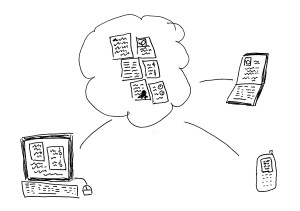
cloud-computingRunning applications online, or “in the cloud” using today’s parlance, is top priority for a lot of businesses.  It’s not that these organizations have a burning desire to post their financials to the web, which is what a lot of folks thought was going to happen when we first suggested they use their financial applications online.  Rather, business owners and managers have begun to recognize and experience the benefits of connecting their various locations, remote and mobile workers with real time access to business applications and data.  Further, centralization of IT coupled with outsourced IT management and subscription service pricing has introduced financial and operational benefits which make businesses more cost-efficient as well as more agile.  From being the basis for foundational process and workflow improvements to allowing the repositioning of IT costs from capex to opex, online application services are proving their value in various ways every day.

The evident popularity of cloud solutions is clearly visible in one small corner of the global software marketplace: the small business accounting solution market. Intuit’s QuickBooks product, almost a default go-to with entrepreneurs and small business owners, is still the most prevalent accounting solution in use by US small businesses.  While there may be growing usage of other applications on the web, such as Xero or FreshBooks (both are awesome SaaS apps that do what they do quite well), there is equally strong growth in Intuit’s own SaaS version of QuickBooks.  The SaaS applications are easier to localize for different places in the world – different languages and currencies – so international use of these products is likely to continue to grow.  Even more to the point, these solutions address functionality and pricing levels which are acceptable to entirely different classes of users that previously wouldn’t even consider buying accounting software to do the books (like freelancers and solo/soho operators), so the overall size of the market of “businesses who use accounting or bookkeeping software” is actually growing.

Intuit’s QuickBooks Online edition is a true SaaS solution that is quite different from the desktop-based QuickBooks.  While QBO has gained tremendous popularity, it has yet to reach the user numbers the desktop products have.  The desktop solutions boast not just a particular range of functionality, but integrated applications and add-ons, and – perhaps most importantly – being a foundation for a wide variety of financial and business record keeping, bookkeeping, accounting, operationally oriented and reporting processes.  To sum it up: it’s embedded.  People know the software, the data is in a known format, and the product is simply part of how the business operates.

Once a solution is as entrenched as QuickBooks is – kind of like the entrenchment Microsoft Word and Excel have in the productivity area – it doesn’t go away very quickly and only when the value proposition is much greater… and maybe not even then.  Rather, folks find ways to make the solution they want work for them.  This is where hosting comes in and meets with the market’s demand for running applications (yes! even desktop applications!) online, as managed subscription service.

Running your QuickBooks desktop online via a hosting provider is how businesses take advantage of the best benefits of SaaS without actually converting to a SaaS application. They retain investments in training, process and integration yet introduce mobility, remote access and office connectivity, centralized information and predictable costs. QuickBooks-using businesses need to know about hosting their QuickBooks and the providers who can offer anything from standardized to extremely customized service.

As technology continues to evolve at ever-increasing rates, businesses will continue to be faced with new paradigms for doing business.  Some will adopt early and some will adopt later, and some simply won’t adopt.  Certainly the market as a whole doesn’t adopt as quickly as software companies would like, but then that’s always the way it is.  Customers will do what works for customers, and right now hosting is working for QuickBooks customers.

Joanie Mann Bunny FeetMake Sense

J