QuickBooks online, or QuickBooks Online? Use Software on the web without using Web-based software

cloud-computingThere is a trend among software makers these days to more fully leverage the “power of the web”, and why wouldn’t they?  The Internet has become the way businesses and users get and stay connected, and has become a foundation for how business gets done.   Remote and mobile access to information and applications has become an expectation of users, as social computing models have encouraged them to remain connected on all of their devices and from any location.  Online describes a working model that many businesses strive for, and software makers are seeking to capitalize on the trend.

The belief that software should no longer be installed and run from a local device has been adopted by some of the largest software vendors in the market, which would lead many users to expect that this is the important trend to follow.  Being encouraged to ditch their desktop software products and transition to using the web-based or SaaS alternative, users who have grown to trust their software products are now facing new buying decisions.  Any time a customer is forced to make a buying decision – like moving from a desktop product to a SaaS solution – there is a potential that the customer will go with a different vendor and leave the product line altogether.   Yet this is exactly what is happening with small business applications, and specifically with the tried-and true QuickBooks products – the solutions which had become the cornerstone of small business finance.

Where QuickBooks Pro, Premier and Enterprise desktop editions were the favored and trusted small business accounting solutions, Intuit is now on a wholesale push to get users transitioned to the QuickBooks Online edition.  In doing so, they’ve opened up the door for new competitors, because they’re forcing their QuickBooks users to make a new buying decision.   Assuming that customers will adopt the QuickBooks Online solution simply because it’s “QuickBooks” was perhaps a poor assumption on the part of Intuit.  Particularly by naming the product “QuickBooks”, Intuit invested the trust and long-standing recognition of the brand and product line into the online edition, and the user base and market has not been amused.  “It may be called QuickBooks, but it’s not the QuickBooks I want” says one customer.  Apparently, the QuickBooks Online edition is not what many experienced QuickBooks desktop users are looking for in a new version of the product.

Desktop QuickBooks users don’t have to move to the Online edition just to get the benefits of the cloud with their beloved QB.  The hosting and cloud service providers I work with help businesses run the QuickBooks desktop products as online service.  We deliver fully managed applications and data, allowing users to access their QuickBooks desktop products online and from a variety of devices just as if they were web-based.  Gaining the benefits of anytime/anywhere access with the added advantage of not changing software is a direction many users are electing to go.  While the price of a hosted solution may not be as low as a QuickBooks Online subscription, it is generally far less than a subscription to Salesforce.com, for example.  Isn’t the business financial data at least as valuable as CRM? The price isn’t unreasonable, and the benefits of online/remote access, managed IT, protected data, and an ability to take your ball and go home if you like are huge.  Grab your data file, install QuickBooks on your PC, and you’re back in action.  Can’t do that with most SaaS solutions, can you?  It’s only do-able with desktop software, which you can run in the cloud with a hosting provider or run on your own PC.

Assuming that all software will ultimately run online could be a big a mistake.  As technology advances and new capabilities introduce new complexities, the “heavy lifting” shifts from the center to the end points and back again.  While there may be a trend towards SaaS and leveraging the power of a remote system, the reality is that our devices – desktops and laptops, tablets and phablets and phones – are all getting more powerful.   Many SaaS applications and remote access technologies rely upon (and find ways to push more resource utilization to) the local device.  Video processes more quickly, input and output devices are more easily recognized, and the storage on the device is faster and easier to access.  A lot of work happens on the local device, and it will continue to be this way as the devices continue to get smarter and more powerful.  “There’s an app for that” for a reason: apps on the device work well and give users the functionality necessary to get things done efficiently.

SaaS is not all that’s out there – much of the software businesses know and love is still available the way they want it.  QuickBooks users need to know they can get their QuickBooks online without having to use QuickBooks OnlineThe desktop is not dead, and it won’t be for a long time.  Desktop software isn’t dead either; it’s just being pushed to the background as software companies attempt to wrap their arms firmly, with subscription based business models, around their respective customer bases.

Make sense?

J

Read more: Cloud Hold Out No More: QuickBooks Desktop Editions in the Cloud

Just Getting Started: App Hosting for Small Business

Just Getting Started: Application Hosting for Small Business

acoustic couplerAccessing software applications and data from a remote system isn’t new stuff.  Starting with telephone modems, acoustic couplers (those things you’d put the phone handset into so that the modem could “hear” the data), green screen ASCII terminals and host computers, users have connected to remote systems to access applications and manipulate stored data for years.  As personal computers became viable for business use, applications and data moved from centralized hosts to local computer environments.

As complexity of local environments rises and broadband becomes truly affordable and accessible, application and data management services are moving back to the centralized system approach.  It’s an expand and contract model, where new capabilities empower the endpoint (the user device) and complexity and scale economies drive centralization of resources and management.  Computing paradigms have once again reached the point where centralization of resources, along with the management and administration of the resource, makes sense for even the smallest of business organizations.  This is the new push for small business IT service delivery, and we’re just getting started.

Application Service Providers (ASPs) were once thought to be the providers who would tip the scales towards server-based computing in the new era.  Rather than creating wide-spread adoption of hosted applications and “virtual” desktops, the ASP business model fell by the wayside as part of the dot-com bust.  It was the right idea, but the market wasn’t ready to accept it and promises of the demise of the desktop turned into the demise of the ASP.

With the successful introduction of SaaS solutions and web-based applications, interest in subscription based IT models has not only grown, but becomes the specific focus of the entire IT industry.  From OEMs to channel resellers, the supply chain for IT products and services is adopting cloud and subscription-based service and business models.  What’s interesting about this second go-around with Internet-based desktop and application services is that the adoption levels are real, the revenue potential is real, and customers are seeking out these solutions rather than being sold.  Managed applications and hosted virtual desktops have become accepted, if not preferred, models for delivering IT services to businesses.

Small businesses can benefit from enterprise-class technologies when a certain economy of scale is developed, and if the environment delivers services around the software and functionality those businesses already need and use.  Logic dictates that Intuit QuickBooks desktop products might be a focus for hosting service providers, as the solution is easily the most accepted financial application by small businesses.  Businesses don’t readily change their financial and accounting software, so addressing this need is a key aspect of adoption.  Also, with QuickBooks, it is as likely as not that the business has an outside accountant who will, at some point, need access to the application and data. Meeting this need and proving the viability of hosting applications such as QuickBooks – offering the solution in the form of subscription service to the customer – has been accomplished through many years of discovery and validation by some of the providers in what is now the Intuit Authorized Host for QuickBooks program.

With the validation of the service model and Intuit’s introduction of an Authorized Host for QuickBooks program, a great deal of opportunity has been created for value added resellers and their small business customers.  Some in the industry would suggest that Intuit’s focus on the Online edition of the product indicates that opportunities around selling or hosting the desktop products have diminished, and Intuit appears to be spending heftily on the promotion of QuickBooks Online.   Yet it remains true that many customers – whether they be existing QuickBooks desktop customers or new QuickBooks customers – want the functionality and the integrations available only with the desktop editions.

For these customers, a hosted/managed application service model is the only answer.  IT resellers working with small business customers are undoubtedly getting the requests, and a few are beginning to recognize the value and service potential associated with offering hosted application services for QuickBooks and other popular small business software products.

As the largest of software vendors (like Microsoft, Intuit, etc.) with small business solutions make their licensing models available to hosting providers, resellers and hosts alike can take advantage these programs and offer their customers the benefits of mobility and managed service around the applications already in use.  Business owners like the benefits to be gained by adopting cloud computing models, but are resistant to changing their software and restructuring their processes.  It is the ability to deliver the benefit without the disruption that makes these application hosting service models attractive.

There are millions of QuickBooks desktop users out there, and only a small fraction are being hosted by authorized providers.  Intuit continues to sell the desktop solutions and the number of QuickBooks users isn’t in decline, so the opportunity to serve those QuickBooks customers continues to grow.  When it comes to providing application hosting services for small businesses, we really are just getting started.

jmbunnyfeetMake Sense?

J

4 Rules of Thumb for Considering Cloud Applications in Business

With all the talk of cloud computing and Software-as-a-Service models, businesses are increasingly questioning their continued use of on-premises and “traditional” software implementations. Having heard that cloud applications are cheaper and better than locally installed solutions, some small business owners and IT managers are actively seeking alternatives to their current software selections. In too many cases, however, these business owners or IT managers aren’t looking at the longer term impacts of their decisions, and may be adopting cloud software solutions simply because it seems to be the way things are going these days.

The cloud is simply a term being applied to a new way of looking at information technology – how businesses buy it, how they use it, and what they expect from it. Even as technology gets more complicated, users are demanding greater ease-of-use and lower costs. The response to these conditions is the cloud: addressing basic and common requirements and delivering the solution for a low-cost to many users. While the approach meets the simplicity and affordability elements, it may or may not fully address all the functional, compliance or sustainability needs of the business.

4-rules-of-thumbOne size never fits all, and this is as true with cloud computing as it is with bathing suits. For the business owner or IT manager considering adoption of cloud-based applications for the business, keep in mind these 4 Rules of Thumb so that the hype and excitement doesn’t cloud your judgment.

Rule 1: Software is software, and it is installed somewhere. Just because an application is accessed using a browser (which is software) doesn’t mean the product isn’t installed somewhere. When it’s a SaaS solution, the product is simply installed and running on the provider’s servers rather than your own computers.  Software can fail even when it isn’t on your computer, so it should be expected that failure could happen with SaaS solutions.  The difference is that a failure of an app on one machine isn’t news; failure of an app that lots of people are using at the same time is news.

Rule 2: Software that talks to other software means there is integration between the two. Whether the products are installed on the PC or whether they run from different providers’ systems, they still have to be able to communicate together at some common level. The Windows platform used to provide a “common” standard for integration of Windows applications. When applications move from the desktop platform to the web, many of the common integration approaches no longer work and new methods must be developed.  Just because a solution integrates with the desktop edition of a product does not mean it will automatically integrate with a web or SaaS edition of the product (QuickBooks exemplifies this).

Rule 3: Software still requires hardware and other resources. When cloud-based solutions are implemented, the cost of the server and storage facilities (along with other elements) may be included in the subscription price. The efficiency and scale economies developed by the provider will ultimately determine their profitability, but it is generally the case that centralization of resources, management and administration can significantly reduce the cost of operations. With most cloud solutions, it is the assumption of scale (leveraging a single asset base to many subscribing customers) which makes things more affordable than deploying similar capabilities individually for each customer. Consider also that any deployment of cloud software solutions still means that businesses must retain their local networks and devices. While PCs, laptops and tablets may not be running business applications, they are still computing devices which may need to connect to networks, have virus protection, have remote access or connection software installed on them, and any number of other things. In short, moving to the cloud does not remove the requirement to have and maintain user devices, printers and LANs.  And really, don’t most people still want Office applications on their devices, even if they also have remote access to such applications?  Office for iPad is somewhat of a tell in that respect; kind of proves the point.

Rule 4: Not all data is stored in the same manner. This is as true on a PC or LAN as it is in the cloud. However, cloud solutions can introduce quite a wrinkle when it comes to keeping copies of business data over time. With PCs and local networks, a business would back up their data in any variety of ways, preserving the files and formats for possible later use. As long as there was software available to read and open the files, the backed up data would be usable. Simply due to the popularity of some data formats, there might also be tools or utilities available to read the data even if the original application was lost. The wrinkle introduced with cloud solutions is not necessarily that the format of the data is strange – it is likely that most cloud-based business applications use fairly proven and recognizable database technology. The difficulty is that the actual database file(s) containing a company’s unique data may or may not be separate from other company data. If it is separate (single-tenant database), it is unlikely that the database as structured is portable. The fact is, most web-based or cloud solutions will allow users to export data from the database, but cannot provide actual structured data files ready for use with another application, lacking logical data or table relationships. Some solutions suggest that simple list exports are sufficient, and others may say they have data conversion capabilities, but the reality is that data existing in a cloud application is not very portable. Business intelligence is a terrible thing to waste, so it is really important to be able to take all the data with you (in a meaningful way, not as a bunch of disparate lists).

Cloud computing covers a really broad spectrum of technologies and delivery models, and most of the above is more about SaaS applications rather than actual cloud platforms. The platforms are where the applications live – server and network environments.  This is where hosting companies do their work, as the things they host live on the platforms.

Businesses electing to add mobility, management, fault tolerance and other capabilities to their systems should explore the benefits of application hosting and cloud platforms, and not immediately look to SaaS and cloud application alternatives to their existing software solutions. By deploying their systems in a managed hosting environment, businesses can often keep using their existing core software products, integrations, and data archiving methods while gaining the best benefits of “cloud”.

Joanie Mann Bunny FeetMake Sense?
J


Go Ahead and Shoot the Server: End of Microsoft Small Business Server Inspires Cloud Adoption with Small Businesses

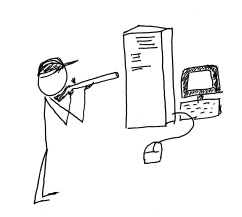
shoot_the_serverMicrosoft has made a decision to include more “cloud” capability in its offerings for small business, ending the life of the successful Small Business Server line and replacing it within the Windows Server 2012 family.  Some businesses are continuing with locally installed servers and are upgrading to Windows 2012 Essentials (or other editions) for in-house use, but more businesses every day are electing to deploy their servers and systems in the cloud instead.

Back when Microsoft introduced the Small Business Server, small business owners found that it was now really easy to implement way more technology in the business than they could directly support.  In one happy little package the SMB could get Windows Server, Exchange, SQL, SharePoint, Remote Web Access, an internal Company Website and more.  Information technology service companies, on the other hand, found it to be a big driver for delivering equipment and services to small business customers, and the product line’s adoption and implementation numbers grew.  Even the smallest of businesses could enjoy enterprise-class email, file and document sharing, client-server applications and remote access for a (relatively) affordable price.  It was this type of offering which created opportunity for server virtualization technologies to be used in small business, as the various server types each benefitted from their own “sandbox”, and IT providers recognized another opportunity to leverage their expertise at the customer location.

Business use of technology continues to expand rapidly so it makes sense that the Small Business Server offering from Microsoft is pretty popular.  In fact, Foresitetech.com says in an article on the subject that “The overwhelming majority of small businesses (80%) with less than 75 employees use Microsoft’s Small Business Server (SBS) software.”

But this fast-paced world of technology continues to move along, and Microsoft has ended the life of the SBS 2011 product.  In its place, small business customers are encouraged to upgrade to one of the editions of Windows Server 2012 as a replacement for their beloved SBS and hopefully they can find an edition which (affordably) delivers the functionality and features the business has come to rely on.  Unfortunately, there isn’t an edition of Windows Server 2012 that offers quite what SBS did, so now there is a big buying decision for the customer.  As the Clash sang it: “do I stay or do I go?”

Microsoft’s elimination of the feature-rich and friendly-sounding Small Business Server has created a lot of opportunity for VARs and IT service providers to move their customers to cloud services, SaaS solutions and hosted environments.  Particularly as information technology continues to become more complex, small businesses (well, businesses of all sizes) are recognizing that they may be better off focusing on running the business operation and managing the company as opposed to spending a lot of focus on IT system purchasing, installation, administration and management.  They have come to understand that IT services are critical to the business, but the server doesn’t have to be under the front desk or in a back closet in order to function for the business.  There is simply too much evidence in the market for these business owners to ignore;  shooting the server is now a viable option.

Every day more business owners are being inspired to [shoot their servers] seek out the services that will allow them to continue to benefit from innovations in technology while relieving them of the direct responsibilities of equipment purchasing, implementation, administration and lifecycle management.  Cloud services deliver this capability, and channel partners and Value Added Resellers should recognize their opportunity to get inspired as well, and to start offering cloud-based and hosted services to their customers and capture the “buying decision” opportunity that Microsoft has created.

Ready. Aim. Fire.

jmbunnyfeetMake Sense?

J

Client Experience and Perceived Value: It’s Looking Cloudy for Accountants Working with Small Business

Client Experience and Perceived Value: It’s Looking Cloudy for Accountants Working with Small Business

Every day it seems there is another professional accounting or bookkeeping firm asking questions about how to get new clients for their new “online accounting” business.  Most of these professionals are likely missing the point that their current clients are probably already looking at online accounting solutions and services. Just like in the days when QuickBooks was beginning to take the lead in the market; today’s increasingly popular online accounting solutions are gaining popularity with the direct users, and are bringing those solutions to the professional community (not the other way around).  Professionals who wish to build their businesses on what the market demands would do well to recognize that the push to the cloud coming from their clients is a reflection of past activities, and firms riding the wave are much more likely to see success than those fighting it.

In reflection, remember that QuickBooks, unlike the other business accounting and financial products at the time, was a retail product marketed to and sold via retail and direct-to-customer outlets rather than via a channel or reseller approach.  At that time, State of the Art Software (which became Peachtree and then Sage 50) was the solution preferred by most accounting professionals, yet more and more small business owners would come to the professionals with the QuickBooks product already in hand, so accountants threw up their hands and adopted (if not embraced) the software.  Over the years, QuickBooks became the “go to” software for small business accounting, and many professional firms didn’t just gear up to work with it, but went as far as developing standards and practices based on the product.

With the introduction of high-speed broadband access, business Internet connectivity and affordable remote/mobile service, businesses are now finding that their options for shopping for, purchasing and implementing various solutions to business problems is possible at any time and from anywhere.  Even more, social computing and the blurring of the lines between personal and business use has made it all but assured that new business owners will seek online solutions where they can access business information and perform business-related activities regardless of location or mode of access.  This is what they have come to expect as consumers of information and services, and the expectation extends no less into their small businesses.

Professional firms must recognize that these evolving paradigms represent opportunity, taking advantage of cloud-based, real-time collaboration models to provide more timely value to their clients.  Where the more traditional on-premises and paper-based models have flourished, the online working models representing lean process and sustainability become the focus.

The movement to the cloud for small business accounting started with the consumer, who ultimately became the small business, and who may eventually become the big business. The professionals who recognize the value of and wisely adopt cloud technologies and online application services in their businesses – specifically in terms of how they work with clients and deliver value – are the firms which recognize that the client experience and perception of value delivered are the most important elements of all.

jmbunnyfeetMake Sense?

J

Degrees of Success: Improving Productivity and Performance through Process Automation

Degrees of Success: Improving Productivity and Performance through Process Automation

Few businesses use just one solution to get all their work done.  In most cases, the business must at least communicate, produce information and account for financial activities – and each of these functions has a software product or service associated with delivering the required capability.  While every business uses technology at some level, some businesses have more success than others in developing streamlined and efficient processes guiding the various tasks and activities performed throughout the day.  Sometimes the problem stems from a lack of understanding of the importance of process automation, and sometimes it’s the software.

integrated

The success (or lack thereof) in streamlining a business process is often enabled by the tools supporting it, yet the truth of software and systems is that not everything  is easily integrated and not all business workflows actually “flow” smoothly.  In many cases it is left to the human user to connect the processes and keep the work flowing, creating the opportunity for missed deadlines, duplicated or erroneous data, and a greater dependency on individual worker knowledge than is good for the business.

The better alternative may be the adoption of workflow and automation tools to assist with bridging and scheduling of repetitive tasks, building the knowledgebase of process and task flow supporting business sustainability efforts and easing the burdens of training new employees.  Process automation helps to improve productivity, it’s just that simple.

If the time is taken to really consider the variety and numbers of repetitive tasks employees perform throughout the day, the cost in time, lost productivity and data errors or omissions would likely add up to far more than initially expected.  People tend to adapt to using the tools they are provided, and will find ways to get things done (whether it’s the most effective way or not).   The end does not always justify the means, and many businesses ultimately find that it is here – where individual worker initiative and unguided action are most prevalent – that the operation fails to accomplish stated goals.

In order to create a sustainable operation with consistently high levels of production and performance, the business must establish a complete framework for process automation and support.  Where existing application and software functionality is not able to meet the requirement, the business should implement specialized tools to bridge the gap and embed the process knowledge in the system.

Scheduled reporting, customer and product data synchronization, import/export routines, data maintenance routines – these are among the tasks and processes which represent the regularly-performed work that may be sucking the user productivity and performance out of the business.  It’s a matter of degrees of success, and productivity improvements introduced through comprehensive process and task automation can make the difference between a little success and a lot.

Make Sense?

J