Software and the Business Lifecycle

Every year, roughly 4.5 million US small businesses are started. The fuel which drives the American economy, small businesses account for more than 99% of all businesses in the US. And job creation happens in small business, which means growth also happens here. Growth happens at every stage of a business if the business is moving forward. From just starting out to achieving large enterprise status, the lifecycle of a business carries with it a multitude of learning moments.

As businesses implement solutions to manage accounting and operational needs, there is often less consideration for the agility of the solution to meet changing and expanding business needs than there is for affordability and the immediacy of the implementation. Small business owners frequently adopt solutions because they fit the needs now, not understanding what may happen when the business outgrows the solution. Sometimes a product meets the functionality requirements quite nicely yet can’t handle the increasing volume. These are among the issues facing growing businesses and forcing stakeholders to make more buying decisions regarding the software supporting the operation.

Each stage of a business where functional or process requirements change drives to another software buying decision. This buying decision is most often met with angst, as considerations include not only cost, but data conversion vs re-loading, new process or system design and setup, user training, proofing the system (running parallel?) and a host of other issues, not the least of which is the business benefit to be derived.

If information is power, too many businesses are losing that power when they migrate from one software product to another.

Businesses often lose valuable historical information by leaving transactional and other detail data behind when they change from one business software system to another.  This should be an area of focus and key discussion point when any change to systems is considered.  After all, the insight and business intelligence gathered over the years was likely instrumental in helping the small business grow to become a successful big business and will continue to be important for years to come.

Maximizing a return on investment is crucial with any business expenditure, whether it is in people, processes or systems.

The selection of software to support the operation plays a most important role in finding that value return, as the software is what empowers the people, guides the processes and drives the systems’ foundation. Knowing the crucial positioning of the software selection in supporting business growth and recognizing that future changes may risk loss of valuable business intelligence, the importance of the initial selection becomes that much greater.

Mendelson Consulting will help you review your business and processes, building an understanding of what functionality needs to be supported and how the business intends to operate. For businesses looking to take the next step, we help identify where automation can improve efficiency and productivity. With that understanding, we help business owners and stakeholders navigate through the overwhelming landscape of solutions and approaches to find the right one for your business.

At every step and stage of business growth, Mendelson Consulting looks ahead to what’s next, helping our clients plan for the future.

While we don’t have a crystal ball, our experience coupled with industry and product knowledge allows us to make recommendations which minimize loss of valuable business intelligence while maximizing the ROI of the software which it informs.

jm bunny feetMake Sense?

J

MSP, IT, Telecom, Channel: Convergence and the Cloud

Small and growing businesses have always relied upon various service providers and vendors to deliver the solutions required which support the business operation. Often viewed as the critical infrastructure of the business, phone and computer systems are among the first acquisitions a new business makes.  Phones and voice service, wired and wireless networks and all forms of communications infrastructure are part of IT and represent a large portion of the business information systems.

Small businesses used to have a phone guy they could call for phone stuff. The phone guy was a person or company who got phone lines installed, ran cabling for phones, installed phone systems and set up voicemail. The phone guy could help get cheaper long distance calling rates and train users on how to use the paging system and transfer calls.  The phone guy interacted mostly with the office manager or receptionist – the person in the office most likely to be “in charge” of the phone system, influencing these purchasing decisions greatly.

The computer guy, on the other hand, made sure the workstations and server were working, defragged hard drives, installed software and set up printers. The computer guy was the person or company that sold and supported the IT in the business, and often consulted with the business owner or line manager when it came to addressing information system requirements.

Telephony and networking is now clearly in the realm of IT, which changes how services are selected and purchasing is influenced. Computing and communications infrastructure, networking and mobile is all part of business IT. The separation of services – voice versus data – is gone.  The phone vendors and the IT suppliers are now the same company, providing the critical infrastructure, the platforms and the application services that businesses are buying. These service providers understand that the foundations for delivering voice and data services are the same; the skills of their techs and the tools they use have converged to the point where there is little separation of duties.

Cloud services and outsourced solution providers offering hosted PBX and virtual applications infrastructure have revealed to business owners that there is often little difference in what the phone guy and the computer guy can provide. Business owners want converged solutions: voice and data when and where they need it to support business operations. Just a little research reveals that these anytime/anywhere models are widely available and that the cloud is the key.

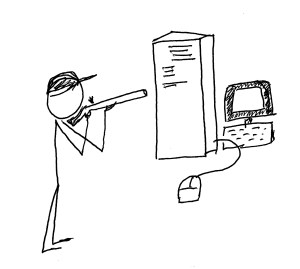
IT services are critical to the business, but the server doesn’t have to be under the front desk or in a back closet in order to function.  There is simply too much evidence in the market for these business owners to ignore;  shooting the server is now a viable option.

Every day more business owners are being inspired to [shoot their servers] seek out the services that will allow them to continue to benefit from innovations in technology while relieving them of the direct responsibilities of equipment purchasing, implementation, administration and lifecycle management.

Cloud services deliver this capability, and channel partners and Value Added Resellers should recognize their opportunity to get inspired as well, and to start offering cloud-based and hosted services to their customers and capture the “buying decision” opportunity that has [been] created.

Ready. Aim. Fire.

Source: Go Ahead and Shoot the Server: End of Microsoft Small Business Server Inspires Cloud Adoption with Small Businesses « Cooper Mann Consulting

Recognition of the convergence of voice and data services and channels hasn’t really hit home for a lot of resellers and channel partners, and this has rightfully positioned providers on both sides of the equation as viewing the others as direct competitors.  The phone guy thinks he is his customer’s “trusted advisor”, and that the loyal customer will certainly come to him if there is ever a need.  As well does the computer guy believe that he is the trusted advisor, having the ear of the business owner and wielding enough influence to ensure a continued revenue-earning relationship.

In truth, both the phone guy and the computer guy probably have earned their business customer’s trust and were the go-to people when there was a new business need. The problem is that the customer may no longer call one or the other of their “go-to” guys because the forward-thinking guys are offering one-stop service that delivers everything the business needs.  The lines between phone and computer stuff are not so clearly drawn any longer; it is all cloud IT and full service providers are winning the customer business.

Channel resellers, agents and MSPs are all telling their SMB/SME customers the same things, and at a base level they’re selling the same things, too.  Everyone is talking about lower up front investments and improved business productivity… and what they’re all selling is cloud and virtual. “Businesses need cloud in order to compete; move CapX to OpX; mobile is the new office” and “remote workers and devices need a secure quality network”.

Whether it relates to telephone systems with voicemail, automated attendants and a little intelligent voice response thrown in, or if the deal is for servers and workstations, software and network cabling, it is all business information technology and the trusted advisor is the guy who can provide it all. Convergence has clearly arrived.

Make Sense?

J

Just Getting Started: App Hosting for Small Business

Just Getting Started: Application Hosting for Small Business

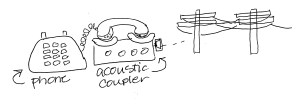
acoustic couplerAccessing software applications and data from a remote system isn’t new stuff.  Starting with telephone modems, acoustic couplers (those things you’d put the phone handset into so that the modem could “hear” the data), green screen ASCII terminals and host computers, users have connected to remote systems to access applications and manipulate stored data for years.  As personal computers became viable for business use, applications and data moved from centralized hosts to local computer environments.
As complexity of local environments rises and broadband becomes truly affordable and accessible, application and data management services are moving back to the centralized system approach.  It’s an expand and contract model, where new capabilities empower the endpoint (the user device) and complexity and scale economies drive centralization of resources and management.  Computing paradigms have once again reached the point where centralization of resources, along with the management and administration of the resource, makes sense for even the smallest of business organizations.  This is the new push for small business IT service delivery, and we’re just getting started.

Application Service Providers (ASPs) were once thought to be the providers who would tip the scales towards server-based computing in the new era.  Rather than creating wide-spread adoption of hosted applications and “virtual” desktops, the ASP business model fell by the wayside as part of the dot-com bust.  It was the right idea, but the market wasn’t ready to accept it and promises of the demise of the desktop turned into the demise of the ASP.

With the successful introduction of SaaS solutions and web-based applications, interest in subscription based IT models has not only grown, but becomes the specific focus of the entire IT industry.  From OEMs to channel resellers, the supply chain for IT products and services is adopting cloud and subscription-based service and business models.  What’s interesting about this second go-around with Internet-based desktop and application services is that the adoption levels are real, the revenue potential is real, and customers are seeking out these solutions rather than being sold.  Managed applications and hosted virtual desktops have become accepted, if not preferred, models for delivering IT services to businesses.

Small businesses can benefit from enterprise-class technologies when a certain economy of scale is developed, and if the environment delivers services around the software and functionality those businesses already need and use.  Logic dictates that Intuit QuickBooks desktop products might be a focus for hosting service providers, as the solution is easily the most accepted financial application by small businesses.  Businesses don’t readily change their financial and accounting software, so addressing this need is a key aspect of adoption.  Also, with QuickBooks, it is as likely as not that the business has an outside accountant who will, at some point, need access to the application and data. Meeting this need and proving the viability of hosting applications such as QuickBooks – offering the solution in the form of subscription service to the customer – has been accomplished through many years of discovery and validation by some of the providers in what is now the Intuit Authorized Host for QuickBooks program.

With the validation of the service model and Intuit’s introduction of an Authorized Host for QuickBooks program, a great deal of opportunity has been created for value added resellers and their small business customers.  Some in the industry would suggest that Intuit’s focus on the Online edition of the product indicates that opportunities around selling or hosting the desktop products have diminished, and Intuit appears to be spending heftily on the promotion of QuickBooks Online.   Yet it remains true that many customers – whether they be existing QuickBooks desktop customers or new QuickBooks customers – want the functionality and the integrations available only with the desktop editions.

For these customers, a hosted/managed application service model is the only answer.  IT resellers working with small business customers are undoubtedly getting the requests, and a few are beginning to recognize the value and service potential associated with offering hosted application services for QuickBooks and other popular small business software products.

As the largest of software vendors (like Microsoft, Intuit, etc.) with small business solutions make their licensing models available to hosting providers, resellers and hosts alike can take advantage these programs and offer their customers the benefits of mobility and managed service around the applications already in use.  Business owners like the benefits to be gained by adopting cloud computing models, but are resistant to changing their software and restructuring their processes.  It is the ability to deliver the benefit without the disruption that makes these application hosting service models attractive.

There are millions of QuickBooks desktop users out there, and only a small fraction are being hosted by authorized providers.  Intuit continues to sell the desktop solutions and the number of QuickBooks users isn’t in decline, so the opportunity to serve those QuickBooks customers continues to grow.  When it comes to providing application hosting services for small businesses, we really are just getting started.

jmbunnyfeetMake Sense?

J

Go Ahead and Shoot the Server: End of Microsoft Small Business Server Inspires Cloud Adoption with Small Businesses

shoot_the_serverMicrosoft has made a decision to include more “cloud” capability in its offerings for small business, ending the life of the successful Small Business Server line and replacing it within the Windows Server 2012 family.  Some businesses are continuing with locally installed servers and are upgrading to Windows 2012 Essentials (or other editions) for in-house use, but more businesses every day are electing to deploy their servers and systems in the cloud instead.

Back when Microsoft introduced the Small Business Server, small business owners found that it was now really easy to implement way more technology in the business than they could directly support.  In one happy little package the SMB could get Windows Server, Exchange, SQL, SharePoint, Remote Web Access, an internal Company Website and more.  Information technology service companies, on the other hand, found it to be a big driver for delivering equipment and services to small business customers, and the product line’s adoption and implementation numbers grew.  Even the smallest of businesses could enjoy enterprise-class email, file and document sharing, client-server applications and remote access for a (relatively) affordable price.  It was this type of offering which created opportunity for server virtualization technologies to be used in small business, as the various server types each benefitted from their own “sandbox”, and IT providers recognized another opportunity to leverage their expertise at the customer location.

Business use of technology continues to expand rapidly so it makes sense that the Small Business Server offering from Microsoft is pretty popular.  In fact, Foresitetech.com says in an article on the subject that “The overwhelming majority of small businesses (80%) with less than 75 employees use Microsoft’s Small Business Server (SBS) software.”

But this fast-paced world of technology continues to move along, and Microsoft has ended the life of the SBS 2011 product.  In its place, small business customers are encouraged to upgrade to one of the editions of Windows Server 2012 as a replacement for their beloved SBS and hopefully they can find an edition which (affordably) delivers the functionality and features the business has come to rely on.  Unfortunately, there isn’t an edition of Windows Server 2012 that offers quite what SBS did, so now there is a big buying decision for the customer.  As the Clash sang it: “do I stay or do I go?”

Microsoft’s elimination of the feature-rich and friendly-sounding Small Business Server has created a lot of opportunity for VARs and IT service providers to move their customers to cloud services, SaaS solutions and hosted environments.  Particularly as information technology continues to become more complex, small businesses (well, businesses of all sizes) are recognizing that they may be better off focusing on running the business operation and managing the company as opposed to spending a lot of focus on IT system purchasing, installation, administration and management.  They have come to understand that IT services are critical to the business, but the server doesn’t have to be under the front desk or in a back closet in order to function for the business.  There is simply too much evidence in the market for these business owners to ignore;  shooting the server is now a viable option.

Every day more business owners are being inspired to [shoot their servers] seek out the services that will allow them to continue to benefit from innovations in technology while relieving them of the direct responsibilities of equipment purchasing, implementation, administration and lifecycle management.  Cloud services deliver this capability, and channel partners and Value Added Resellers should recognize their opportunity to get inspired as well, and to start offering cloud-based and hosted services to their customers and capture the “buying decision” opportunity that Microsoft has created.

Ready. Aim. Fire.

jmbunnyfeetMake Sense?

J