Building Smarter Businesses

Achieving Growth, Efficiency and Sustainability Through Greater Business Intelligence

Every business needs to know how they’re doing so they can find ways to do better. This is what business intelligence is, and it’s the key to taking advantage of new opportunities and building success.

Consider the IBM commercials that were aired, about developing models for the prediction of traffic conditions in Singapore and “infusing intelligence into the systems and processes that make the world work”.   What they’re saying makes sense, but most business owners would likely say that it addresses bigger issues and doesn’t really speak to them. Yet those messages are for even the smallest of enterprises because you must really understand what’s happening in a business – and how it’s happening – to improve and excel.

The ability to leverage technology to collect data and analyze it in real time can make a huge difference, whether it is in a small business or a global system. With an intelligent approach to enabling the enterprise, we can build smarter and stronger businesses.

“Together, we have to consciously infuse intelligence into our decision-making and management systems, not just infuse our processes with more speed and capacity . . . We are moving into the age of the globally integrated and intelligent economy, society and planet. The question is, what will we do with that?”

former IBM chief executive Sam Palmisano

Business software and systems have reached the point where data collection and raw business intelligence is being gathered in real time by businesses small and large. This is where businesses must transform, replacing paper-based systems with digital workflows and enabling the collection of real-time information as data for analysis.

Forward-thinking accounting and finance professionals realize that accounting is not simply the final resting place for after-the-fact financial data. The finance department is where collected data is turned into actionable information, and information is power.

The competitive landscape for businesses of all kinds is changing along with the progress and adoption of technology.  Business owners and accountants should learn to use the tools which will help them find the patterns and trends in the system that help to forecast more accurately.

Working with NOOBEH cloud services and Mendelson Consulting, accounting professionals and business owners can implement the agile platforms and connected technologies to help achieve the benefits of growth, efficiency and sustainability envisioned by the Smarter Planet initiative.

jm bunny feetMake Sense?

J

Migrating Your Processes and Knowledge to the Cloud

Adopting cloud platforms can bring great business benefit without forcing dramatic change.

Many business owners believe they must dramatically change their software and business processes just to embrace cloud working models. Too often they are left believing that any business use of cloud technologies requires changing software and systems over to subscription web-based solutions which enable the much-desired anytime/anywhere working model.  What too many businesses aren’t being told is that there are ways to move to cloud platforms without losing their investments in people, processes and business knowledge.

The benefits of a cloud computing model are many, with mobility and managed service being the most obvious.  Less evident are the potential cost savings, because the subscription approach to paying for IT services may, on the surface, look like an equivalent or even higher cost over time. 

What isn’t being considered is the potential to improve processes and increase productivity.  These benefits are often achieved simply due to a centralized management and access approach, and are not necessarily attributable to the adoption of new software tools.

The cloud is the right answer for deploying and managing IT for many businesses, and delivers more value than on-premises systems can for the same price.

Eliminating the on-premises server and network with a cloud server implementation should be considered first, before changing out the software and tools in use throughout the organization. Hosting the existing applications means users can access their regular desktop software via the cloud, allowing the organization to fully retain their investments in people, processes and knowledge, and to build on that foundation with centralized service and improved collaboration..

Businesses of all sizes and types are are finding that the cloud, hosted applications and remote access provide the answers to a variety of business IT problems.  Even more, those answers are being provided affordably, with a simplicity of setup and with higher levels of service than is usually provided for with localized IT.

Small businesses and enterprise organizations alike can experience many benefits with a cloud hosted and managed IT approach.  It doesn’t take a comprehensive application or process overhaul to begin improving internal IT operations for the business, and it makes no sense for a business to give up investments in training, process development, and people knowledge in exchange for a centrally managed and remotely accessible system. 

Rather, the smart business takes the steps to solve the real issues of IT management and mobility while allowing users to continue performing their tasks and doing business as usual – only better now because the platform is working for them.

jm bunny feetMake Sense?

J

Direct-to-Consumer Causing Manufacturing Logistics Issues

Manufacturers have traditionally been positioned as a link in the long chain of supply. Somewhere between raw materials and finished products is where the manufacturer exists, transforming the materials into products that can be resold via distributors and wholesalers.

The supply chain was linear and relatively predictable, but that is all changing. With the introduction of broad internet connectivity, web-based services, large e-commerce platforms and increasingly innovative and competitive new logistics players, the supply chain is becoming a spiderweb of connectivity and communication, with linear approaches out the window and, to some extent, predictability along with it.

The economy we have today is an environment where customers demand more direct and personal approaches, and producers are being forced to find ways to accommodate. With the huge e-commerce platforms like Amazon and Alibaba, along with more direct-to-consumer channels, manufacturers are being turned into direct-to-consumer suppliers. Acting as drop shippers for the seller, the manufacturer isn’t shipping bulk or volume to distributors or wholesalers but smaller shipments direct to the consumer.

Many retail stores have now become more fulfillment locations than the place where the customer buys. This is causing tremendous change in logistics tools and approaches because the size of shipments is becoming smaller while the number of deliveries – and delivery locations – is only increasing.

Customers can go right to the brand’s website and buy direct, driving increased focus on building brand value and improving the overall customer experience. With the demand from consumers for flexibility in how and where they buy, retailers have shifted their approaches to bring e-commerce into the brick-and-mortar stores. This is where online and offline sales channels come together, creating pressure in ordering and fulfillment systems to offer the flexibility and experience consumers want.

While this converged channel model requires businesses to make new and continued investments in e-commerce and digital solutions to enable the flow of orders and information, it also delivers several potential benefits to the business, including the ability to better manage growing customer expectations, better compete in the digital marketplace, and address disruptions in the supply chain by having alternative options.

Delivering the goods has always been an operational challenge, with success often measured in performance and cost. Today’s marketplace requires more agility and flexibility, which means the role of supply chain managers is more strategic than ever. Simple logistics now has a direct impact on the customer’s decision to buy now, as well as buying again later.

jm bunny feetMake Sense?

J

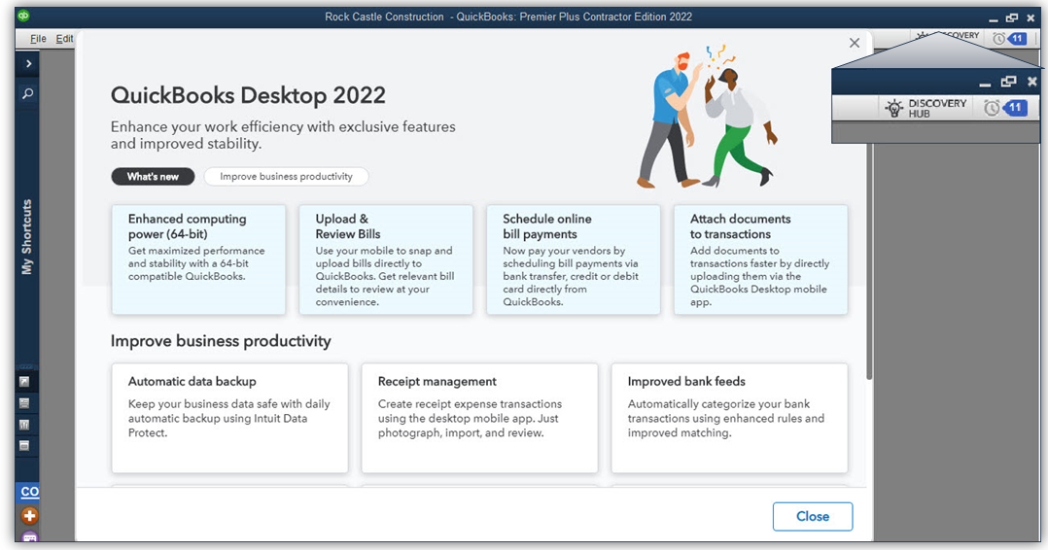
QuickBooks 2022 Boasts Modernized Foundation

Every year, businesses around the world anxiously await the release of the new versions of QuickBooks desktop software. While that may sound a bit silly, the truth is that QuickBooks is widely used in numerous countries around the world and when Intuit makes big changes to QuickBooks it impacts a lot of businesses.

While the focus for Intuit, like most software companies, is online subscription service, the fact remains that the desktop products and the ecosystem around them continues to grow.

Over the past few years, the company has invested in artificial intelligence and platform solutions that extend and add value to the desktop and online products. Some of these investments are becoming clearer with the launch of QuickBooks desktop 2022 editions.

64-bit QuickBooks [1]

The “guts” of QuickBooks was elderly and wasn’t up to current processing standards. Now, QuickBooks has a 64-bit foundation and the full capability of 64-bit processors can be used. This typically means faster application and data load times, faster report generation and an ability to handle larger data sets more efficiently. Beware of QB 2022 until you verify that your computers are all 64-bit machines, because QB 2022 can’t be installed on 32-bit systems. If you’re working with a hosting platform, you’ll need to make sure your host has modern infrastructure and up-to-date operating systems.

E-commerce for QuickBooks with Webgility [2]

Need to track your revenue from different selling platforms like Amazon, eBay, and Shopify, and sync the data directly with QuickBooks? There are a lot of e-commerce integrations for QuickBooks desktop, but Webgility wins when it comes to working with QuickBooks. There’s now a bundle that makes it easier to get the Webgility e-commerce integration for QuickBooks. Customers still must sign up with Webgility to get the service but purchasing the bundle package makes that quite a bit easier. Webgility uses a database to keep track of orders, so you’ll want to make sure your system is able to handle the extra load. If you’re on a hosting platform (other than NOOBEH), be ready to pay additional fees to support running Webgility.

Bill payment approval process

Improve your accounts payable process by creating a structured approval process so that only the right bills get paid. AP workflows can help businesses manage cash flow and improve transparency. Working in conjunction with the user’s Intuit.com account, the company can set up rules for QuickBooks to check which bills need approval for entry and payment. Users are then prompted to send bills for approval

Pay and schedule bills faster with Melio payments

Some subscription holders of QuickBooks Desktop Pro Plus, Premier Plus, or Enterprise are working with the new feature (from Melio Payments) that allows businesses to use QuickBooks to schedule and pay bills using a bank transfer, credit card or debit card. The vendor doesn’t have to have a Melio account; they can receive their payments either as ACH or paper check.

Bill entry automation and customized bill payment stubs

Save time and have QuickBooks automate bill entries from the QuickBooks Desktop mobile app (iOS or Android versions) or from bills sent via email. Review the bill data once it’s uploaded and match it to existing transactions in QB. Bill payment stubs are now on the list of customizable forms, so you can set up and email formal payment confirmations to vendors.

Upload documents [3]

Instead of scanning files on your PC to attach to QuickBooks transactions, you can now use the QuickBooks Desktop mobile app to attach documents to transactions. The attached documents feature of QuickBooks is awesome because it lets you use QB as kind of a document management solution where you can store original copies of bills, receipts, contracts, or other documents that associate with financial transactions or entities in your QB files. This new feature that allows documents to be uploaded via the QuickBooks Desktop mobile app is a great solution for businesses operating on some hosted platforms that can’t or won’t support scanning. One “gotcha” with attached documents is that many businesses forget that they have them, and when they go to migrate their QB data to another platform or computer, the file attachments either get forgotten or are so voluminous that it makes the migration difficult.

Choose from multiple customer contacts

Only available with Plus and Enterprise subscriptions is the ability to add multiple customer contacts to batch email runs. The program now lets you send emails more quickly by choosing batch mail recipients from a list of customer or vendor contacts, reducing the chances of email troubles caused by manual entry of addresses.

Instant deposit

When you use QuickBooks Payments (or any other payment service), it generally takes a few days for the money to wind up in your bank account. With a QuickBooks Payments account and for an additional fee, Intuit is now letting you get your money faster when customers pay. Instant Deposit is a service that works with a VISA or debit card to deposit the money into your checking account – any processing or other fees will continue to be debited from your regular payments bank account.

Payment links

Now you can do in QuickBooks what you can do with PayPal, Zelle and other money transfer apps. Businesses can use simple Payment links to collect payments before work is performed and even before an invoice is created. As with all other payments features, you need a QuickBooks Payments account to use this one.

Changes to software purchasing options

QuickBooks Desktop 2022 is only available as a subscription purchase. There is no outright purchase option for QuickBooks desktop any longer. For businesses that need only the most basic features of QB, Intuit is hoping the QBO platform will work, and changing the software from purchase to subscription is just one more step in moving users to adopt the web application. QuickBooks Pro and Premier are still widely used so they will be available for some time to come, but Intuit is clearly making moves to try to push smaller edition desktop users to the web.

[1] NOOBEH deploys only modern architecture, 64-bit systems for QB on Azure and other hosted solutions

[2] NOOBEH doesn’t charge extra to have Webgility or any other applications installed in your QB on Azure service

[3] NOOBEH QB on Azure  and other cloud hosting solutions support scanning directly from your local PC to QuickBooks, using specialty 3rd party tools. Whether you use QuickBooks mobile or scan directly to QB using the Attached Documents feature, NOOBEH supports it.

jm bunny feetMake Sense?

J

Cybersecurity Terms Every Business Owner Should Know, and Zombies are Bad

The world of cybersecurity constantly changes, making ongoing education the key to understanding the threats businesses face and how to possibly deal with them.

Cybersecurity is often defined as a set of techniques for protecting an organization’s digital infrastructure – the networks, systems, and applications – from being compromised by attackers and other threat actors. Cybersecurity is comprised of the efforts to design, implement, and maintain security for any organization network which is connected to the Internet.

Cybersecurity is made up of the technology, people, and processes which create strategies to protect sensitive data, ensure business continuity, and safeguard against financial loss.

To understand what cybersecurity entails, it is important to have a basic understanding of the relevant terminology.

Starting with a few that are frequently misused, here are some cybersecurity terms to add to your business vocabulary.

Data are the bits and bytes. When multiple bits and bytes are combined, they make up information. Knowledge is required to turn information into action.

A threat is the possibility that something bad that might happen, while a risk includes the probability of the bad thing happening and the possible result.

Risk Management is the process of responding to the possibility that something bad might happen. Traditionally, there are four options for managing risk in the business: accept it, transfer it to someone else, avoid it altogether, or mitigate it (reduce the severity).  To manage cybersecurity risk, many businesses establish requirements or controls to identify activities, processes, practices, or capabilities an organization may have. Controls may or may not be mandatory, but requirements generally are.

Information Security, or Information Assurance, is the protection of facts, news, knowledge, or data in any form. Information Assurance is an important aspect of preserving business resources and is often combined with cybersecurity, although it isn’t squarely in that area. Where cyber addresses digital, information security must also address non-digital such as paper, human knowledge or memorized, stone tablets, pictures, and signals or whatever.

Authentication is the process of proving an individual is who they say they are (claiming an identity and then proving it), whereas authorization is the use of access controls to determines and enforces what authenticated users are permitted to do within a computer system. Access Controls are the means and mechanisms of managing access to and use of resources by users.

Audits, in cybersecurity, are usually performed after a security incident. In general, an audit is an official inspection of some type. An assessment is often more like a health check for gauging capability or status. Audits may be performed internally or by outside entities. Compliance is meeting a requirement, whether internal or external. Sometimes these are regulatory requirements where a certification or attestation of some type is shown. Both audits and assessments may be required to be compliant with certain standards or designations.

A cyberattack is any attempt to violate the security perimeter of a logical environment. This could be a single computer system, a local or wide-area network, a cloud server, etc. – whatever is within your “perimeter” and is interconnected with your systems, regardless of location in the physical world. Cyberespionage, on the other hand, is the unlawful and unethical act of violating the privacy and security of an organization for the purposes of leaking data or disclosing internal, confidential, or private information.

And then there’s malware (malicious software), which includes any code that is written for the specific purpose of causing harm, disclosing information or in some other way violating the security or stability of a system. The malware category includes lots of different types of terrible and potentially damaging programs including virus, worm, Trojan horse, logic bomb, backdoor, Remote Access Trojan (RAT), rootkit, ransomware, and spyware/adware and more.

To better-secure your systems, multi-factor or two-factor authentication is suggested. Multi-(multiple) factor and two-factor authentication are a means of verifying a “claimed” identity using two or more types of proof (authentication factors). The password is typically the initial proof provided, and the other factor/method might be SMS to your phone or possibly an authenticator app.

For example: You claim that the email address is your identity, and you verify that by entering your password. That is one “factor” that proves your identity. But if your password gets hacked or revealed, it would be good to have another layer of protection on that login. Two is better than one in this case; MFA (multi-factor) and 2FA (two-factor) authentication is considered stronger than any single factor authentication and requires another method (factor) of identification to prove your identity.

Finally, there are zombies. Yes, Zombies. This is a term that relates to the concept of a malicious network of “bots” (a botnet). Botnets are made up of poor, innocent computers that are compromised by malicious code so that they can run remote control or other agents. The agents give the attackers the ability to use the system’s resources to do nefarious things, like perform illicit or criminal actions. The zombie can be the system that hosts the malware agent of the botnet, or it could be the malware agent itself. Either way, zombies are bad.

Security is an essential consideration for every business, and the Internet and the interconnected design of today’s technology has made things so much more complicated. The most important thing is to be aware of the threat and how that landscape is changing, and to educate team members so that everyone in the company participates in keeping the system, and the business, protected.

jm bunny feetMake Sense?

J

Building A Solid Foundation for Business Cybersecurity

The cybersecurity threat landscape has changed dramatically in the last few years. No longer primarily a big-business concern, cybersecurity has become a key focus of businesses small and large. Attacks on SMBs are on the rise, perhaps because they represent a plentiful and often easy target. And the cost of damage and disruption to business just keeps going up.

Cybersecurity is not a problem you can simply throw a bunch of money and tools at to fix.

No matter how much great software or fancy systems you implement, the people will always be a big part of the equation. The root cause of over half the data breaches reported is a result of negligent employees or contractors.

That means that nearly half of all attacks are being executed through phishing or social engineering. The only tool you can apply to this problem is education. Efforts should be focused on security awareness and training workers to be more cautious to the point of almost being paranoid. Better to be safe than sorry in this case.

Training workers to be more careful as they work with emails, documents and websites is part of it, but there is much more to making sure the business is addressing the entire cybersecurity issue. NIST (National Institute of Standards and Technology) offers a wide variety of information and guides that businesses can use to learn more about and implement cybersecurity practices. Among these resources is the Cybersecurity Framework.

According to NIST, “the Framework focuses on using business drivers to guide cybersecurity activities and considering cybersecurity risks as part of the organization’s risk management processes.” It is a highly useful tool in helping the business align and prioritize activities with business requirements, risk tolerances and resources. The standard framework includes elements that are consistent and common across sectors and critical infrastructure, so it can be oriented to any business.

Even if the business is not prepared to delve into the details of a comprehensive cybersecurity policy and guideline, a basic outline and approach cannot be avoided without asking for disaster.

Putting this squarely into the Risk Management category, there is an ongoing process of identifying, assessing, and responding to risk situations or conditions. To manage the risk, businesses need to consider the likelihood that an event will occur and what the potential impact is as a result.

Knowing the acceptable level of risk for reaching the business objective is the risk tolerance. If a business understands its risk tolerance, the company can prioritize cybersecurity activities and make informed decisions about cybersecurity expenditures.

There are five key functions to consider as it relates to cybersecurity risk: Identification, Protection, Detection, Response and Recovery. How the business addresses each of these in the context of the systems and activities is essentially the business’s cybersecurity posture, a high-level and somewhat strategic view of the organization’s management of cybersecurity risk.

The key to building a solid foundation for  business cybersecurity practice is to establish a platform where all the business applications and data can be identified and access secured.

User desktops, productivity applications, operational software and business data can be hosted on private cloud servers, allowing the business to fully-manage data and application access. The server-based model reduces or eliminates the need to sync data to devices, and remote desktops keep user environments secure, patched and up-to-date.

Our consultants can’t write your cybersecurity policies or determine your risk tolerance, but we can help implement a solution that improves fault tolerance, resilience, and recovery.

Make Sense?

J