Analysis, forecasts and modeling: What’s the point?

Analysis, forecasts and modeling: What’s the point?

financeIn today’s business world, risk, uncertainty and volatility are just par for the course – everyday realities of simply being in business.  Nothing is certain, they say, except death and taxes.  Yet there is a fine art to driving profitable growth in a business, and adapting to existing and emerging risk takes a great deal of experience, information and agility.  While planning and process development may occur at many levels within the organization, it is the FP&A (financial planning and analysis) capability which helps top performing businesses be top performers.

Financial planning and analysis are activities central to enterprise performance management (EPM) and must necessarily extend beyond finance.  Integrating various functional domains in the business (financial, operational and strategic), FP&A should bring data together from the various facets of the business and use the information to help structure and guide the organization toward meeting short-term and long-term goals.  Among the most critical of the duties of FP&A is calculating the financial impact, the monetary effects, of potential business decisions.  Everything in business means money, so there is always an impact to a decision.  With the right information supporting the decision, it is far more likely to have a positive impact and a level of sustainability.

While many CFOs may recognize the importance of performance measurement, planning and forecasting, a great many also believe the process isn’t very effective. The cause is frequently the divide between the various domains in the business and the information systems supporting them.  Operational data are distilled into summary financial information and fed to finance systems, losing much of the underlying intelligence that might be gained from analysis of the details.  Strategic development and planning may overlook certain volatile elements in the market, or may base successful outcomes on an expectation that conditions within the business will not change.  Finding ways to integrate the data from the respective domains into a comprehensive model is essential to developing a better and more robust forecasting and scenario-playing capability.  With the right information, analytics may be applied to all facets of management decision-making, anticipating and shaping business outcomes far more effectively than could be done without the insight.

Small business owners may believe that things like “predictive modeling” and “enterprise performance management” aren’t things they need to worry about, but the small business could use this information just as beneficially as a larger enterprise – perhaps even more as the insight could be the key to small business survival and growth.

Using analytics, the owner is able to adjust and re-align strategy in real-time to keep on the right path and goals clearly in sight.  Analytics can also help a business better understand what really drives revenue, working capital and profits.  Analytics can even help managers align compensation and strategy with business objectives, preventing compensation issues from outpacing business benefit.

There is a cost to growing a business, and some strategies might be more sustainable than others.  Time will tell, but it is great if the business owner has some business intelligence that might indicate what’s going to happen before it actually does.

Make Sense?

J


Trusted Advisor is About the Work, Not the Title

Trusted Advisor is About the Work, Not the Title

Many accounting professionals believe they are THE trusted advisor the client comes to for advice and guidance on business financial matters.  Having fully bought into the messaging about the value of the accounting and tax work, these professionals are feeling pretty relaxed about their client engagements.  They believe the client will come to them with questions and provide the opportunity to deliver advice or work.  And each year  many clients return to get their taxes prepared or financial statements produced, and even new clients may appear.  But the work remains largely the same – financial statements and tax returns, and addressing additional needs only when the client brings it up, which isn’t all that frequently.

happy_clientOn the other hand, there are professionals who recognize that a proactive approach to helping clients results in better and richer client engagements and better-performing client businesses.  These professionals are truly the business advisors to the client – the trusted partners who understand the variety of conditions which impact business performance and care to make sure they are properly addressed.  This advisor not only reports but makes recommendations and provides guidance on certain situations or processes which are essential in the business model.  These professionals recognize that the bookkeeping and operational information collection is not simply a means to an end; these professionals understand that these foundational processes and the information they encompass are the important details which reflect the true performance of the business… details which no summary report can fully describe.

Having more direct participation in clients’ financial systems is a highly successful component of practice building, helping the firm to mine opportunities that may be hidden in current or new client engagements.  This does not mean that the accounting professional becomes part of client operations or workflows.  Rather, it suggests that the accounting professional understand these aspects of client operations and assist in the development of necessary controls and processes involving data collection or validation.  It may include the implementation of KPI and benchmarking solutions to help identify problems and map improvements, or it may involve the installation of a solution to improve the importing of orders and other transactions into the system, improving the efficiency in processing the information while at the same time reducing the potential for manual data input errors.

Regardless of the depth of direct involvement in client systems, professionals can more fully benefit from every client engagement by providing some level of training, consulting or supporting service in addition to compliance and reporting work.  Services may be aligned toward helping clients set up or support their own in-house bookkeeping and controllership responsibilities, or they may be more suited to providing real-time guidance and review of client business performance data. Either way, the quality of the financial information derived is generally far better and requires less work to adjust and report on.

The key is recognizing that the work involved – whether it is through training, regular process and data reviews, or more direct participation – is not intended to simply streamline reporting on outcomes.  The work the trusted advisor performs is intended to help the client save money and improve business and financial performance, and the practice is rewarded with higher value billable services and a much increased opportunity to engage the clientele in other efforts.

jmbunnyfeetMake Sense?

J

State of the Union: The Irrelevance of Good Accounting?

State of the Union: The Irrelevance of Good Accounting?

financeI’m a little concerned, and any professional in accounting and finance who works with small businesses should be just a little concerned, too.  Why?  Because there is a belief out there that some nifty software and Internet Of Things (IoT) approach to finance will ultimately eliminate the need for a small business to work with skilled, trained accounting professionals.  Remember the marketing slogan introduced by Intuit with QuickBooks – the one that suggested that, “if you can write a check, you can do your own books”?  Most accountants will tell you that it is not true, and the ability to operate a product like QuickBooks does not magically turn poor accounting and bookkeeping information into good business data.  In fact, it most frequently enables bad information to turn into bad business decisions – quickly.

DIY bookkeeping solutions have been around for a while, so why the distress about it now? Up until this point, it hadn’t been so overtly stated to small business owners that having less-than-great accounting data is very much OK, and that the role accounting professionals play in small business finances is more of a burden than benefit.  Consider the statement made by President Obama in his recent State of the Union address:

“Let’s simplify the system and let a small business owner file based on her actual bank statement, instead of the number of accountants she can afford”

If I’m an accounting professional, I am pretty steamed up about that statement because I know how screwy business accounting data gets when the work is done by folks without the proper training.  Incorrect or improper accounting treatment can make a big difference when it comes to filing those taxes mentioned…. and not in a good way.  That transaction on the bank statement… Is it a cost of goods sold or a regular business expense? Is it an asset or supply item? Is it a reimbursement or revenue?  Is the payroll deduction before or after taxes?  Is that even a viable payroll deduction item?  These questions and more arise frequently in a small business, and the treatment for these items is improper as often as not.

There is a big value in what a trained accounting professional can offer a small business owner, and the value often translates to eliminating unnecessary tax burdens and the delivery of accurate reporting – both of which are really important when it comes to actually trying to grow a healthy and sustainable business.

Small businesses are often considered to be the fuel powering our economy.  Doesn’t it make sense for us all to recognize that smarter businesses are likely to be more successful, and that more successful small businesses means growth in the economy?  The importance of good fiscal and financial management and reporting – in business and in government – is not something to minimize, and suggesting that it takes no intervention or skill to do the job properly reflects poorly not only on the person saying it, but on the entire establishment.

jmbunnyfeetMake Sense?

J

Audit or Advice? Small Accounting Firm Practitioners and Small Business Clients

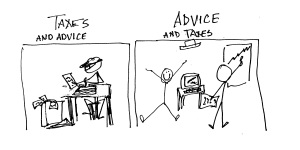
adviceortaxesWhen a small business owner needs advice about running the business or strategizing on financial matters, one would think that the business owner would engage their accountant in the discussion.  Following along with that logic, many small firm practitioners believe that their small business clients will ultimately engage with them for this advisory work and move beyond statutory audit and compliance work.  For a great many firms, however, there remains a struggle to achieve more work and greater opportunity from client engagements; the firm remains relegated to performing mechanical functions of accounting and reporting and fails to gain the additional work which is truly desirable. There are a number of elements which present themselves in this discussion – considerations that the small firm practitioner may not be addressing – and which are likely contributing to the firm losing the opportunity to deliver more and deeper services to the client.

First, let’s consider why small business owners initially engage with their accounting professionals.  More than with larger businesses, smaller businesses tend to rely more heavily upon the involvement of outsourced accounting professionals simply because the business isn’t able to justify the cost of staffing the position full-time.  Needing office managers and bookkeepers or data entry operators is often a more evident need to the business owner, where assistance with daily operational and information management processes are more urgently required.  Functions considered to be “accounting” could effectively be outsourced to a 3rd party and handled in more of an after-the-fact basis.  For many small business owners, accounting is something which can be performed after all the real work is done, and presents the information necessary for payment of taxes, processing of payroll reports and the like.  The accounting professional is typically engaged because the business owner knows this work must be done by somebody, and believes the selected practitioner to be competent and trustworthy, and they’re also probably local.

With the convergence of market environment changes, regulatory and jurisdiction conditions, as well as changes in behaviors (cultural, sociological, technological), a new level of demand has been created for business and financial advisory services. Yet small business owners often remain reticent to approach their local small firm practitioner for the service. Why is it that the client doesn’t often approach their small firm practitioner with requests for advice and advisory services?

Part of the problem is perception.  Small business owners often believe that their needs require specialized knowledge and experience to address, and that the skill and experience can only be derived from a larger firm. Particularly if the smaller firm is not presenting itself in a manner that suggests that business advisory services are not only offered but are a specialty, the firm may simply lose to competitors who communicate the ability more effectively (something larger and more established firms are able to do via referral and reputation as well as through marketing).

A possible way to address the competency and perception issue is partnering, where firms join to collectively deliver solutions to the client.  Where one firm may specialize in an aspect of the engagement and the other firm addresses other areas, the delivery of full service to the client is ultimately the goal, and sharing the work and the revenue is often a more agreeable approach than losing out on the engagement altogether.

Another factor presenting itself in the equation is the “entrepreneurial spirit” from which many small businesses are fueled.  A small business owner is often somewhat of a superman, taking on multiple roles and performing a variety of functions in the business.  It is this DIY (do-it-yourself) attitude that contributes to the business growth and success, but it is also sometimes the barrier to achieving a higher degree of success. Believing more in the personal power of critical thinking than in the reliance on the professional’s education, experience and insight, the business owner simply refrains from asking for advice because they don’t think they need it.

Frugality is another factor playing into the small firm/small business relationship.  Small business owners may want advice, but they don’t want to have to pay for it.  Anyone selling products or services to small business recognizes that there is a certain amount of consulting and advice that accompanies most sales.  For some, this is simply a part of the sales process; helping the customer determine that this is the best choice and they should buy it.  It’s not so simple with accounting and finance, however.  There’s a big difference – and perhaps large risk associations – in giving advice versus performing accounting and compliance work.  Certainly, advisory services aren’t something the firm would elect to give away, so it becomes essential that the value of the advisory service be expressed in a way that the client can understand and believe.

 I once heard a financial planner address this same argument, where a prospective client suggested that they couldn’t really afford to pay for the advice.  The financial planner countered with the argument that a good financial plan will increase the return, which then recoups the cost of the advice.  If you pay $100 for the advice, and you earn $500 more than you would have without the advice, then it kind of feels like you’re getting paid to get advice because you gain more than you spend.  It’s the same with accounting, finance and business advisory services: sound advice should improve the rate of return, which would more than compensate for the cost of the advice.  The trick is getting the client to view the service as something real and valuable and not as snake oil, and to make a commitment to following the advice.  Real value must be communicated and tangible results measured and delivered, not smoke and mirrors.  Otherwise, the client return isn’t there, and the advice proved valueless.

As regulatory requirements increase – and become increasingly complex – the demand by small business for outside help also increases.  It is this ever-expanding demand which represents opportunity for small firm practitioners to capture more (more interesting and more profitable) work from their small business clients.  But competition is also growing from new providers and systems delivering advice, forcing adjustments to how the small firm must present its offerings and services, as well as change how they deliver and support those offerings.Whether through partnering and referral models, the development of new competencies and capabilities, creation of new workflows and methods, or some/all of the above, small firm practitioners must adapt in order to get that opportunity.

While the small firm practitioner may recognize that the small business client is greatly in need of advisory services, what they may not recognize is that the traditional approach has turned around, and it has become more likely that the client will seek advice first and statutory audit work second. For small firm practitioners, it is time to recognize that relationships are changing and how business is done must evolve to meet and advance that change.

jmbunnyfeetMake Sense?

J

Revenue Recognition and closing the reporting GAAP

Revenue Recognition and closing the reporting GAAP

chartOne company earns what the other company spends.  This is business, and it seems like it would be pretty straightforward, accounting for the money coming in and the money going out.  But it is really not that simple when it comes to business finances and accounting for revenue.  With investor pressure to improve share prices and market pressures forcing greater competition, businesses have always sought out ways to make the performance look as good as possible – on paper even if not in reality.  It is this requirement to make the business look better than it may actually be that drives “innovation” in financial reporting, and encourages some companies to use whatever rules are available to mislead investors or paint a rosy picture for stakeholders.  When the balance is lost and financial reporting standards become so oblique as to allow regular and gross misrepresentation, it is time to change the standards.

There are numerous instances of fraud and scandal reported from the finance departments of big businesses, but instances of improper or misleading revenue recognition can happen in even the smallest of companies, and not necessarily on purpose.  It is important to understand that properly and accurately reporting business revenue and earnings isn’t done just for investor satisfaction, it is an essential part of describing business performance that any owner or manager must be able to rely on.

Generally Accepted Accounting Principles (GAAP) provide investors and business owners with some consistency in the financial statements they use to analyze company performance, but only minimally.  This is partly due to the fact that GAAP is based not only on some standards established by policy boards (the authoritative standards) but also on “generally accepted” standards, which are often not really standards at all but simply past practice that was found to be accepted.  Especially in the global economy where fewer businesses operate solely within traditional territorial boundaries – and where accepted reporting methods vary widely – having a single financial reporting standard has become more important than ever.

Make it so, Number One.

Now there are new rules from FASB (Financial Accounting Standards Board) and IASB (International Accounting Standards Board) which provide clear and detailed guidance for how businesses recognize revenues.  These rules are based on a consistently applied set of principles, no matter what sort of business is involved and regardless of where the business is located.

A focus of the new rules of revenue recognition centers on customer contracts, delving into the details of how earnings from those agreements should be recorded. Consider that many businesses combine multiple products and services into a single agreement, even though there may be several deliverables or milestones included.  This method of booking customer contracts allowed companies to report revenues they were not yet due as part of a total agreement, often resulting with inflated earnings reports.   Stakeholders would perceive that the company had reached one earning threshold, but the reality was something quite different and performance expectations were unmet.

“FASB and the International Accounting Standards Board (IASB) issued converged guidance on recognizing revenue in contracts with customers. The new guidance is a major achievement in the Boards’ joint efforts to improve this important area of financial reporting.”  http://www.fasb.org/jsp/FASB/Page/BridgePage&cid=1351027207987

The new rules force an additional level of discussion, including a full set of disclosure requirements that will provide more information about contracts with customers.  Businesses must identify each promised deliverable and attached revenue or earning component, which helps to better understand how the revenue may be earned (and recognized) as the business performs on the various obligations to the customer.

Just take a look at some big ERP companies and the lawsuits generated from problems and failures in delivery – problems that might have been more clearly identified to investors and stakeholders if the tie between product sales and services to be performed were more clearly described.  In many cases, these situations exemplify the revenue recognition reporting problem, where large customer contracts and license sales were fully booked and recognized even though implementation services milestones attached to those license sales remained undelivered.

“2010 – JDA Software (i2) – Dillard’s, Inc.:  Dillard’s had alleged i2 failed to meet obligations regarding two software-license agreements for which the department-store operator had paid $8 million.” http://www.zdnet.com/blog/projectfailures/erp-train-wrecks-failures-and-lawsuits/12055

For private companies, reporting periods beginning after December 15, 2017 must follow the new guidance.  It may seem like a long period of time – from the decision to apply the new rules to the effective date – but the number of businesses the new rules will impact is large.  The FASB made a decision to delay the effective date because of the broad scope of organizations affected and “the potentially significant effect that a change in revenue recognition has on other financial statement line items.”

Business owners and their accounting professionals need to make sure that financial systems and processes are up to the task and can track and produce the detailed reporting these new rules require. For investors and analysts, the new reporting rules and detailed information they generate will go a long way towards minimizing the impact of innovative revenue reporting practices, and will hopefully bring a new level of believability and usefulness to business financial reports.

Make Sense?

J

The CPA for Small Business: Proactive, Responsive, and Helps Paint a Beautiful Picture

chartI once read an article written by Doug Sleeter which describing the findings of a published report titled What SMBs Want from Their CPA.  The report was a summary of results from a study conducted by The Sleeter Group, and was intended to help accounting professionals understand the factors in the market which influence business use of professional accounting services.  While adoption and use of technology was not named as the top item on the list, capabilities which can be rendered only if such adoption occurs were.  In short, it’s not the technology that clients demand, but the level of service that professionals can only deliver by embracing advancements in technology and applying them to the client engagement.

The report and article placed a specific focus on trends relating to technology adoption and use in the professional practice, and establishes a foundation for firms to understand why technology is and always has been a key factor in the success of the CPA-client relationship.  It’s not that the accounting professional must become a skilled technologist and promote high technology to the client.  Rather, the success factor rests with the firm’s motivation to implement technologies and tools which will improve their ability to deliver more (and more valuable) service to the client in a more direct and timely manner.

The survey’s two critical questions posed to small business owners who use the services of a CPA were 1. What factors played a role in your decision to leave your former CPA?, and 2. What types of services would you like to receive from your CPA?   Both questions are pretty straightforward, and the top responses from surveyed SMBs were equally unambiguous.

To the first question (factors playing into a decision to leave former CPA), the top two answers indicated that reactive and/or unresponsive are the problems which ultimately cause a small business owner to change accounting professionals.  The top response was “Former CPA didn’t give proactive advice, only reactive”.  The close second response was “Former CPA had poor responsiveness”.

Unfortunately, these responses more than accurately describe many professional firms and their approach to client service.  These firms are perfectly content with waiting for clients to deliver after-the-fact information, delivering reports long after their relevance has past, and providing no sense of urgency in helping clients address business issues facing them here and now.  These firms are content to work with their write-up and trial balance solutions, depreciation and amortization and tax products – and give little consideration to how they could adjust their operation to a better, more relevant and rapid delivery of service and insight to the client.

The second question, “What services do SMBs want from their CPAs?”, was met with the same responses professionals have been hearing for years; small business owners need help with business planning and business strategy and they wish the help would come from their CPA.   It is surprising how many accounting professionals list business planning and strategy among the services they promote on their websites, and then just sit back and wait for clients to ask.  Communication with clients remains relegated to annual reminders for tax information, or maybe slightly more frequent notes about other tax or compliance work to be done.  It may be a bit unfair to place all the blame on the professional.  Regulatory and reporting impacts on business are increasing and are increasingly complicated.  Many professionals find it challenging enough simply to keep up with changes relating to the services they currently and regularly provide.

This is where practitioners should seriously take notice, and accept that the ability to meet changing market and customer demands is by intelligently leveraging technology to accomplish what people and process cannot do alone.

  • It takes information technology to speed up the bookkeeping, accounting and reporting processes; technology is required to help turn information into useful and relevant data;
  • technology facilitates the faster collection of information from and the delivery of information to clients;
  • technology is applied to reflecting numbers as pictures and helping users visualize the meaning of the data, and
  • technology enables the collection and analysis of “big data”, which leads to AI advancements and greater intelligence delivered through the applications businesses use.

The Sleeter Group report clearly demonstrated that small business owners continue to need and want more than just tax returns and post-facto reports from their accounting professionals, and that the lack of attention in these areas pose a direct threat to the small business/CPA relationship.  Professionals can remove the threat by working closer with their small business clients, applying technology and process controls to get better information in a more timely manner, and returning the result with greater insight.  Be proactive and be responsive, and apply the necessary technologies and business philosophy to get there before the client base looks for satisfaction elsewhere.

I’ve said before that small business owners don’t care about the numbers, they care about the picture the numbers paint, and they care about getting to a place where the picture is absolutely beautiful.  With the right tools in place, their CPA can help guide them there.

jmbunnyfeetMake Sense?

J


