It’s amazing how much time and energy continues to be spent on duplicate data entry and re-keying information generated by one system into another. Human-based data entry is prone to errors, takes time, and carries with it the burdens of employee costs and resources. It is a problem that businesses of all types have battled for years even though enabling solutions have been around for a while.
Methods of integrating applications and data have existed for quite some time, and in recent years these methods have expanded to include a wide variety of platforms and more open standards-based approaches. Even in the small business world, business owners using traditionally limited software products can enjoy sophisticated extensions and integration of their applications and business data.
To provide a simple example of the problem: when an individual writes a check, that check must be recorded for several purposes including the recording of the cost or expense as well as the reduction of funds in the bank account. When a product is sold to a customer, inventory is relieved, sales are increased, accounts receivable or cash is increased, costs of goods sold are experienced, and customer activity is captured. All of this information must be recorded, and the activity accounted for throughout the financial and operational systems and can represent a tremendous burden if not automated. This also means that data exists in a variety of places, increasing the challenges of information collecting and reporting.
Cloud-based integration and infrastructure services such as DBSync and Microsoft Azure enable seamless collection, transformation, aggregation and storage of business data. Whether linking accounting with sales CRM or pushing financial and operational data to an Azure data warehouse for analytics, Noobeh and DBSync provide the data engine and the infrastructure to put it all together.
A small business owner’s situation offers a direct illustration. He sells computer parts through an ecommerce website. Orders from this website are emailed to his order operators, who then turn around and re-key the orders into their accounting system where the inventory is also tracked. Because of the increasing number of sales orders and product purchase orders to enter on a regular basis, there were three operators working in the department responsible for making sure website orders make it into the accounting system. Orders were frequently missed or misplaced, entry errors caused problems in accounting and product delivery, customer satisfaction went down, and the cost of handling web orders was increasing.
By implementing a single software solution, the company was able to not just address the current problem, but was set up to seamlessly increase business without increasing headcount. The solution was a system which takes transaction data from the ecommerce system and imports it into the accounting/ERP system. This single step allowed the business to reduce and redirect personnel costs, improve accuracy and timeliness of data entry, and increase customer satisfaction as well as overall business performance.
In even a small company, one piece of information may be used in a variety of ways and in a variety of systems. This complexity is found in simple business models as well as larger and more complex enterprises, revealing the value of integration solutions and automation tools at every level of operation.
Mendelson Consulting and Noobeh cloud services recognize that every business needs the right information at the right time to operate effectively. Our expert teams help businesses implement the solutions which bring business data together, empowering workers to be more productive and giving stakeholders the decision-support tools they need.
Analysis, forecasts and modeling: What’s the point?
In today’s business world, risk, uncertainty and volatility are just par for the course – everyday realities of simply being in business. Nothing is certain, they say, except death and taxes. Yet there is a fine art to driving profitable growth in a business, and adapting to existing and emerging risk takes a great deal of experience, information and agility. While planning and process development may occur at many levels within the organization, it is the FP&A (financial planning and analysis) capability which helps top performing businesses be top performers.
Financial planning and analysis are activities central to enterprise performance management (EPM) and must necessarily extend beyond finance. Integrating various functional domains in the business (financial, operational and strategic), FP&A should bring data together from the various facets of the business and use the information to help structure and guide the organization toward meeting short-term and long-term goals. Among the most critical of the duties of FP&A is calculating the financial impact, the monetary effects, of potential business decisions. Everything in business means money, so there is always an impact to a decision. With the right information supporting the decision, it is far more likely to have a positive impact and a level of sustainability.
While many CFOs may recognize the importance of performance measurement, planning and forecasting, a great many also believe the process isn’t very effective. The cause is frequently the divide between the various domains in the business and the information systems supporting them. Operational data are distilled into summary financial information and fed to finance systems, losing much of the underlying intelligence that might be gained from analysis of the details. Strategic development and planning may overlook certain volatile elements in the market, or may base successful outcomes on an expectation that conditions within the business will not change. Finding ways to integrate the data from the respective domains into a comprehensive model is essential to developing a better and more robust forecasting and scenario-playing capability. With the right information, analytics may be applied to all facets of management decision-making, anticipating and shaping business outcomes far more effectively than could be done without the insight.
Small business owners may believe that things like “predictive modeling” and “enterprise performance management” aren’t things they need to worry about, but the small business could use this information just as beneficially as a larger enterprise – perhaps even more as the insight could be the key to small business survival and growth.
Using analytics, the owner is able to adjust and re-align strategy in real-time to keep on the right path and goals clearly in sight. Analytics can also help a business better understand what really drives revenue, working capital and profits. Analytics can even help managers align compensation and strategy with business objectives, preventing compensation issues from outpacing business benefit.
There is a cost to growing a business, and some strategies might be more sustainable than others. Time will tell, but it is great if the business owner has some business intelligence that might indicate what’s going to happen before it actually does.
Creating and keeping a competitive edge is critical to building a successful business. Developing a plan, monitoring the plan to make sure the business remains on target, and setting goals for growth and profitability are foundations of business success. But great strategy and detailed planning cannot ensure success because the economy and business environments are unpredictable; no amount of planning is a guarantee that bad things won’t happen and the business won’t experience challenges. On the other hand, regularly monitoring small business performance data can reveal trends and indications that things are not going as expected, and provide a basis for making the decisions necessary to get the business back on track and regain the competitive edge.
Business owners must be prepared to make adjustments as conditions change, acting on decisions made based on business performance data. Whilebusiness analytics are more important than ever, with businesses facing volatility in financial markets and increasingly globalized competition, finding a way to approach the matter is often the biggest barrier. The growing difficulty – the increasingly expanding problem facing business owners and their advisors – can be distilled down to three particularly noticeable trends.
The volume of data flowing into organizations is already high and is increasing.
The data is complex
The data lacks similarity (data is disparate)
The volume of information flowing in to businesses is already high, and is increasing steadily. With all the data collection applications and tools available, and as the business seeks to gain more information and intelligence from more sources, the volume of information gathered by businesses has increased at astounding rates. Technology has adapted to this need, allowing businesses to gather than store vast amounts of data. To be of value, however, the data must be analyzed tofind the answers to questions posed. What technology is only now beginning to address is the complex and disparate nature of the collected data. Coming from varying sources and in equally varying formats, data must be “normalized” and related for it to make much sense.
More Users
More business decision makers in more job roles and functions are getting involved
More people approaching the problem with their own “brand” of analysis
In a very small business, decisions are generally made by the owner. This is most often due to the fact that the owner is the person who not only knows what’s going on in the business, but is generally the one doing a lot of the work. As businesses grow and bring in personnel to manage various functions, these managers become decision-makers. Decisions are made in businesses at all levels, and as management layers are compressed, those “closer to the action” are being handed more responsibility for the decisions impacting their areas. Without a comprehensive and company-wide framework for data analysis and reporting, these individuals and workgroups find ways to capture and analyze the data they feel is pertinent to their requirement and within their own realm.
Less Time
Timeframe for making decisions is shrinking, and is shrinking at an “alarming” rate
The “velocity” (rapidity of motion) of business is increasing
It may be that, in some businesses and markets, certain decisions don’t have to be made with any great speed. Businesses or markets of this type are tough to find these days because the Internet, information technology and connected systems have all but eliminated the effects of time and distance. Just about everything in business today moves at a rapid pace, and that means that business decisions are often demanded on-the-spot, providing little time for detailed consideration and working through the problem. Without the tools and data providing meaningful real-time visibility into business performance, decision-makers may be able to act fast but not wisely, and are most frequently guided by their “gut feel” as to what the right move is.
Driving Small Business Analytics
Business decision makers are now recognizing the need to know more about the business and how it is operating and competing in order to effectively address the choices and decisions faced each day. The cause for this recognition may be due to variable elements, but the conclusion reached was the same: good business decisions require business analytics to support them.
Not surprising was the report finding – that the majority of small business owners felt pressured to adopt a business analytics solution primarily due to the fact that “critical business decisions rely too much on “gut feel”. Surprise! Other drivers listed were lack of visibility into operational metrics, the growing number of people in the business who want analytical capability, the business’s inability to identify and act upon business opportunities, and having less time to make decisions.
Steps to Get There
As with any business project, there are “degrees of success”, and the ultimate success of a business initiative requires that all parties be on board with it. Businesses who recognize a need to improve their analytical capability, but who do not then empower their systems, processes and people, will not achieve the same result as those who do.
Focusing on the business data, it is important to address both the volume and disparity by creating formal data management practices and policies, and implementing systems and processes which assist with the intelligent capture and storage of business information. Simply retaining the data is not useful; it must be presented and applied in a meaningful manner for it to become useful as decision-supporting information. The value of the information increases dramatically when it becomes truly useful to the business. Additionally, by empowering a broader framework for data collection and analysis, businesses extend the “intelligence” to others in the organization, supporting individual and workgroup efforts to make better decisions for their respective areas of responsibility. Of course, if the information is not provided in a timely manner, its value is reduced if not eliminated (hindsight may be 20/20, but that doesn’t help you see where you going to step next). Any approach to building business intelligence should leverage connectivity and integration to provide a timely delivery of complete information how and when it is needed.
What’s the Proven Benefit?
source: article
The obvious benefit of business analysis is that business owners are provided with data to help them understand more about the business operational and financial performance. The real and proven benefit is that the information provides a basis for gaining insight into trends and conditions which impact performance, and which support making the necessary decisions which facilitate improvement in various business areas.
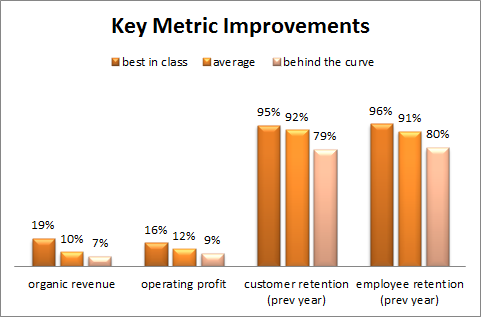
The highest level of proven benefit, according to the Aberdeen Group report, was achieved by those businesses who embraced the requirement to know more about the organization and operation, and who implemented a focused effort at building business intelligence.
Fast Facts: Best-in-Class SMBs Achieved 24% year over year increase in new customer accounts sold compared to 12% for the industry average, and 11% for the laggards.
These organizations which achieved the greatest improvement operated from real data rather than being guided by gut and emotion, enabled the entire organization to participate in the development of organizational and business intelligence, positioned themselves to identify and act on new business and market opportunities, and ensured that those who must make decisions have the information and insightful data to support making the right ones.
Accounting Professionals Should Do This: Be Proactive and Regularly Communicate with Clients
I’m not sure where I heard it, I think it was a sky diver on TV, who said about the sport “you’re dead until you do something about it”. At the same time that I realized that I never wanted to sky dive, I also realized that this fairly desperate philosophy at some level applied to a lot of business situations. Weirdly enough, one of them was how this relates to public accountants and bookkeepers working with small business clients.
One of the things I’ve heard a lot throughout the years is that bookkeeping and doing other work for small business clients is tough, because they never bring you the information you need when you need it. With a philosophy of “help me help you”, accounting professionals are trying to find ways to make it easier for the client to deliver the work to them. The missing element, however, is a closer working relationship with the client, coupled with PROACTIVE and REGULAR (please note the big letters) reminders that getting the work to the professional is the only way to get it processed in time .
How many firms really communicate with clients only during tax season? Is the client organizer your main method of reminding them that you’ve got a relationship? It’s not even funny how many business owners couldn’t name the accountant who did their tax return last year, and who don’t seem to care to know. This is definitely not the way to build and retain client relationships, yet it is the approach many professionals take. And then they wonder why the client base isn’t growing, and why they are having a hard time “communicating their value” and they want to know how to get more of that profitable “higher level” work.
You’re dead until you do something about it.
Put into the context of the reactive accountant, it starts to make sense. Accounting professionals must be proactive – be doing something to build customer loyalty and retention, be actively and regularly communicating with clients so it’s not a mad rush during tax season, and be implementing tools and solutions to help them offer more meaningful services to their clients. This is how to make the firm grow and thrive. So, go do something about it.
If you own and operate a business, you probably want to make it successful. Granted, success comes in many flavors, and there are also “degrees” of success, where maybe you do okay but not as well as you’d like (or not as well as your local competitor). Running a successful business, and crafting a business with sustainability and long-term value, takes information as well as know-how. Remember that information = power and you want to be as powerful as possible when it comes to running your business.
While today’s information technologies, mobile devices, and “everything as a service” have the capability to deliver way too much information for the average business owner to make sense of, there are a few areas of the business where investing in a little insight and reporting can make a big difference in the level of understanding you have about the business.
Rather than making decisions based on guesses or gut, business owners should use actual historic data relating to these are key areas (and key performance indicators) to help predict sales and order volumes, estimate cash flows, and forecast profitability.
Getting Customers
The “customer lifecycle” does not start when someone buys from you, it starts when they become a potential customer (often referred to as a target). Even before someone buys, your business may expend resources to expose your brand or product to them on websites, in advertisements, and through other marketing channels. These marketing efforts will (hopefully) result in the generation of qualified leads for the business to sell to. Unless the business understands the costs involved and the efficiency of the marketing and lead generation efforts, it cannot understand the actual cost of getting a new customer.
The next step in getting customers is turning a qualified lead into an actual paying customer. The business will want to keep track of conversion of leads into customers, along with sales data including total sales, number of items sold, and how items were priced. Powered by sales performance data, business owners can learn whether or not their lead qualification efforts are working, if their products are competitive, and if the pricing is in alignment with the industry.
Producing Work
When businesses operate, they essentially produce whatever work product their business model is designed to produce – whether it is a professional service, product, logistical support or whatever. Every business produces some type of work product. This is the operational aspect of the business, and business owners should want to know as much as possible about how well operations are running and how effective the operation is. This isn’t just the cost of production, (the yield expected for a given investment in materials or equipment), it is also about the quality of the product (customer satisfaction) and the quality and value of the service behind it (customer retention).
Keeping Money
Money (more specifically, cash and the availability of it) is the metric that most small business owners tend to focus on. It makes sense, too, given that most small businesses survive based on what they have in their bank accounts. Then again, looking at the accounts receivable and payable won’t tell the entire story, either. Business owners need to know how quickly their customers generally pay, and they need to know how much capacity or inventory they have before needing to buy or develop more.
The message underlying this entire discussion is that fact that you can’t analyze what you can’t quantify (no information = no power), so it is essential that systems be in place to capture information from the business and its activities. Further, recognize that it takes some skill and experience – perhaps from your trusted accounting professional – to put the information together so that it makes sense and is useful.
Make Sense?
J Measure, Manage and Succeed. It’s all about knowing how to speak the language of finance
An Educated Guess is Not a Crystal Ball – Forecasting the Future
If every business could peer into the future to see how they will perform, there wouldn’t be a need for historical data and performance benchmarking. Unfortunately, nobody has a crystal ball, so it becomes necessary for business owners to plan for the future. By making educated guesses with valuable information gleaned from the past, companies can establish the path they will take to growth and profitability.
Accounting professionals are great at producing accurate historical financial performance information. The value in this historical data is only partially found in the periodic reports and financial statements generated. The primary value, the insight delivered from this historical data, is the information it reveals about the business operation over time. It is from this historical data that certain trends are identified, providing a basis for making the educated guesses necessary to learn how the business will look in the future.
Forecasting is very important for businesses, as it provides the framework for laying out your expectations for the business. In essence, it is a way to (hopefully) predict what your business finances will look like in the future based on forecasted growth. And, armed with the forecast, you can now more confidently build a reasonable plan to reach your stated business goals. While there are myriad approaches to creating a business forecast, it makes sense to simplify the process and focus on the area you likely spend most of your time attending to: sales. Use your sales goals and projections as the basis for establishing a forecast, setting realistic goals for the current year and for a few years after that. Once you’ve forecast the new sales goals, you can more easily appreciate what it will take in personnel and other costs to support that growth.
Recognizing that the forecast is simply an educated guess, it is important to regularly compare actual performance to the forecast to see if the business is on the right path to reach the established goal. If sales are not growing as projected, then the business may need to make adjustments in terms of personnel hiring and other plans to ensure that costs don’t outpace sales. Without a path to follow, business owners will not necessarily know if the operation is “on track”, as there is no track to be on – there is nothing to measure success against. Certainly, profitability is the goal, but it is a matter of degrees of success, and the business will not know whether it is being as successful and profitable as it might be.
Accounting professionals should help their clients create realistic forecasts, along with organizing the information and formulating a plan for the business owner to follow. On an ongoing basis, the accounting professional’s involvement delivers continued value by helping the business owner recognize and respond to changes in the business, adjusting plans as necessary to keep the business on the right path. And, no crystal ball is required.


 Make Sense?
 In today’s business world, risk, uncertainty and volatility are just par for the course – everyday realities of simply being in business. Nothing is certain, they say, except death and taxes. Yet there is a fine art to driving profitable growth in a business, and adapting to existing and emerging risk takes a great deal of experience, information and agility. While planning and process development may occur at many levels within the organization, it is the FP&A (financial planning and analysis) capability which helps top performing businesses be top performers.



 Cooper Mann Consulting