

Efficiency and Value with Cloud Accounting

For some accounting professionals, the problem is finding a way to provide services that are valuable to the client, and doing it in a way that makes it profitable for the provider.  Outsourced and online accounting models are the answer, employing innovative tools in the practice and with clients: tools and resources necessary to get more informed and run the business better.
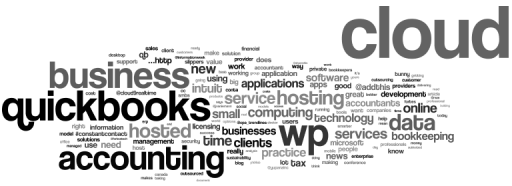
accountingCloud

With online accounting solutions the firm is able to increase profitability with the range of services offered, often adding clients and work without hiring more personnel.  Online solutions allow professionals and their clients to work from anywhere at any time, providing both with the freedom to focus on core business capabilities (and lifestyle).

Reducing the requirement for sophisticated on-premises technology may mean providing everyone with the ease of use and security of server-based computing models, which is among the benefits of a cloud IT approach.  Centralizing and managing applications, protecting valuable data resources, and streamlining business processes are among the benefits to be achieved with an outsourced, managed application hosting solution.  Businesses who outsource their IT management often realize an increased capacity to do business simply by leveraging the cloud to make the current working models more efficient and effective.

Leveraging mobility and real time access is also about increasing the overall range of opportunity to deliver value.  Contractors, employees and clients all find improvements in getting the information they need when it matters, and the firm finds a greater agility in meeting client demands and expanding service offerings.

Cloud computing and online accounting solutions have proven the viability of anytime, anywhere working models, and professional accounting practices of all sizes and orientations are realizing the benefits of working closer with their clients by applying them to the engagement.

Cloud accounting is really about improving the profitability of the accounting practice while delivering higher levels of service to the client.  The movement of information from one place to another; translating data from one form to another – these are the processes representing the cost and inefficiency in the practice, and are specific areas where a collaborative, online approach may introduce new service efficiency and value.

jmbunnyfeet

Make Sense?

J

It is worth noting that “cloud accounting” and online accounting models do not necessarily require the use of a SaaS solution.  QuickBooks Online, Xero, Freshbooks – these are new small business offerings that exist purely on the web.  QuickBooks desktop editions can be “cloudy”, too, when they’re hosted by an authorized QuickBooks hosting provider.  The point is not necessarily to use web software, but to approach IT management and systems from an outsourced perspective, allowing for centralized management and administration and delivering secure remote and mobile access.  The systems should facilitate the working model, not force it.

The Productivity Paradox: Accounting for Returns on IT Investments

The Productivity Paradox: Accounting for Returns on IT Investments

There has always been somewhat of a struggle between the IT department and “management”, much of the difficulty existing with the need to demonstrate clear returns on investments for IT purchases.  Unfortunately, expenditures in information technology are often the result of short-term views of long-standing problems, applying “solutions” that do not fully address the requirement or which do not deliver the productivity or performance gains expected, particularly in a dynamic and rapidly changing business environment. The assumption is that a wise investment in information technology will result with improved profitability and performance.  Demonstrating this on paper is not always easily accomplished.

There is a great deal of research on the subject of accounting for returns on IT investments.  Some of this research describes “The Productivity Paradox”, referring to early studies on the “relationship between information technology and productivity, and finding an absence of a positive relationship between spending on IT and productivity or profitability”. [1]  Previous to the emergence of cloud computing and widely available remote and mobile technologies (and now possibly even more with the prevalence of available options), businesses invest heavily in IT infrastructure and applications which deliver nominal benefit to the business when measured against the cost of acquisition and implementation.  Heavy IT investments are made with little or no measurable benefit to profitability, even if operational performance improvements are created.  In many cases, the difficulty in “proving” benefit from information technology investments rests with the lack of information relating to impacts in non-operational areas, such as with investors, auditors or analysts.

The early research has become a foundation for making the argument that accounting professionals should be more directly involved in determining the value and impacts of IT investments – due largely to the fact that accounting professionals are generally familiar with the variety of formulas and approaches which become relevant in measuring the effects of IT purchases.  Information technology spending will result in short-term impacts, but will impress on the business over the longer view as well. With a foundation in accounting principles, valuation and analysis, and accompanied by IT knowledge and experience, management accounting benefits from an improved ability to recognize the relevance and value in IT implementations even where no direct profit improvement is visible.

Can difference in firm performance be explained by differences in IT investments?
Can differences in firm performance be explained by differences in IT investments?

Emerging technology models are having huge impacts in business capability as well as risk, and this new paradigm requires that accounting professionals apply their skills to understanding more fully the influences from and results of IT spending in the enterprise.

Having a basis for studying valuation and recognizing the good and bad of focusing on various key measurements (return on assets vs equity vs sales vs investment…) is essential in developing a “formula” for predicting impacts of and potential returns from IT spending, and solving the puzzle that is the productivity paradox.

jmbunnyfeetMake Sense?

J

[1] Journal of Information Systems Vol. 16; “Returns on Investments in Information Technology: a Research Synthesis”

Predicting Outcomes and Providing Guidance | Being Nostradamus| Proformative.com

I have a gripe with the accounting profession.  My gripe is with the fact that accounting information delivered to most business owners is old news.  Stuff happened, the professional properly recorded it and reported on it,  you paid your taxes, and that’s that.  Game over.

Once upon a time, accountants had to work with book ledgers, pen and pencil (mostly pen, putting that single line through incorrect entries), and stacks upon stacks of paper documents.  Just keeping up with the process of recording transaction information, adding it all up (and making sure the footing totals jibe), and then summarizing the information into usable form took all the time available, and the focus was on the accuracy of the work – not necessarily the timeliness of it.  With the advent of computers and computerized accounting systems, the process of creating and storing the data became easier, but the volume and nature of information increased and thus the complexity and time to process increased (the “everlasting gobstopper” problem.. it never really goes away).There isn’t any argument over the critical value and importance of that work.  Every business owner understands that not properly accounting for business activities can mean increases in tax burdens, penalties and interest, and more.  It’s good work… but what do you do with it?  My intent is not to try to diminish the value of today’s approach to accounting.  Rather, I’m trying to point out how the accounting profession could make a huge impact in today’s pathetic economy, help businesses get financially healthier, and help put the small/medium business market on a path to growth and success.  It involves seeing into the future.

These days, technologies exist which facilitate acquiring the information (even in paper form), converting that information into digital data, and then actually interpreting the data to arrive at a transaction.  Traditional software and cloud service providers alike are recognizing that mechanical data entry is passé, and do-it-yourself solutions for accounting and bookkeeping will rely upon “smart” engines which can read and properly understand what each scanned document means.

So – once the accurate data entry problem is solved… what’s the next logical step?  Analytics!  It’s only really possible now that online solutions have brought the business information to the accounting professional in real-time, and have allowed the accounting professional and the business owner to collaborate and share data faster than ever before.  If information is power, we have a lot of power in our hands… but do we really know it?  This is where BI (business intelligence) and analytics come in, and where the opportunity exists for the accounting profession to become a guiding force in rebuilding our economy.

What if an accountant could not only tell his client that the business lost money last year or last month, but that they’re going to lose money through this month and year if they don’t change their behavior?  And, what if the accountant could run a variety of scenarios which would help forecast the most positive business outcome based on certain choices which could be made, or certain activities which could be handled in different ways?  What if the accountant could help his client peer into the future, and get an inkling of what the business could look like if certain economic or business conditions continued… changed… ?

Maybe I’m a little overzealous when it comes to believing that the accounting profession could have recognized the economic trauma which was coming, or that they could have prepared their business clients for it.  But I don’t believe I’m very far off the mark in believing that not nearly enough “analysis” occurs in the typical public accounting engagement, and even when it does… is the suggested path the right one?  I would submit that BI is new enough to so many people that it may not be.  Learning what the numbers are telling you is one thing… staving off disaster is quite another.

I would encourage all BI and Data Analytics fanatics to check out an article on CFO.com on this subject:  That New Big Data Magic  http://www3.cfo.com/article/2011/8/analytics_that-new-big-data-magic

A few memorable takeaways from the article:

“you may be spot-on about a problem, but the solution doesn’t magically appear out of the data.”

“what you do with [data] is a people-based activity, a skill base you have to mature.  And it doesn’t come quickly.”

“CFOs have a gut sense that there’s money out there in all that data… The challenge is how to turn that data into new opportunities.” The good news.. is that new technologies are making it more economical to make sense of Big Data… The caveat is that those technologies will not provide those opportunities. That’s still up to the people who make business decisions.”

jmbunnyfeetMake Sense?

J

reblogged from Proformative.com  Being Nostradamus – Predicting Outcomes and Providing Guidance