Private Equity: Operational Systems Create the Value Financial Models Only Predict

Executives signing acquisition documents during a private equity deal meeting

Why connected workflows and reliable data are essential to scalable growth

Financial models can project revenue growth, margin expansion, cash generation, and even a successful exit. But a spreadsheet cannot produce those outcomes. Value is created inside the business, through operational systems that make work repeatable and data integration that gives leaders a reliable view of performance.

From Financial Plan to Operations Reality

An integration plan for operations should address a practical question: What will the company be able to do consistently better after the integration that it cannot do today? The benefits are typically found with consistent approaches to pricing, structure and pipeline reporting for sales, streamlined and preferential purchasing capability, guardrails for and improvements in service delivery, creation of working capital, and analytical reporting with an AI capacity.

Those capabilities depend on systems. Pricing needs govern discount rules and margin visibility; sales needs a defined process and trustworthy pipeline data; and cash conversion requires billing, inventory, purchasing, and collections to work as one coordinated workflow.

Integration Turns Activity into Insight

Many companies have the necessary applications but still lack visibility of the relevant data. Customer, transaction, inventory, project, and financial data often remain in silos, use inconsistent definitions, and arrive too late to guide meaningful decision-making. Teams will try to compensate – using spreadsheets, manual reconciliations, and competing versions of the truth.

Data integration creates a shared view of how activity becomes revenue, profit margin, and cash. Leadership can see whether price increases are making a difference, which opportunities convert profitably, where purchasing savings are gained or lost, and why earnings aren’t getting to the bank account. This is not about simple data movement; it’s about having timely, trusted information to support business decisions as they are made.

Standardize Before You Automate

New software cannot repair an undefined process or inconsistent data. To standardize something, first establish ownership of a process or area, make sure everyone is using the same definitions, understand where decision rights exist, and identify the most meaningful measures first. From there you can move to stabilize critical workflows, standardize the master data, connect the systems supporting high-value decisions, and automate.

The key is to connect investments to operating outcomes, such as faster quoting, better sales forecasting, reduced inventory, fewer billing errors, and more efficient administration.

Build for Acquisitions and Scale

Acquisitions introduce more and different applications, customer structures, products and product codes, reporting practices and more. A repeatable integration capability defines what must be standardized, what can remain local or localized, how the data maps across systems, and when reporting comes together. This approach reduces operational disruption and accelerates time to value, capturing the synergy more quickly.

The Real Source of Durable Value

Long-lasting value does not come from having more technology. Extended value return comes from operational systems which employees can execute, integrated data that business leaders can trust, and a management mentality that turns information into action. When pricing, sales, procurement, delivery, and cash management use connected processes and consistent data, growth becomes more predictable and margins more defensible.

Turn Fragmented Operations into Measurable Results

Ready to connect your systems, improve data visibility, and build more scalable operations? Noobeh is ready to help!

Let’s start by identifying your highest-impact workflow and defining the business outcome, and then together we’ll create a practical integration roadmap. The sooner your applications, data and processes work together, the sooner your strategy can produce measurable results.

bunny feetMake Sense?

J

Controlling SaaS Inflation

The cost of everything is going up, and that is as true for businesses as it is anywhere else. From office space and salaries to vendors and suppliers, everything is hitting the bottom line harder than before. For businesses invested in online application services and Software-as-a-Service solutions, the rising cost of usage is outpacing other expense categories at a fairly high rate.

Consider that many small businesses start with whatever is cheapest and easiest to use, which usually means a web-based solution. From there, the business cobbles together it’s IT by using a variety of applications and services and eventually ends up with a tangled web that can be difficult to straighten out.

Even larger enterprises find that shadow IT implementations and web-based application services make their way into the mix, costing companies greatly through unmanaged subscriptions, lack of vendor management, and missed opportunities for consolidation of resources.

Covid and remote work requirements fueled a lot of the growth in SaaS adoption as businesses implemented solutions and services to support a distributed workforce. Leaving millions of square feet of office space unused while at the same time investing in remote and mobile work, businesses have had a hard time of it.

According to an article on CFODive, “Software inflation has remained “stubbornly high” this year at a rate of 8.7% — more than double the inflation rate as measured by the consumer price index in the U.S., according to research conducted by London-based Vertice, a software-as-a-service and cloud spending management company.”

In 2023, SaaS inflation increased by 8.7%, meaning the same unchanged set of SaaS products will cost businesses significantly more than it did a year ago.

Vertice.one SaaS Inflation Index report


The Vertice report indicates that sales software, finance software and productivity tools represent categories of software that saw inflation rates of over 10% as compared with 2022. Another uncomfortable reveal from the report is that most software companies simply hiked their prices, and in some cases, they hiked them up a lot (23% increases, for example). The rising cost of Software-as-a-Service, referred to as SaaS Inflation, is a lot higher than with other products.

Part of the problem may be the global nature of online application services and SaaS companies. Costs of operations and the pricing of the product may be consistent across geographies, yet different regions will experience inflation in costs of other goods and services based more on regional factors. The result is a SaaS inflation rate higher than the consumer inflation rate. Yet even in areas where the SaaS inflation rate seems to be more in line with consumer inflation, it’s still a lot higher than many other categories of products and services. Only food and beverages compete at similar levels of price inflation.

Another part of the equation is the value for the dollar. Everyone knows that a dollar today buys less than it did last year. At the grocery store, this shrinkflation is obvious when an item is now more expensive, and you get less for the same price. With SaaS, the shrinkflation may not be quite as obvious. License packages change, features are introduced (or removed), and the value to the customer can change dramatically over time while the rates simply increase.

There are some important steps a business can take to minimize the impact of SaaS inflation, and it all starts with knowing what you have and how you use it. Reducing or eliminating shadow IT and implementations outside of general governance, consolidating vendors and licensing, and reducing redundancy in functionality and process support are key areas to focus on to control the spend.

Mendelson Consulting has experienced consultants that can work with your business to understand your needs and evaluate your options, helping to find the right solution for the problem while minimizing sprawl and spending.

Whether you rely on Software as a Service, Infrastructure as a Service, or any other -as a service solution, the Mendelson Consulting and Noobeh cloud services teams can help you do more with your investment.

jm bunny feetMake Sense?

J

Direct-to-Consumer Causing Manufacturing Logistics Issues

Manufacturers have traditionally been positioned as a link in the long chain of supply. Somewhere between raw materials and finished products is where the manufacturer exists, transforming the materials into products that can be resold via distributors and wholesalers.

The supply chain was linear and relatively predictable, but that is all changing. With the introduction of broad internet connectivity, web-based services, large e-commerce platforms and increasingly innovative and competitive new logistics players, the supply chain is becoming a spiderweb of connectivity and communication, with linear approaches out the window and, to some extent, predictability along with it.

The economy we have today is an environment where customers demand more direct and personal approaches, and producers are being forced to find ways to accommodate. With the huge e-commerce platforms like Amazon and Alibaba, along with more direct-to-consumer channels, manufacturers are being turned into direct-to-consumer suppliers. Acting as drop shippers for the seller, the manufacturer isn’t shipping bulk or volume to distributors or wholesalers but smaller shipments direct to the consumer.

Many retail stores have now become more fulfillment locations than the place where the customer buys. This is causing tremendous change in logistics tools and approaches because the size of shipments is becoming smaller while the number of deliveries – and delivery locations – is only increasing.

Customers can go right to the brand’s website and buy direct, driving increased focus on building brand value and improving the overall customer experience. With the demand from consumers for flexibility in how and where they buy, retailers have shifted their approaches to bring e-commerce into the brick-and-mortar stores. This is where online and offline sales channels come together, creating pressure in ordering and fulfillment systems to offer the flexibility and experience consumers want.

While this converged channel model requires businesses to make new and continued investments in e-commerce and digital solutions to enable the flow of orders and information, it also delivers several potential benefits to the business, including the ability to better manage growing customer expectations, better compete in the digital marketplace, and address disruptions in the supply chain by having alternative options.

Delivering the goods has always been an operational challenge, with success often measured in performance and cost. Today’s marketplace requires more agility and flexibility, which means the role of supply chain managers is more strategic than ever. Simple logistics now has a direct impact on the customer’s decision to buy now, as well as buying again later.

jm bunny feetMake Sense?

J

Are You Prepared for SQL Server 2008 End of Support?


Everything gets old eventually, and now it is official for SQL Server 2008.

03-2012sean-phone-328-e1377042261105On July 9, 2019, support for SQL Server 2008 and 2008 R2 will end. That means the end of regular security updates and general support for the product. Are you ready?

It took more than 10 years for Microsoft to end support for our beloved SQL 2005 and version 2008 has enjoyed a similarly long reign. But it’s over and you need to get used to the idea. Even more, you need to get upgraded to a new version of SQL so your systems can still be patched, updated and supported. With all the nasty exploits out there, letting your software get out of date is more of a business risk than ever.

With cyberattacks becoming more sophisticated and frequent, running apps and data on unsupported versions can create significant security and compliance risks. The 2008 family of products was great for its time, but we highly recommend upgrading to the most current versions for better performance, efficiency, and regular security updates.

Now is a Good Time to Consider Azure

Microsoft is giving a present to businesses that want to migrate their workloads to Azure. For those customers that elect to take this as an opportunity to move to the Azure cloud, extended security updates will be available for free in Azure for 2008 and 2008 R2 versions of SQL Server and Windows Server to help secure workloads for three more years after the end of support deadline. Moving existing systems to the Azure cloud is a natural step in modernizing the business infrastructure and makes the next step of upgrading to managed database services and/or migrating to new Azure servers a lot easier.

Upgrading isn’t simply a matter of maintaining status quo, either.

Moving to new versions can be a foundation for new strategic capability and increasing overall business potential, powering new decision-making processes fueled by analytics and business intelligence.

The Microsoft Lifecycle Policy offers 10 years of support (5 years of regular support and another 5 years of extended support) for the 2008 and 2008 R2 versions of SQL Server and Windows Server. When the extended support period ends, there will be no patches or security updates, which always creates security risk.

If your business is going to remain competitive, you can’t rely on outdated systems.

Your business is tough enough to manage without having your systems work against you.  Software that prevents you from keeping up with demand, creates risk in compliance and security, and reduces operational performance is not what you need. Collecting, storing and rationalizing data takes power and speed, and securing your growing information warehouse requires vigilance in security and update management.

Use this opportunity to review your platforms and applications, and consider moving your on-premises or co-located systems to the cloud. The upcoming milestone is a great opportunity to transform applications and infrastructure to take advantage of cloud computing and the latest versions of SQL Server and Windows Server.

jmbunnyfeetMake Sense?

J

MSP, IT, Telecom, Channel: Convergence and the Cloud

Small and growing businesses have always relied upon various service providers and vendors to deliver the solutions required which support the business operation. Often viewed as the critical infrastructure of the business, phone and computer systems are among the first acquisitions a new business makes.  Phones and voice service, wired and wireless networks and all forms of communications infrastructure are part of IT and represent a large portion of the business information systems.

Small businesses used to have a phone guy they could call for phone stuff. The phone guy was a person or company who got phone lines installed, ran cabling for phones, installed phone systems and set up voicemail. The phone guy could help get cheaper long distance calling rates and train users on how to use the paging system and transfer calls.  The phone guy interacted mostly with the office manager or receptionist – the person in the office most likely to be “in charge” of the phone system, influencing these purchasing decisions greatly.

The computer guy, on the other hand, made sure the workstations and server were working, defragged hard drives, installed software and set up printers. The computer guy was the person or company that sold and supported the IT in the business, and often consulted with the business owner or line manager when it came to addressing information system requirements.

Telephony and networking is now clearly in the realm of IT, which changes how services are selected and purchasing is influenced. Computing and communications infrastructure, networking and mobile is all part of business IT. The separation of services – voice versus data – is gone.  The phone vendors and the IT suppliers are now the same company, providing the critical infrastructure, the platforms and the application services that businesses are buying. These service providers understand that the foundations for delivering voice and data services are the same; the skills of their techs and the tools they use have converged to the point where there is little separation of duties.

Cloud services and outsourced solution providers offering hosted PBX and virtual applications infrastructure have revealed to business owners that there is often little difference in what the phone guy and the computer guy can provide. Business owners want converged solutions: voice and data when and where they need it to support business operations. Just a little research reveals that these anytime/anywhere models are widely available and that the cloud is the key.

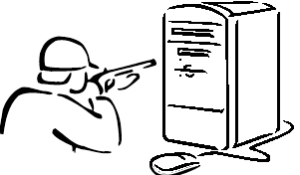
IT services are critical to the business, but the server doesn’t have to be under the front desk or in a back closet in order to function.  There is simply too much evidence in the market for these business owners to ignore;  shooting the server is now a viable option.

Every day more business owners are being inspired to [shoot their servers] seek out the services that will allow them to continue to benefit from innovations in technology while relieving them of the direct responsibilities of equipment purchasing, implementation, administration and lifecycle management.

Cloud services deliver this capability, and channel partners and Value Added Resellers should recognize their opportunity to get inspired as well, and to start offering cloud-based and hosted services to their customers and capture the “buying decision” opportunity that has [been] created.

Ready. Aim. Fire.

Source: Go Ahead and Shoot the Server: End of Microsoft Small Business Server Inspires Cloud Adoption with Small Businesses « Cooper Mann Consulting

Recognition of the convergence of voice and data services and channels hasn’t really hit home for a lot of resellers and channel partners, and this has rightfully positioned providers on both sides of the equation as viewing the others as direct competitors.  The phone guy thinks he is his customer’s “trusted advisor”, and that the loyal customer will certainly come to him if there is ever a need.  As well does the computer guy believe that he is the trusted advisor, having the ear of the business owner and wielding enough influence to ensure a continued revenue-earning relationship.

In truth, both the phone guy and the computer guy probably have earned their business customer’s trust and were the go-to people when there was a new business need. The problem is that the customer may no longer call one or the other of their “go-to” guys because the forward-thinking guys are offering one-stop service that delivers everything the business needs.  The lines between phone and computer stuff are not so clearly drawn any longer; it is all cloud IT and full service providers are winning the customer business.

Channel resellers, agents and MSPs are all telling their SMB/SME customers the same things, and at a base level they’re selling the same things, too.  Everyone is talking about lower up front investments and improved business productivity… and what they’re all selling is cloud and virtual. “Businesses need cloud in order to compete; move CapX to OpX; mobile is the new office” and “remote workers and devices need a secure quality network”.

Whether it relates to telephone systems with voicemail, automated attendants and a little intelligent voice response thrown in, or if the deal is for servers and workstations, software and network cabling, it is all business information technology and the trusted advisor is the guy who can provide it all. Convergence has clearly arrived.

Make Sense?

J

Focusing on Transformation

Focusing on Transformation

In January of 2007, Network World published an article stating that “user satisfaction with software as a service (SaaS) is starting to slip, but customer interest in this method of outsourcing IT functions is continuing to grow“, and says that recent survey results clearly demonstrate SaaS being “a dominant force going forward”.  That was 10 years ago, yet the same message is being played out today as managed services and hosting continues to grow in popularity. IT outsourcing makes sense for thousands of businesses, whether the software is part of the package or not. Today, outsourcing IT is almost an imperative if the business is to keep up a competitive pace.

Users need and demand mobility and will get their anytime/anywhere access to applications and data however they can get it. Businesses require agility in their technology, which is difficult when significant investments in hardware and infrastructure must be earned out prior to any new investment. Making systems accessible from outside the firewall, securing them in a reasonable manner and keeping them up and running all the time so users can access at any time is not a job for part-time IT.  Keeping the systems on and available at all hours requires full-time IT management, and this is in part what fuels the popularity of outsourcing it all.

SaaS (Software-as-a-Service) goes a long way toward helping businesses manage their IT costs in that the systems are part of the service.  The hardware running the application, the storage of the data and the support accompanying the solution are all part of the package.  Unfortunately, the SaaS solutions is not generally the only thing in use by the business, so continued reliance upon PCs, desktop software and locally stored data causes IT management costs to persist.  One size does not fit all, even with online application services.  Although customizations and add-ons can help a single app become a broader solution framework, there is usually something left behind that ends up anchoring a process or function to the desktop, device or local network, and requiring IT management and administration to go along with.

Application hosting services compete somewhat with SaaS in that the systems and management of them is included in the hosting service subscription fee.  While the business user retains licensing of applications and the flexibility of using the software already embedded in the operation, the organization is enabled to focus on operational improvements and not on the underlying systems supporting them.  By reducing or eliminating the requirement to directly manage and maintain servers, complex networks and user working environments, businesses are able to focus their in-house technical energies towards innovation and improvement. The centralized nature of the system facilitates new collaborative capabilities while allowing the business to build on the knowledge and base of information already invested software and processes.

Outsourcing IT service provisioning and management is just a baby step towards improving the business agility and positioning the organization for growth. Real digital business transformation begins with a change in the business mindset: not simply a focus on operational processes and improvements, a new strategy should evolve where the enterprise is situated to interact with its market seamlessly, at any time and all the time.  Businesses that wish to compete at this level must consider whether or not purchasing and maintaining their IT infrastructure is where they wish to focus their energies or if they’d rather invest their technical talent towards market building and transformational objectives.

Make Sense?

J