Unlock KPIs and Improve Reporting with QuickBooks

It is surprising how many businesses still keep boxes of 3×5 ledger cards with customer and vendor information on them. More likely than the card box, the business may be storing its essential customer billing and vendor product information in the accounting system because that is the system they have.

These growing businesses need a better system to capture more information that delivers greater detail for accounting and reporting purposes. Just as likely, the business has other information it should and possibly could be capturing but isn’t sure about what steps to take next.

When details that inform a process are not part of an integrated system, it creates greater potential for lost or inaccurate data. The larger the volume, the more difficult and error-prone managing the information becomes.  

Business needs more detailed information about… everything.

Businesses may need to track time for payroll or jobs or both, job tracking may be a requirement, inventory tracking or more detailed inventory management may all be areas for greater attention. Mendelson Consulting can help develop these capabilities by making sure the business is using the right software, and then enabling the functionality needed to support the workflow and capture more and better data.

No data means no KPIs.

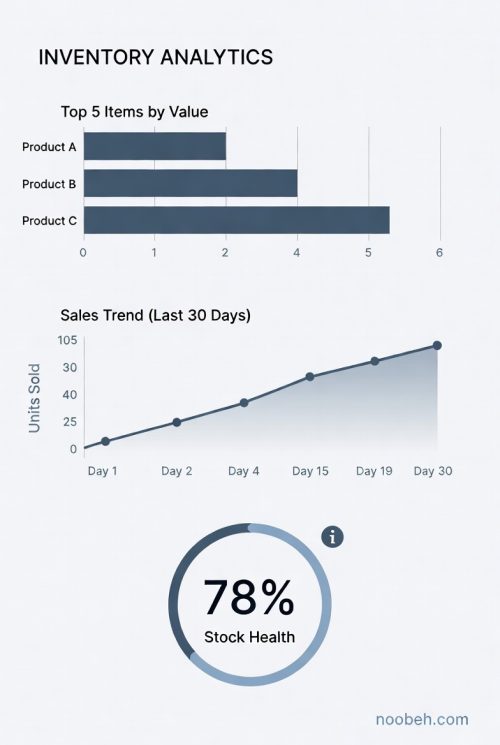
More and better data means more information to fuel KPI reporting. Key performance indicators can reflect operational performance in a variety of areas and may help identify where improvements are required.

Using data from the accounting and operational systems, businesses of all sizes measure their effectiveness using KPIs to evaluate the successes – or failures – of their processes and activities.

Mendelson Consulting’s team of QuickBooks Enterprise Experts and ERP consultants provide guidance, implementation and training, and report development to get beyond bookkeeping to proper processes that result in good accounting data. Mendelson’s cloud services team – Noobeh – sets it all up on Microsoft Azure, where data connectors, data warehouses and Microsoft Fabric weave it all together.

Whether just starting out or an enterprise or franchise expanding at a national or global level, we help businesses do more with their systems and software. We understand each stage of business and how to help our clients reach their next best level.

jm bunny feetMake sense?

J

Mo Bigger Data

Losing valuable business data is a terrible thing. It is worse when it’s done on purpose. Every business faces changes in accounting or operational systems over the lifetime of the company and these changes more frequently than not include losing data of some type. And that means losing business intelligence.

The frustrations of changing business systems are compounded the further into the business life cycle the change comes. Much of the historic intelligence of the business is derived from the earlier days of operation. This is data which reflects the stages and activities of the business over time. When a business reaches a point where data volume or list sizes force a systems change, much of that early historic data is ultimately abandoned. There is so much data to load into a new system that the task often proves too daunting for the company, so valuable historic detail information is lost and summary information is loaded into the new system.

As a business matures, and for the business to mature in a healthy manner, specific and detailed information must be captured and analyzed. Software addressing a broad view of the business, offering only generalized functionality and basic process support, will not provide a growing business with the operational support and resultant business intelligence needed at this level.

For example, a manufacturing business needs to fully understand and manage the manufacturing processes and materials supply chain to ensure profitability and consistent product quality. A retailer needs to know which products sell in which markets to ensure product stock and availability to key customers. And all this information is time-critical if the business is to make necessary adjustments in time to benefit from them.

In the end, it is the demonstration of well-defined processes, deep insight into the business operational metrics and financial performance, and the ability to effectively and accurately report on this information that creates a basis for provable business value.

Mendelson Consulting understands how important it is to not just collect the right data to support various processes, but to use that data to better understand operational and financial performance. As operations grow, so does the need to collect data from a variety of possible sources, from phone systems to time clocks and more. Even getting data out of the accounting system can be a challenge, but there is tremendous value in having transparency of business data.

From data warehouses to data lakes, Power BI and data visualization, we help businesses access their information and develop reporting that not only informs but helps deliver greater insight which leads to improvements in performance and profitability.

When information is power, we help owners and stakeholders gain mo power by being mo better informed.

jm bunny feetMake sense?

J

Transform Your Business with M365’s Integrated Accounting Solution

The Best Alternative to QuickBooks May Be Part of a Fully Integrated Framework You Already Use

When looking at the business accounting and finance systems available in the market – particularly considering those which have earned a level of market share – there are visible gaps – big ones.

This is clearly reflected in the numbers, where Intuit QuickBooks leads in the small business market but has no reciprocal in the midrange or enterprise markets.

QuickBooks fits into that early space where the business is just starting out, but QuickBooks Enterprise can expand to keep more detailed customer, vendor and item information. Yet there often comes a point where a business has requirements that extend beyond the ability of the QuickBooks software.

Sometimes the mere thought of change is so terrible, usually based on a bad initial implementation experience, that the business uses the software far beyond what it was built to handle. In other cases, add-on solutions are adopted which offer more in-depth or complex capabilities to handle the growing business requirements. Both options may prove to be temporary solutions, meeting most functional demands as long as business needs don’t change.

If a change is in order, it makes sense to consider the benefits of using tools built on a familiar platform that is essentially a framework for designing exactly the system the business needs now, and which has flexibility and scalability enough to change as the business changes.

We understand that an integrated framework can provide much more scalability and support than a standalone solution.

We also recognize that, in today’s modern business, creating workflow efficiency and enabling user productivity are paramount.

While many products calling themselves ERP systems offer a broad range of functionality, integration, and data management capability, they often dictate more to the business how it must operate rather than revealing how it might operate.

Instead, we believe every business should have the opportunity to adapt their business software to make it easier for users to accomplish their work effectively while delivering the data and insight to guide the operation forward.

The need is for an entire tech stack and framework, not simply an application.

Competing ERP systems on the market typically address more and increasingly complex business processes while scaling to support larger business sizes. But the cost and complexity of these products, coupled with poor or too-expensive implementation services, is often the barrier to their adoption and retention.

In most cases, there is no small business version of the big business software, so the upgrade path is unclear and problematic.

Given the huge gap between the “typical” small business system and the upper-levels in the enterprise applications catalogue – the transition from very small to very large software is not likely to be made in a single step. Yet businesses can reduce the number of migration steps in the lifecycle of the company by moving to a flexible platform that can adapt and scale with the operation.

There are three things every business does: communicate, produce information, and keep score.

Microsoft places at the top with the first two, providing email and other communication tools used by businesses of all sizes around the globe, and creating the Microsoft Office family of productivity tools recognized and used by just about everyone.

In the third spot, keeping score, Intuit QuickBooks remains the clear winner. But when the business needs something beyond QuickBooks, or desires to have a solution that fits better, and maybe even integrates into their current M365 working environment, we can introduce the stakeholders to M365 Dynamics Business Central.

Business Central is part of the Microsoft 365 family of products.

Business Central is part of the Microsoft 365 family of products and is integrated with Microsoft Outlook directly, as well as the rest of the family of applications.

It is all able to be connected to the Microsoft Fabric, which weaves together the solutions and services that drive business operations around the globe.

Microsoft has the framework to provide the entire stack of applications, services and technologies working seamlessly together to deliver functionality and process support to fit the business and how it works.

When a siloed financial solution no longer supports the business requirement, or as operations become unworkable due to software that no longer fits the needs, connect with the experts at Mendelson Consulting to see what options are available.

There is never just one way to solve a problem, but there is usually a best way.

jm bunny feetMake sense?

J

Phishing, Cybersecurity and Your Small Business

Phishing can have a significant and often devastating impact on small businesses. Unlike larger organizations, small businesses typically have fewer resources to dedicate to cybersecurity, making them an attractive target for cybercriminals.

Small businesses can be impacted by phishing and other types of attacks in ways that might not have been considered before. Here are some of the more common ways that phishing attacks can impact the business:

Financial Loss
Phishing attacks often result in direct financial losses due to funds being stolen, fraudulent payments being made, and ransoms being paid. Cybercriminals often use phishing emails to trick employees into transferring money to fraudulent bank accounts, and attackers may impersonate legitimate vendors or clients to request fake payments. Worse, phishing emails can be used to deliver ransomware, locking up or encrypting critical systems or data until a ransom is paid.

For small businesses, even a single financial loss can be catastrophic.

Data Breaches
Phishing can lead to the compromise of sensitive business information or customer data, such as customer personal information or payment details, employee credentials or other private information of the employee, or business trade secrets and other proprietary business data. Data breaches can easily result in legal liabilities, fines, and damage to the business reputation.

Reputational Damage
When a phishing attack exposes sensitive customer information or disrupts services, it erodes customer trust. This can lead to clients taking their business elsewhere and makes attracting new customers harder. It could also impact vendor relationships, causing partners to view the business as a weak link in the supply chain.

Operational Disruption
Cyber-attacks, including phishing attacks, can disrupt business operations and cause numerous problems. Ransomware or malware delivered through phishing emails can render IT systems unusable, causing loss of productivity. If employees lose access to critical tools, files, or data, there will be delays in work and projects. Businesses also must divert time and resources to recover from attacks, taking away from regular business operations and revenue-generating activities.

Why Small Businesses Are Often Targeted
Small businesses are rich targets for cyber-attacks, especially phishing, because they often have weaker defenses compared to larger enterprises. Often made up of a few trusted employees, small businesses are attacked in ways that exploit trust and personal familiarity. Due to many small businesses having weaker cyber-defenses, attackers can find high payoffs in financial rewards or valuable data with a single successful phishing attack.

Noobeh Helps Businesses Protect Themselves
Every business should teach their employees how to recognize and report phishing emails, and MFA (multi-factor authentication) should protect all accounts, but human beings can only do so much, so it makes sense to implement tools that can put additional intelligence behind your services and defend your systems to help keep the problem from ever getting to your users.

Our team at Noobeh recommends and provisions Microsoft Defender for Office 365 to block phishing emails and messages with malicious links and content. Advanced email security helps reduce inbox spam and blocks messages from spoofed senders, which helps prevent users from interacting with bad emails and potentially exposing protected information.

Email protection is only part of the needed coverage. Noobeh also recommends having strong endpoint protection solutions to detect and prevent phishing-related malware and other attacks. Microsoft Defender for Endpoints does this, working seamlessly with our remote monitoring and management and your other Microsoft services to provide a higher level of protection for the business.

By understanding the risks and taking proactive measures, small businesses can minimize the impact of phishing attacks and protect their operations, reputation, and customers.

jm bunny feetMake Sense?

J

Enhancing Business Insight: Noobeh Cloud Services and Azure-Based Solutions

Technology is evolving and so are our ways of using it. While the rules of accounting haven’t changed for years, the solutions we use to do the work have changed a lot. Yet there remain many businesses that haven’t yet embraced the idea of fully digital workflows, integrating and automating how data moves through the “system” to provide a comprehensive view of the business and how it is performing.

This is where accountants and bookkeepers can best serve their clients, by helping them implement the platforms and solutions which transform operations and provide greater insight into these areas.

Over 20 years ago, a technology model was developed which allowed businesses and the accounting professionals who serve them to work directly and collaboratively in the clients’ accounting system. By hosting QuickBooks and Sage desktop products on host servers, small business users and their accountants could both access the software and the data in real time.

This new approach was a boon for accountants, bookkeepers and others working with small business clients as it not only enabled closer work, but also provided those advisors an opportunity to do more – and more complex – work with the client. Yet many platforms and working models created barriers to broadening the scope of service or access to client systems, limiting to just basic accounting products like QuickBooks, and not effectively addressing the rest of the business need.

As technology has evolved, so have these transformations.

More accounting professionals understand the benefits as well as the necessity of moving from analog to digital workflows, removing manual entry and improving efficiency and accuracy of data. Yet this improvement doesn’t require changing accounting software and undoing years of learning and business knowledge. Rather, the platforms and connections must be the primary focus, replacing the manual with automation and smoothing out the bumps where data isn’t flowing at all. If the system isn’t in place to handle the complete flow of the data, there is a break. Like a pipe leaking water, this break results in data loss – which is also loss of business intelligence.

A key to all of this is the consideration of where the data ultimately resides. When business data exists in closed silos – whether web-based software or closed hosting platform – it takes a comprehensive approach to collection, storage and analysis. This is among the benefits to be derived from the modern cloud and Noobeh’s Azure-based hosting approach.

Noobeh’s hosting is not just about the desktop or the applications.

The cloud platform, and Azure in particular, also provides resources for data analysis and business intelligence, workflow and data flow automations, improved security and identity management, IoT and computing on the network edge.

For professionals looking to evolve their practices by helping clients go beyond basic recordkeeping and reporting, it’s time to delve into the operational details, data flows and development of real business intelligence and insight. Noobeh Cloud Services and Mendelson Consulting have the platforms and the supporting services to help bring it all together, improving profitability and performance of their clients through the intelligent application of technology.

jm bunny feetMake Sense?

J

Cybersecurity and Retail Should Always Go Together

Retail cybersecurity is a critical concern for every business in the retail industry, which is why cybersecurity and retail should always go together. Retailers are prime targets for cyberattacks due to the valuable customer data they collect, which usually includes personally identifiable information (PII) and credit card numbers. Retailers can handle large volumes of customer data, which becomes an attractive target for cybercriminals seeking to profit from selling it on the dark web.

Recent statistics from various sources suggest that more than 24% of cyberattacks specifically target retailers, making it one of the most heavily targeted industries. Roughly one third of retailers cite cybersecurity concerns as their primary obstacle in transitioning to e-commerce, with cost and technology barriers coming close behind.

For the bad guys, however, it is all about the money. Almost all retail cyberattacks are driven by financial motives. When consumer data is compromised, most of the information exposed consists of payment information and personally identifiable data which can fetch a good price on the dark web.

Retail cybersecurity threats occur because the environment tends to have a lot of elements. The hybrid nature of many retail businesses introduces additional risk, where brick-and-mortar stores are combined with e-commerce platforms and services.

NFC (Near Field Communications) vulnerabilities exist in some payment systems, and many Point of Sale (POS) systems still do not use point-to-point encryption for their communications. Even if communication streams are encrypted, it makes little difference if the software has known vulnerabilities or if insecure plugins or add-ons are being used.

Cloud-based storage and mobile apps increase the presence of stored data online, which increasingly leads to new threat vectors like cloud-based botnets and more.

The key is for businesses to prioritize security and invest in platforms and solutions that will help protect customer and business data. Critical in this effort is the implementation of IT best practices in regularly updating operating system and application software, limiting the access users have for installing or modifying software on their devices, and always monitoring the systems for vulnerabilities.

Like cybersecurity and retailers, Noobeh and secure IT go together. We help retail and other businesses proactively address cybersecurity challenges so they can protect both their business and their customers. Noobeh cloud services helps retailers secure their business servers and systems, delivering scalable, high availability and highly agile solutions that keep business and finance operations running.

Noobeh provides services for Microsoft 365 and Microsoft Azure platform and deploys solutions for manufacturing, inventory management, multi-channel commerce, EDI, financial and more. Get together with Noobeh and find out how we can help your business operate more securely and with better, more agile and resilient IT.

jm bunny feetMake Sense?

J