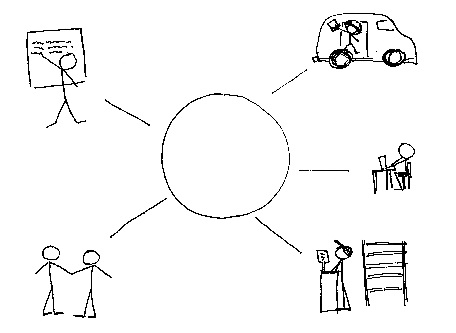
Finance Department Participation in Supply Chain Management

When most businesses approach Supply Chain Management, the focus is on the item or product – the physical thing that ultimately gets delivered somewhere, somehow. What many businesses do not consider is that the orchestration and timing of “supply chain” activities can have significant impacts on financial performance, reporting and cash flow. The current processes could just be working just “okay”, and not delivering the financial benefit that might be obtained through modernization of technologies and transformations in approaches. The key is to get the right people involved.

One big aspect of seeking to integrate electronic commerce and collaboration with customers, suppliers and payment services is the recognition that supply chain activities involving orders, invoices, payments, and remittances are directly related to finances, revenue recognition and cash management.

For any project to be successful, it should include execs from both the supply chain and finance areas so that all concerns relating to event timing may be addressed to allow proper treatment in the financial statements. After all, the same things that trigger supply chain activities (orders etc) are the same documents which drive finance. When the information is accurate and timely, and when the inefficient manual processes can be replaced with electronic workflows, the business is best positioned to improve cash flow and overall financial performance as well as business value.

Unfortunately, few business owners have a real understanding of the costs associated with manual entry activities and how the direct financial impacts they have. The speed and accuracy of processing orders and invoicing customers means faster cash in, and leveraging the speed of electronic data interchange with suppliers so that “just in time” orders may be placed and logistics processes more fully enabled means cash out when necessary and not ahead of time.

… using a digital transaction for payments allowed [businesses] to hold on to cash longer and better control the timing of the release of funds, something more difficult to control when mailing a physical check. Check fraud remains rampant across many industries. According to an AFP payment fraud and control survey, 70% of U.S. organizations reported check fraud in 2019, responsible for more than $18 billion in losses.” –

source: What Every CFO Needs to Know About Supply Chains; Study published by DiCentral and Lehigh University; 2012

For example, there are many studies which show that purchase orders that are not sent digitally are most often manually processed, and that this manual processing may be done by any number of departments in the company – but most often the job falls to finance. Rather than looking to eliminate the manual entry of data and the errors and delays that come along with it, businesses execs first looked to where the lowest labor cost rests and had them handle the extra data input.

A digital strategy that transforms inefficient manual process into efficient electronic workflows is the better solution. While many companies have approached streamlining of activities by exchanging manual entry operations for data file formatting and imports, they still have not solved the problem as would be with an integration that takes even less human time and effort.

The real goal of any business improvement effort is to improve overall business value. By bringing in finance along with supply chain execs to the “digital transformation” discussion, the business is much better positioned to make real progress in areas that directly impact cash performance as well as long-term business value. It comes down to having all the information and being able to weigh the risks against the potential rewards to be gained from the contemplated changes.

jm bunny feetMake Sense?

J

It’s Not Easy Being Small – Thoughts on the Disruption and Rethinking Business Priorities

The global pandemic has been the source of disruption to business and personal lives for over a year now and businesses have found that, regardless of the challenges they face, business must continue.

With operations and supply chains strained and positive cash flow at a premium, companies everywhere are focusing on the fundamentals while enabling work-from-home and distancing mandates. COVID-19 has, in many ways, become the event that is forcing many businesses (and entire industries!) to rethink how they operate, and to look to transform their global supply chain models.

A fact that can’t be argued with is that the pandemic has exposed where many businesses are vulnerable, being heavily dependent on supplies of raw materials or finished products that are no longer readily available.

What’s also been exposed is the lack of agility in business I.T. infrastructure, as operations struggle to find ways of continuing operations with reduced personnel or users working from various locations and finding that their systems aren’t really helping in those efforts.

“Supporting small manufacturers has probably never been more important that it is now”, said a panelist at the “National Conversation with Manufacturers” session hosted by the National Institute of Standards and Technology’s Hollings Manufacturing Extension Partnership (NIST MEP). While larger companies are certainly impacted by what’s happened this year, small manufacturers face the challenge of running a company with a smaller available base of resources, technology and supporting tools.

“The conversation’s participants represented very small manufacturing companies with fewer than 20 workers. They all recounted a mad scramble over the past six months. First, they had to figure out whether their operations were essential enough to stay open under their state-mandated shutdown orders.

Then began the efforts to keep their workers safe, implement cleaning regimens, source protective materials, respond to public health protocols that evolved during the pandemic, determine what emergency support they qualified for, and go through the steps to access funds. All of this was being done with a small staff that needed also to continue getting product out and deal with obstacles to normal operations. Hurdles included delays and disarray in the supply chain, disruption in cash flow, with both account receivable extensions and overnight changes in credit terms, shipping impediments and customers still expecting on-time deliveries.”

https://www.nist.gov/blogs/manufacturing-innovation-blog/sometimes-its-not-easy-being-small-manufacturer?utm_medium=email&utm_source=marketingcloud&utm_campaign=

To add to the troubles, disruptions in global trade with China have created significant impact in supply chains worldwide. Companies who rely on direct and secondary suppliers in China are currently experiencing significant disruption, and this is likely to continue. But it isn’t just China… countries around the globe are experiencing challenges with having enough personnel, materials and technology to deliver their goods.

For so many years, businesses have focused on optimizing their supply chains to minimize costs, reduce inventories, and increase asset utilization. This streamlining has also removed the buffers and the flexibility to absorb disruption. COVID-19 has shown that many companies aren’t aware of their vulnerability when supply chains suffer from a global shock of some type.

So, how can organizations respond to the immediate challenge?

There are steps that businesses can take to help address the changing conditions facing businesses today, and a major item that should be addressed is the alignment of IT systems and support to evolving work requirements. Further, enhancements in operational systems should be made to illuminate the extended supply network and enhance inbound materials visibility, and a new focus on production scheduling agility as well as evaluating alternative outbound logistics options should be approached.

NOOBEH’s cloud solutions have been the foundation for business continuity and operational support throughout these difficult times.

We’ve helped companies around the country implement Microsoft Azure cloud servers where they are able to run their entire operations. From order entry, manufacturing, inventory management, pack and ship, and through to accounting and finance – businesses run their applications, integrations and services that allow them to keep the business operating even with reduced personnel or as their users are forced to work from home. OneDrive and SharePoint file storage, and TEAMS for closer collaboration and simplified access to information, helps hybrid working models and distributed workgroups stay in step with projects and business goals.

As a Microsoft Cloud Solution Provider, Mendelson Consulting and NOOBEH provide and administer Microsoft 365 and Azure services, enabling us to more closely manage the licensing and computing platform to make sure it works in the best possible way for your business. With NOOBEH managing your services, you get predictable performance at predictable costs, allowing your business to operate without interruption or subscription overages.

As the past year has proven, life is unpredictable. Let Mendelson Consulting and NOOBEH help your business implement the cloud services and technologies that will give your organization the ability to adjust to changing conditions because you’ll have the most agile IT platform available.

jm bunny feet

Make Sense?

J

Connecting Your Web Store to QuickBooks on Azure

If you sell products via the Internet using a web store or shopping cart application, then you are probably facing the problem of getting your order and sales activities into QuickBooks and then getting shipping and product information back into the web store. For some, the additional need is to mirror the products and pricing information between the inventory management or financial system and the web store. In many businesses, this is a big chore and requires literally hours of redundant data entry and updating.

As with any manual process, there are many opportunities for errors and mistakes which ultimately cost the business both time and money.

Online selling is a dynamic business, and the sale is made when the customer is ready and willing to buy and the seller has the item available at the right price. The web store (ecommerce system) exists to process this sale in order to meet the immediacy of customer demand. If the system is not up to date with current product or pricing information, then the customer may not find what they want, and the sale is lost.

This means that the connectivity between the online selling system and the inventory/accounting system is of paramount importance in the ability to do business.

Synchronizing inventory information between the web store and the inventory/accounting system ensures that product and quantity information is updated on the web as product is sold and shipped (or received in). At the same time, importing invoices and sales receipts into the accounting system helps to ensure proper and accurate recording of sales and payment information and improves tracking of accounts receivable, shipping charges, and sales taxes.

cloud-small-business

To make this connection between the Web store and the inventory/accounting software, an integration solution or connector is generally required. The connector gets installed on the same systems as the inventory/accounting solution (on the same systems as QuickBooks, in this case) and provides the mechanism to synchronize data between the web store and the accounting system.

Integrating an always-on web store with an on-site accounting solution can be a challenge, even for the most tech savvy business owner.

Creating seamless processes for exchanging data between these remote systems requires that both solutions be operating in a secure and accessible platform. While the web store is accessible via the Internet, getting to data in accounting and other systems residing on local PCs or networks is more problematic.

An option that many successful online businesses have adopted is NOOBEH‘s QuickBooks on Azure service, which provides centralized hosting and management for the QuickBooks desktop and any connected inventory or warehouse management applications as well as the integration to the web store.

Enabling the accounting and operational systems to be online and always on, like the web store, allows them to exchange data when and where it is required.

Connecting services in a secure and managed environment introduces new efficiencies and eliminates risk due to data entry errors or lost transactions. The QuickBooks on Azure cloud hosting service provides the system management, platform security and uptime required to ensure that the inventory and accounting systems supporting the always-on web store are also always on.

jm bunny feetMake Sense?

J

Where in The World is Your Data?

Where in the World is Your Data? Even better.. where would you like it to be? In a datacenter near you? In a datacenter far away from you? Maybe you’d like your production system nearby, but backups stored on the other side of the country. Or perhaps you want redundant systems on each coast as well as something somewhere in the middle.
With Microsoft Azure as your platform, you have all the choices in the world, literally.

Microsoft Azure is the platform of choice for businesses of all sizes, offering virtualized infrastructure and services that can be tailored and tuned to meet the unique needs of any organization. No longer tied to on-premises infrastructure, companies find that they can implement better and more comprehensive solutions because they have the agility to adapt systems to immediate needs while retaining the ability to adjust as conditions change.

With Microsoft Azure and Microsoft 365 Services, NOOBEH enables businesses to focus on transformation and improving efficiency, not the IT that supports it.

NOOBEH cloud services, part of the Mendelson Consulting team, sets up Azure infrastructure and manages it for their clients. Business users focus on getting their work done, not on the IT supporting it. NOOBEH QuickBooks on Azure services give small and medium size businesses the most flexible and resilient infrastructure available to run all their desktop and network applications.

Because QuickBooks is rarely a standalone solution, NOOBEH QuickBooks on Azure services have no limitations on what add-ons, extensions, integrations or other applications the business may need to use. All the software a business needs can be deployed on the platform, allowing the company to keep its information systems and assets secure, fully-managed and available when and where they are needed.

While NOOBEH uses Azure platform and Microsoft 365 services to continue to deliver new capability for private sector users, Microsoft is advancing innovation in the delivery of connected services and computing power for private and government sector users wherever it is needed. Azure Modular Datacenters represent a partnership that delivers computing and communications capacity anywhere in the world… and beyond.

Microsoft Azure Modular Datacenters and SpaceX

The Azure modular datacenter is basically a “data center in a box”. It comes with everything needed to deliver computing capacity anywhere in the world.

“We designed the Azure Modular Datacenter (MDC) for customers who need cloud computing capabilities in hybrid or challenging environments, including remote areas. This announcement is complemented by our Azure Space offerings and partnerships that can extend satellite connectivity anywhere in the world. Scenarios range from mobile command centers, humanitarian assistance, military mission needs, mineral exploration, and other use cases requiring high intensity, secure computing on Azure.”

https://azure.microsoft.com/en-us/blog/introducing-the-microsoft-azure-modular-datacenter/

It has power and everything else it needs, and now it also has the connectivity needed, even when there is no (zip, zero) infrastructure. Microsoft has partnered with SpaceX, using SES satellites to bring Internet connectivity to remote areas.

“We can connect via satellite links any element on the Earth to another point on the Earth..”

https://arstechnica.com/information-technology/2020/10/microsofts-new-data-center-in-a-box-will-use-spacex-starlink-broadband/

They’re calling it part of “a multi-orbit, multi-band, multi-vendor” approach to connectivity. That’s pretty cool, if you ask me.

It takes the whole bookkeeping in bunny slippers philosophy of “work when and where it works for you” to an entirely new level.

Make Sense?

jm bunny feet

J

Update your Mac to keep getting Office application updates

Microsoft’s upcoming November 2020 update has some direct impacts to users running macOS, especially if running macOS 10.31 or earlier. As of November 10, 2020, existing Microsoft 365 for Mac users running macOS 10.13 or earlier will not receive any further Office application updates. If the machine is upgraded to macOS10.14 or later, updates will be allowed to proceed on that computer.

With the Microsoft 365 for Mac November 2020 update, users running macOS must be running 10.14 Mojave or later in order to continue to receive updates for Office applications, and any new installs of Microsoft 365 for Mac will require macOS 10.14 or later.

Word, Excel, PowerPoint, Outlook and OneNote are the applications included which will no longer receive updates – including security updates – if the macOS they’re running on is too outdated.

Among the benefits of using Microsoft 365 is that the software is always kept up to date, including enhancements and new features as well as security and safety updates that help keep the software (and the associated data) more secure. You may continue with the older version of macOS, and your Office applications will continue to work. But losing out on updates not only keeps you from benefitting from the most current capabilities of the software (and getting full value from your subscription), but it also puts your security and compliance at risk.

Microsoft 365 applications are continuously updated with new features, connected services and enhancements to security. Modern operating system platforms are necessary to support some of these improvements, requiring users to update their computer operating systems as well as the applications running on them. With the Microsoft 365 November update, Mac users need to be running one of the three most recent versions of macOS to keep their Office applications recent, too.

Make Sense?

J

Building A Solid Foundation for Business Cybersecurity

The cybersecurity threat landscape has changed dramatically in the last few years. No longer primarily a big-business concern, cybersecurity has become a key focus of businesses small and large. Attacks on SMBs are on the rise, perhaps because they represent a plentiful and often easy target. And the cost of damage and disruption to business just keeps going up.

Cybersecurity is not a problem you can simply throw a bunch of money and tools at to fix.

No matter how much great software or fancy systems you implement, the people will always be a big part of the equation. The root cause of over half the data breaches reported is a result of negligent employees or contractors.

That means that nearly half of all attacks are being executed through phishing or social engineering. The only tool you can apply to this problem is education. Efforts should be focused on security awareness and training workers to be more cautious to the point of almost being paranoid. Better to be safe than sorry in this case.

Training workers to be more careful as they work with emails, documents and websites is part of it, but there is much more to making sure the business is addressing the entire cybersecurity issue. NIST (National Institute of Standards and Technology) offers a wide variety of information and guides that businesses can use to learn more about and implement cybersecurity practices. Among these resources is the Cybersecurity Framework.

According to NIST, “the Framework focuses on using business drivers to guide cybersecurity activities and considering cybersecurity risks as part of the organization’s risk management processes.” It is a highly useful tool in helping the business align and prioritize activities with business requirements, risk tolerances and resources. The standard framework includes elements that are consistent and common across sectors and critical infrastructure, so it can be oriented to any business.

Even if the business is not prepared to delve into the details of a comprehensive cybersecurity policy and guideline, a basic outline and approach cannot be avoided without asking for disaster.

Putting this squarely into the Risk Management category, there is an ongoing process of identifying, assessing, and responding to risk situations or conditions. To manage the risk, businesses need to consider the likelihood that an event will occur and what the potential impact is as a result.

Knowing the acceptable level of risk for reaching the business objective is the risk tolerance. If a business understands its risk tolerance, the company can prioritize cybersecurity activities and make informed decisions about cybersecurity expenditures.

There are five key functions to consider as it relates to cybersecurity risk: Identification, Protection, Detection, Response and Recovery. How the business addresses each of these in the context of the systems and activities is essentially the business’s cybersecurity posture, a high-level and somewhat strategic view of the organization’s management of cybersecurity risk.

The key to building a solid foundation for  business cybersecurity practice is to establish a platform where all the business applications and data can be identified and access secured.

User desktops, productivity applications, operational software and business data can be hosted on private cloud servers, allowing the business to fully-manage data and application access. The server-based model reduces or eliminates the need to sync data to devices, and remote desktops keep user environments secure, patched and up-to-date.

Our consultants can’t write your cybersecurity policies or determine your risk tolerance, but we can help implement a solution that improves fault tolerance, resilience, and recovery.

Make Sense?

J