Migrating Business Data to the Cloud

Migrating Business Data to the Cloud

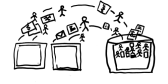
When businesses elect to have their desktop applications hosted in the cloud with a hosting service provider, they are also electing to have their data hosted with the provider.  This point is not always obvious to non-technical users and those unfamiliar with the hosted application concept.  Many business owners have adopted an online or hosted application solution and then realized after-the-fact that their data was no longer present on their computer.  At least, no current data was present, and it was quite a surprise the day they wanted some information but could not get it because they were not connected to the Internet at the time.  An important thing to remember, and the essential factor in measuring risk associated with use of cloud services and hosted solutions, is that adopting online applications in almost any form means that the data associated with (and possibly even data remotely associated with) the application will also migrate to the cloud.

mobile cloud data

Migrating on-premises servers – and the applications and data residing on them – to the cloud makes sense for many businesses.  Particularly as network and internet threats increase in number and as system vulnerabilities are more frequently introduced with remote and mobile access technologies, cloud solutions can significantly assist a business in mitigating the risks of being connected.  Yet business owners and IT managers must be diligent in terms of understanding the measures their service providers take to protect and preserve as confidential the customer’s business data.  And it becomes more than essential that any and all tools or services implemented be part of a strictly controlled information management and data protection plan.

Where applications are simply interfaces and logic; the value for a business is in the data used by the applications – data containing information about the company, how and with whom it does business, and how it makes money.  It is critical that the business consider how and where users need access to applications and data, so that any cloud deployment does not wind up hindering productivity rather than facilitating it to a greater level.  It is when the user becomes disenfranchised, unable to perform their work due to lack of access to information or tools, that “shadow IT” deployments appear, and data sharing solutions are introduced outside of the governance of management or IT.

The vast number of offerings for hosting applications and managing business data in the cloud makes finding and implementing the right business solutions a complicated and often frustrating process.  Even large providers that specialize in delivering from a menu of business cloud solutions often forget that their target customers may not be particularly tech-savvy, and will fail to recognize the nuances in service delivery or protection that could make big differences to the business down the line – like in the case of a system failure or outage.

Among the keys to a successful cloud solution deployment, particularly when critical and frequently used applications and data are to be migrated off-premises, is a thorough understanding of how users currently work with the tools provided, ensuring that processes and utilization can be fully adapted to the new IT model.

As long as users are able to retain their productivity and efficiency, and when improvements in workflows and information access become additional benefits, the security and protection of the business data is more likely, as users will feel less compelled to find alternative and less secure means for making the business data available from the cloud.  You may want to migrate your business data to the cloud, but you don’t want your data to migrate further than you can reach.

Joanie Mann Bunny FeetMake Sense?

J

A Higher Level of Customer Relationship Management: Building Closer Customer Relationships

A Higher Level of Customer Relationship Management: Building Closer Customer Relationships

Most businesses recognize the importance of creating a quality experience for customers doing business with them.  The thing that many business owners overlook is how their internal workflows and information management systems serve to either support or impede the delivery of a well-rounded positive customer experience.  Growing businesses must adjust their processes and improve their tools in order to have the necessary information available to workers at various levels of the organization, providing a centralized means for collaboration, data sharing and analysis.   With the right information systems and process support, even small businesses are able to function at exceptionally high levels and provide the consistently high-quality service and customer experience that establishes long-term value in each and every customer relationship.

Businesses which excel at providing very high levels of customer service tend to have a few common characteristics – features of the business that identify it as an organization geared towards growth and success in driving the customer engagement and business value.  Among these characteristics is the recognition of the need to use technology better – leveraging automation to a greater degree to create consistency in work performance, and improving information collection and integration to provide more context and depth to the data. Added efficiency which affords employees time to focus on customer oriented tasks and elevating the customer experience even more is the payback.

total-business

Many CRM solutions describe the benefits of a “360 degree” view of the customer, yet these solutions often orient themselves to supporting only sales and Contact Management and do not address product and/ or service delivery (fulfillment of what was sold/ordered)  or project management, contracts and agreements tracking or other aspects of doing business with the customer.

Granted, customer interaction occurs most frequently with sales and service teams, but there are potentially vast number of processes and tasks performed within the business which operate with the same information as sales and services, and which would benefit by integration within the same information and workflow framework.

By selecting a solution that addresses the wider variety of business and information management requirements rather than focusing solely on sales and support, business owners and managers find that they are better able to address internal workflows with streamlined process automation.

The result is significant improvement in the quality and completeness of the information available to users throughout the organization, ultimately improving the quality and nature of customer engagement and interaction. Perhaps even more impactful is the ability for the business to better understand  the context of and motivations for customer interactions, and (most importantly!) having the capability to take immediate action based on that knowledge.

With the right customer relationship and business management solution in place, and with a focus on systematic approaches to enabling process and workflow automation, businesses can become more flexible and responsive to changing customer needs and expectations.  Creating the complete view of the customer relationship and capturing the data which helps users understand the dynamics of the entire relationship serves to build closer customer relationships that will strengthen and grow over time.

When a business needs to implement a Customer Relationship Management solution to address sales and support needs, it makes sense to also review information management requirements for:

  • Delivery of products and/or services  – i.e. fulfillment of what was promised by sales
  • Scheduling of Work/Service Orders and integrated billing based on completed work
  • Time and personnel activity management as well as time reporting and billing
  • Project or job resource and time management and reporting
  • Documents, contracts, before & after pictures, and agreements of all types
  • Products and services, proposals and quotes, price books and channels

Additionally, since the processes are so closely related in terms of the information collected or used, it makes sense that the CRM solution would also work with:

  • Marketing campaigns and activities, lead generation systems and e-newsletter solutions
  • Accounting solutions which also utilize customer, product, job, time, cost and other data
  • Expense spending management, approvals and reporting

To be truly useful, the solution must also support remote and mobile workers since field service personnel and other workers are often not in the office when they need to get something done.  Whether the access is via hosted solutions providing full remote desktop functionality, or via web-based application extensions allowing device independent access (or both!), the solution should be designed to allow users to access the system and perform their work from wherever it is required.

Even more, a comprehensive approach to managing business activities and information, particularly with a focus on providing all departments with all the information and capability they need to get their jobs done properly, requires that everyone in the company be on board.  There really isn’t a great way to centralize and manage critical business data when the approach is to give a few people some information and functionality, leaving it up to human beings and individual initiative to connect the dots (and the data).  The result is almost always a series of gaping holes in various processes where information and requests get lost.

Among the best solutions I have found which delivers the foundation for all of this functionality is Results CRM.  Thousands of users have successfully migrated from ACT!, Goldmine, Telemagic, Salesforce.com and other SFA and CRM solutions to the Results CRM platform, and have benefitted from better workflow automation, more logical company and contacts associations, and a broader range of functionality supporting everything from sophisticated quote and proposal development to comprehensive project, time and expense management.

At the end of the day, it’s the reporting that wins.  If the data isn’t in the database, you can’t report on it.  If you can’t report on it, you can’t measure it. If you can’t measure it, you can’t make good business decisions and grow the business.

Make sense?

J

Degrees of Success: Improving Productivity and Performance through Process Automation

Degrees of Success: Improving Productivity and Performance through Process Automation

Few businesses use just one solution to get all their work done.  In most cases, the business must at least communicate, produce information and account for financial activities – and each of these functions has a software product or service associated with delivering the required capability.  While every business uses technology at some level, some businesses have more success than others in developing streamlined and efficient processes guiding the various tasks and activities performed throughout the day.  Sometimes the problem stems from a lack of understanding of the importance of process automation, and sometimes it’s the software.

integrated

The success (or lack thereof) in streamlining a business process is often enabled by the tools supporting it, yet the truth of software and systems is that not everything  is easily integrated and not all business workflows actually “flow” smoothly.  In many cases it is left to the human user to connect the processes and keep the work flowing, creating the opportunity for missed deadlines, duplicated or erroneous data, and a greater dependency on individual worker knowledge than is good for the business.

The better alternative may be the adoption of workflow and automation tools to assist with bridging and scheduling of repetitive tasks, building the knowledgebase of process and task flow supporting business sustainability efforts and easing the burdens of training new employees.  Process automation helps to improve productivity, it’s just that simple.

If the time is taken to really consider the variety and numbers of repetitive tasks employees perform throughout the day, the cost in time, lost productivity and data errors or omissions would likely add up to far more than initially expected.  People tend to adapt to using the tools they are provided, and will find ways to get things done (whether it’s the most effective way or not).   The end does not always justify the means, and many businesses ultimately find that it is here – where individual worker initiative and unguided action are most prevalent – that the operation fails to accomplish stated goals.

In order to create a sustainable operation with consistently high levels of production and performance, the business must establish a complete framework for process automation and support.  Where existing application and software functionality is not able to meet the requirement, the business should implement specialized tools to bridge the gap and embed the process knowledge in the system.

Scheduled reporting, customer and product data synchronization, import/export routines, data maintenance routines – these are among the tasks and processes which represent the regularly-performed work that may be sucking the user productivity and performance out of the business.  It’s a matter of degrees of success, and productivity improvements introduced through comprehensive process and task automation can make the difference between a little success and a lot.

Make Sense?

J

Is it Cloud or is it Desktop?

Is it Cloud or is it Desktop?

There are a few realities that users of purely SaaS-based solutions are finding, and among them is that most web-based applications don’t readily integrate with the desktop – and the desktop is still where a lot of the real work gets done.  Yes, users are increasingly mobile and are using smartphones and tablets to create and access information via mobile applications and services, yet the PC desktop – whether it’s an actual desktop computer, laptop or full-featured tablet – remains as the workhorse for business.  Even the most popular SaaS applications continue to rely upon the desktop and locally installed applications to get some of the work done (note that many Salesforce.com users still find Excel to be their most effective reporting tool).  In an effort to deliver mobility for those applications traditionally tied to the desktop, software developers have adopted two main approaches: redevelop the application for the web (which usually means bringing functionality down to a lowest-common-denominator approach), or applying a traditional terminal server or virtualized application approach and calling it “cloud”.

desktop-apps

Neither option is awesome for the software maker – the time and cost of development certainly isn’t low, and the realities of hosting conventional desktop or LAN-based applications in shared infrastructure are pretty ugly at best.  What these software makers need is a way to allow businesses to continue to use their software for the desktop and LAN, enabling the user with software license use rights to access that software product and associated data on any of their “desktops”, regardless of where that desktop might be (or what device it is running on).  The model is cloud, but then it’s a desktop model too.

Independent software vendors are more frequently turning to platform providers (PaaS) to help deliver whatever “cloud” approach the company elects, and these ISVs are also feeling the bite of outsourced service fees and growing costs of delivery.  It is not just the direct customer questioning the cost of deploying resources in the cloud – software providers are questioning these costs, too, especially as they attempt to deliver resource-intensive solutions from hosted infrastructure that bills them based on resource utilization.  MyQuickCloud is proving that ISVs and their customers no longer have to bear large infrastructure costs in order to deliver complete user mobility. MyQuickCloud supports IaaS providers and their partner networks, allowing infrastructure-as-a-service offerings to include a simple and fast way to immediately make that infrastructure useful for desktop and application delivery.

The information technology industry has seen a lot of disruption in recent years, with complexity and risk in systems rising as users demand more functional mobile capability and software developers struggle to protect and preserve their assets (users included).  MyQuickCloud jumps right into the middle of it, delivering solutions for business customers, software developers and cloud providers alike, and answering the question of whether it’s cloud or desktop.  The answer is “yes”.

jmbunnyfeetMake Sense?

J

Growing Up: Software buying decisions throughout the business life cycle

Two-TallThere are two certainties in life – death and taxes. While both are unavoidable, at least the taxes issue can be managed. Managing taxes and business finances in general takes detailed information. Considering how most small businesses get their start with business bookkeeping and accounting, it’s no surprise that information gathering becomes one of the most time-consuming and frustrating tasks around tax time. Fixing the problem from the beginning and implementing a system to manage the detailed information the business needs on an ongoing basis is key to avoiding the rush as well as building a business information framework that might span the life of the business entity.  Yet fixing the problem for this year’s tax information gathering is relatively simple compared to figuring out how to format, retain, and continuously collect and compile new data for analysis throughout the life of the business.

In order to understand how to address the problem, it is important to understand the evolution of business accounting. Not how the concepts or practices have evolved, but how technology has (or has not) been applied to certain problems, and where the gaps are.

Starting Up

The first things a new business owner generally does is get a business license, get a computer, and run down to the discount store to buy a copy of QuickBooks or maybe Microsoft Excel. Now, this business owner isn’t necessarily prepared to properly handle the accounting for the business, but he understands that he has to do something. Keeping a check register, at the minimum, lets him know how much money is in the bank. And that’s what it’s all about for the small business person – cash flow and cash availability. But the focus on the checkbook frequently causes the business to postpone implementing deeper, more beneficial processes.

With a focus on the checkbook, the business manages cash by counting payments out and receipts in. But the nature of the payment or the receipt is the true question that must be answered and accounted for. It is surprising how many businesses still keep ledger cards – those manual 3×5’s in a box – where customer and vendor information is kept. It is a simple method, and provides the business a way to keep individual account records. But the fact that this detail information is not part of an integrated system creates a greater potential for lost or inaccurate data. Further, the greater the volume the more difficult and error-prone managing the information becomes.

It is at this point that the business seeks to find a more comprehensive means to manage the additional business data. This is another buying decision the business owner must make, introducing a new system which can handle the additional activities around accounts receivable, accounts payable, inventory and sales orders, etc. The business was already keeping track of products or services, customers and vendors. But here we are at a step where new systems and processes must be introduced. Although a belated effort, this after-the-fact implementation of customer, vendor and item tracking now establishes the means to manage more business activities as part of an integrated system.

The difficulty comes in loading the historic information and learning new systems. Depending on volume, the quality of the manually kept data, etc., it may be determined that historic transaction details are not to be entered. So, the business moves forward with a better system for managing business activities and data, but loses the value of the early transaction detail.

Volume and Growth

The business has implemented an accounting system which helps to keep track of customers, vendors, items, and cash. More detailed processes are introduced as the business requirement grows – offering perhaps more specific information on costs of certain products, or summaries of customer purchases or item sales activity. This data provides a much more informed basis for business decision-making, but also impacts the systems as the volume of data to be managed grows.

Growth may present itself in many ways – growth in the number of products or services offered, growth in the number of transactions processed regularly, growth in the dollar value of transactions, or growth in the number of employees who need access to the system. All of these areas impact the ability of the system to continue to support the business requirements. Quite frequently, a certain “density of data” is reached and the current system is not able to efficiently manipulate and manage the volume. Here again is another buying decision. Can the existing system be expanded to handle the additional volume? Or must a new system yet again be introduced? The business process requirements may not have changed, but the earlier choice of systems may cause a forced change simply due to business volume or number of users.

The frustrations of changing business systems are compounded the further into the business life cycle the change comes. Much of the historic intelligence of the business is derived from the earlier days of operation; data which reflects the stages and activities of the business over time. When a business reaches a point where data volumes force a systems change, a worst-case scenario occurs: The volume of historic data is too great for the current system, and loading it into a new system takes a huge amount of time and effort. Unfortunately, this task often proves too daunting for the company, so again valuable historic detail information is lost and summary information is loaded into the new system.

Operationally Specific Systems

As the business matures – and in order for the business to mature in a healthy manner – specific and detailed information must be captured and analyzed. Systems which take a broad view of the business, offering only general information and process support, frequently do not supply the business with the levels of intelligence truly required. For example, a manufacturing business needs to fully understand and manage the manufacturing processes and materials supply chain to ensure profitability and consistent product quality. A retailer needs to know which products sell in which markets in order to ensure product stock and availability to key customers. And all of this information is time-critical if the business is to make necessary adjustments in time to benefit from them.

This level of detail can only come from a system which incorporates a certain specific orientation towards the operational processes of the business. The fact of selling a product to a customer is an activity which gets recorded, but the additional details of the customer location, pricing levels, purchasing levels, salesman, inventory item, and warehouse location tell the rest of the story. Over time, the business owner can then better understand customer purchasing habits, inventory item turnover, supplier dependencies – a wealth of business intelligence. This data is then used to assist the business owner or management in determining the specific activities or actions necessary to keep the business moving forward and improving performance.

In the end, it is the demonstration of well-defined processes, deep insight into the business operational metrics and financial performance, and the ability to effectively and accurately report on this information that creates a basis for provable business value.

No Best Answer

When looking at the business accounting and finance systems available in the market – particularly considering those which have earned a level of market share – there are visible gaps – big ones. This is clearly reflected in the numbers, where Intuit QuickBooks leads in the small business market, but has no reciprocal in the midrange or enterprise markets. QuickBooks fits into that early space, where the business is just starting out and, maybe, extending into keeping more detailed customer, vendor and item information. MS Excel is also a winner for very small and new businesses, as the spreadsheet is a simple and easy solution to creating an electronic check register. But there comes a point where a business has requirements that extend beyond the ability of the small business software. Sometimes, the mere thought of change is so abhorrent (usually based on a bad initial implementation experience) that the business attempts to use the software far beyond what it was built to handle.

Other application makers offer systems that have a number of small business features, but that also offer more in-depth or complex capabilities to handle the growing business. These systems, too, have a great potential to be outgrown, and can be costly implementations which handle only a portion of the business life cycle.

Larger, module-based systems and frameworks offer a broad range of functionality, integration, and data management capability. They typically address more – and more detailed – business processes, and can scale to very large sizes. But the cost and complexity of these systems is often the barrier, and given that there is no clear seed product (small business version of the big business software), the upgrade path is unclear and problematic. Given the huge gap between the “typical” small business system and the upper-levels in the enterprise applications catalogue – the transition from very small to very large software is not likely to be made in a single step.

Losing intelligence with each step

Each stage of business requirement typically drives to a buying decision. This buying decision is met with angst, as considerations include not only cost, but data conversion vs re-loading, new process or system design and setup, user training, proofing the system (running parallel?) and a host of other issues, not the least of which is the business benefit to be derived.

The emergence of SaaS solutions and multitenant web applications has compounded this issue, as there is a tendency for such solutions to provide only list data and other easily exported data.  Transaction information and details are frequently unavailable for export to another solution, or the data may be exported but not necessarily in a meaningful form.

Small Businesses should be particularly concerned about whether or not the solution will fit the needs of the business for an extended period of time and through a variety of business conditions. The small business should also determine if there is a way to continue use of the solution (or transition from the solution) if the solution or the provider stop meeting the needs of the business. Small business owners are particularly at risk, because the SaaS solutions oriented towards small business users often don’t have the on-premises options that some of their enterprise counterparts offer. And small businesses are the ones who are most likely to need to transition to another solution as the business grows. Further, the small business user often lacks the technical knowledge to manage the conversion effectively, and doesn’t typically employ skilled in-house IT personnel to handle it for them. The result: consulting dollars get spent, just to retain the data the business already has.  http://jcmann.blogspot.com/2009/11/salvaging-business-intelligence.html

If information is power, too many businesses are losing that power when they migrate from one software product to another – they are losing valuable historic information by leaving transaction and other detail data behind when they convert from one system to another.  This should be an area of focus and key discussion point when any change to systems is considered.  After all, the insight and business intelligence gathered over the years was likely instrumental in helping the small business grow up to become a successful big business, and will continue to be important for years to come.

jmbunnyfeetMake Sense?

J

Marketing and Sales Needs System and Process Automation

Marketing and Sales Needs System and Process Automation

Running a business means finding and keeping customers who will buy from you.  This isn’t necessarily easy, particularly with the number and variety of “impressions” people get throughout their day.  It used to be that simply locating a business in the right place would generate drive-by traffic, with location being the key to generating impressions and causing people to actually stop and shop.  Impressions – yes, those brief instances where your brand or service is viewed – count.

The entire lifecycle of the customer relationship starts with the first impression, so it needs to be a good one.   Marketing impressions expose your business and products to prospective customers, with efforts oriented towards the generation of sales leads.  A lead is a business or individual that may ultimately develop into a sales or business opportunity.  Rather than attempting to engage with businesses or individuals one at a time, businesses use marketing to target large groups in hopes of earning the permission to engage group members in more focused or individualized sales activities. When the business earns the ability to communicate directly with a prospective buyer, a sales lead is generated, and the business now has a prospective customer and the potential to make a sale.

Sales leads don’t stop becoming leads just because they purchase from you.  Every customer remains an ongoing opportunity to generate new business directly or indirectly via referrals or recommendations.  The best case scenario for your business is when you know when and why your customer buys from you, when the customer wants more, and that they will refer their friends or business associates to you.

Part of the problem with marketing and sales is that there are often too few people and/or resources to apply to the task.  Most businesses aren’t in the position of simply throwing money at a problem (which rarely actually solves the problem), so it becomes essential that you find a way to get the job done with the same or fewer people and resources.  The keys to solving this problem are systems and processes (automation).  Automation doesn’t always mean that there is an “automatic system” somewhere which performs all of the tasks for you.  In most cases, it simply means that the process is structured, efficient, and is able to be effectively repeated without significant deviation or loss.  Structured systems and processes, along with a strong commitment to capturing activity data and measuring results, is the foundation which will support growth.

Marketing Automation Explained (Infographic) | The automation of business function is set to be the new trend in 2014. There are already dozens of sales, marketing and finance automation options, and for good reason: The quantifiable returns they provide are undeniable. Here is a look at marketing automation and how it works. 

http://www.entrepreneur.com/article/227923#ixzz2ghHq9Qpn

From the very first impression through the conclusion of the sale and ongoing, it is essential to capture the data which describes the activities and events around doing business with your customers.  It is important to track unsuccessful efforts as well as those which are successful.  By understanding what does not work, you develop valuable insight which helps refine the process and the approach, resulting in fewer wasted efforts. The accumulated data tells the story of how you earn new business and how you create a customer relationship, which helps you understand how and where you are successful in earning new business and why you are able to retain loyal customers.

Joanie Mann Bunny FeetMake Sense?

J

Read more about Enterprise Functionality for Small Business | Relating to Customer Data