PowerBI, Data Warehouses and Combining QuickBooks Enterprise Data with Other Data

Businesses of all types are looking for ways to discover more useful information hidden in their systems. With a desire to implement business intelligence tools such as Microsoft PowerBI, companies need the ability to combine and analyze data coming from a variety of sources. The data can help businesses inform their conclusions rather than leaving it up to “gut”, supporting decision making in all areas of the company.

The tools for exposing and combining data are many. Enterprise ETL (Extract/Transform/Load) products have been available for many years. When it comes to SMBs and the applications they utilize, the options aren’t quite as prevalent nor as powerful. In most cases, businesses are left to working with data exports and a bunch of linked Excel worksheets.

Noobeh understands that businesses need their data available for integration, analysis and reporting. Noobeh are experts in deploying SMB applications such as QuickBooks Enterprise desktop, Acctivate Inventory, Sage ERP, MISys Manufacturing and more, all on the Microsoft Azure platform, positioning the applications and their data perfectly for use in business analytics and data warehouses.

Data warehouses and data lakes are growing in popularity because there is simply too much disparate data present in any growing business to effectively analyze it one data silo at a time. The number and variety of data sources in a single small business can be far larger than the company realizes until it attempts to capture and report on that data.

Any approach to data warehousing should consider the potential number and variety of data sources involved. This is among the reasons for Noobeh electing to work with Microsoft Azure and PowerBI. The Azure platform provides the infrastructure services and platform tools to enable data connections needed, powering the data warehouse and exposing the data to PowerBI and other reporting and analysis tools.

Even QuickBooks Enterprise desktop data can be extracted into its own standalone data warehouse, connected to a broader data warehouse and then combined with other business data. When businesses can combine data from their various solutions, even those which may still be desktop-bound, the power of the information and intelligence contained in it can be revealed.

Whether the purpose is process improvement, performance monitoring, management reporting or combined operational intelligence, collecting and storing the data is the first step. Noobeh is there to help make it happen.

jm bunny feetMake sense?

J

Competitive and Profitable Construction: What’s it take to get there and stay there?

The short answer is… update your operations and transform the business. It’s time to modernize and embrace the cloud.

Construction firms need to be more data-driven, analyzing and responding to conditions revealed by the various systems supporting the business operation. Turning a profit on complex projects means applying automation to manual processes and workflows, introducing more collaborative tools, and delivering real-time data to gain greater insight into the operation’s performance and profitability. The foundation for all of this is the cloud platform, extending connectedness beyond traditional boundaries.

Digital transformation and the adoption of agile and connected cloud platforms can result in productivity gains of 14 to 15 percent and reduce costs from 4 to 6 percent. These improvements are the way to address fading profits even as the pace of business increases. https://www.mckinsey.com/business-functions/operations/our-insights/decoding-digital-transformation-in-construction

There are several factors that typically weigh down the operation and cause profits to fade. Strained IT resources is a big item for most construction companies, where technical people spend far too much time building and maintaining on-premises servers and networks. Maintaining on-premises servers adds up fast. A single IT manager can easily cost around $150,000 per year, and the “cost of cybersecurity compliance raises the price by an additional $200,000.” (5 Reasons Contractors Need to Modernize Their Operations to Stay Competitive and Profitable by Trimble Viewpoint)

Even when you factor in the costs of hardware, software and IT personnel, those costs don’t include the hidden expenses that come with the use of on-premises servers, like disconnected and siloed data that requires manual processes to use, duplicated data entry requirements (increasing the potential for human error) and more costs for labor. When you figure in all the capital costs and expenditures, on-premises solutions can cost up to four times as much as their original purchase price. On the other hand, NOOBEH cloud servers, deployed on the Microsoft Azure platform, offer reliable, cost-effective solutions to support the variety of important business applications and integrations that high-performance operations require.

NOOBEH cloud services focuses on addressing the pain points businesses have with their IT. We help businesses implement services that promote real collaboration for real use-cases, and we look for ways to connect projects and operational data so it can be analyzed to unlock greater value across the entire enterprise.

Disconnects cause inefficiency, delays, errors, and reduced productivity. Lack of insight on the labor and equipment side leads to uncontrolled resource utilization and a lack of predictability. Jobs get delayed and profits fade. Lost productivity due to duplicate entry of information is leveled at 10%-30% (or more), and these rates are not uncommon. https://www.eckerson.com/articles/hidden-costs-of-duplicate-data.

Clearly, automation, connected workflows, cloud platforms and real-time data are essentials in the transformation and improvement effort. Let in-house IT focus on activities that bring value to the business, finding ways to innovate and improve how things get done. Replace cumbersome, manual processes with software and systems that facilitate greater automation and integration, eliminating redundant data entry and improving the quality of information.

Construction projects are becoming larger and more complex, and project owners want the latest technologies, real-time reporting, and comprehensive approaches to compliance. Today, industry-leading contractors are embracing connected cloud technologies so they can scale and future-proof their businesses.

The modern contractor takes advantage of connected platforms, automation and real-time data that feeds data analysis and business intelligence… innovations only available with the cloud. That’s what NOOBEH delivers.

jm bunny feetMake Sense?

J

Building Smarter Businesses

Achieving Growth, Efficiency and Sustainability Through Greater Business Intelligence

Every business needs to know how they’re doing so they can find ways to do better. This is what business intelligence is, and it’s the key to taking advantage of new opportunities and building success.

Consider the IBM commercials that were aired, about developing models for the prediction of traffic conditions in Singapore and “infusing intelligence into the systems and processes that make the world work”.   What they’re saying makes sense, but most business owners would likely say that it addresses bigger issues and doesn’t really speak to them. Yet those messages are for even the smallest of enterprises because you must really understand what’s happening in a business – and how it’s happening – to improve and excel.

The ability to leverage technology to collect data and analyze it in real time can make a huge difference, whether it is in a small business or a global system. With an intelligent approach to enabling the enterprise, we can build smarter and stronger businesses.

“Together, we have to consciously infuse intelligence into our decision-making and management systems, not just infuse our processes with more speed and capacity . . . We are moving into the age of the globally integrated and intelligent economy, society and planet. The question is, what will we do with that?”

former IBM chief executive Sam Palmisano

Business software and systems have reached the point where data collection and raw business intelligence is being gathered in real time by businesses small and large. This is where businesses must transform, replacing paper-based systems with digital workflows and enabling the collection of real-time information as data for analysis.

Forward-thinking accounting and finance professionals realize that accounting is not simply the final resting place for after-the-fact financial data. The finance department is where collected data is turned into actionable information, and information is power.

The competitive landscape for businesses of all kinds is changing along with the progress and adoption of technology.  Business owners and accountants should learn to use the tools which will help them find the patterns and trends in the system that help to forecast more accurately.

Working with NOOBEH cloud services and Mendelson Consulting, accounting professionals and business owners can implement the agile platforms and connected technologies to help achieve the benefits of growth, efficiency and sustainability envisioned by the Smarter Planet initiative.

jm bunny feetMake Sense?

J

Improving the Business of Art: Making Beautiful Business Decisions

There is a lot more to managing and maintaining an art collection than simply collecting.  In the art business, knowing where something came from, how it got to where it is now (and what it cost to get there), and keeping track of it thereafter requires software and systems to store and manage the information.  A professional art collection management solution will do much more than simply keep an inventory list of items.  This solution must store all the relevant information about the work as well as gather information while facilitating the various business processes relating to activities around the work. The first step to improvement is ensuring all the processes are being facilitated.
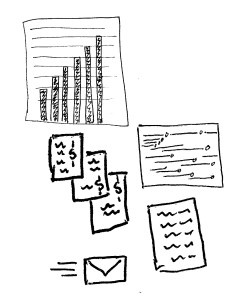

Acquiring the item, transporting the item, preparing the item, showing the item, maintaining the item, selling the item… all of these business activities performed must not just be accounted for, they must relate back to the work of art and become part of its historical record. Art tends to move around. Traveling from collector to collector or to different galleries, works of art may change location and ownership or custodial care frequently.  The origin of a work and the tracked purchase history, as well as the history of placements is among the critical information to be stored with each item. This most valuable data is part of the legacy of the work that any professional system should address. If information is power, then better retention and management of information regarding a work makes the entire collection stronger.

The location or exhibition of a work, its purchase history, the related museum and contact records – all this and more must be maintained and managed with each and every item in a collection.  Essential data such as provenance, condition and value is certainly kept for each work, but the key to making a truly useful system for collectors and artists both is the ability to get all the needed data in a single view or report.

Having the inventory information available for invoicing and reporting is one thing, but also being able to connect or identify individual works and collections with relevant contacts is surprisingly valuable. Tracking other information items like costs associated with shipping or framing, or storing both an appraised value as well as an insured value, provides for a comprehensive record of the work and its properties and makes forms and documents preparation not only more accurate but more efficient and useful, too.

Art businesses are like many other “product”-based businesses in that they have e-commerce needs, they build websites to show off their catalogue, they use mobile applications to display items, and they find much higher efficiency and agility when the websites and mobile applications work with the same real-time inventory data that the rest of the system works with.  The goal is to achieve measurable results through improved efficiencies, and that comes from improved information management and integrated systems.  Centralized computing models and connected cloud services establish the foundation.

Cloud hosting, remote access and mobile technologies, and location-based solutions are all part of the package for businesses involved in the business of art these days.  Implementing a hosting solution which enable anytime/anywhere access to business applications and information is often the first key to unlocking the better and more efficient art business.

Whether it is collecting, selling or showing, users involved in the business of art need secure access to all their information whether they’re in the office or not so they have the data needed to support making beautifully intelligent business decisions when it matters most. The rest is just pretty pictures.

Make Sense?

J

Technology-Enabled Practice is Profitable Practice

A profitable accounting “firm of the future” is not out of reach for even the smallest of professional practices, because it doesn’t take a lot of people to develop a highly efficient and profitable operation.  The key is having the right business foundation – the technology and the concentration on structure and process – which will serve the business for years to come. Profitability is really about effectiveness and efficiency… delivering more value and doing it in a more intelligent manner than the next guy.  This is how the practice not only stays profitable, this is how it beats the competition.

Powered in part by efficiency created with technology-enabled business, professional firms find that they are able to realize increased revenues by billing for services, not by the billable hour.  Data processing and performing the “mechanics” of the bookkeeping process is going by the wayside, with artificial intelligence and automation taking the lead in these areas.  This creates the opportunity for professionals to broaden their scope of service and involvement with business clients.   The higher value work, the tasks that most professionals would rather spend their time on, is now available because the lower value data entry and tabulation is handled electronically.  When accountants are able to spend less time on entering information and more time on evaluation and analysis, business clients find greater value in the insight delivered from the engagement.

It is more than possible for the professional to develop new competencies in business technologies without having to invest the entire practice and put the client base at risk. Hosting and remote access solutions, for example, bridge the gap between on-premises computing and the cloud, delivering the benefits of mobility and anytime/anywhere working models without the complete transition to SaaS applications and web-based frameworks.  This allows the firm to streamline production by taking advantage of connected systems and real-time data, which is at the core of efficiency in business.

The small business market is the economic growth sector, and the number of opportunities being presented to smaller firms is increasingly significant. With the correct technology and approach, small firms are able to compete at levels previously available only to their larger counterparts.  The business of accounting is changing because the technologies supporting it are evolving more rapidly than ever before.  The firms that embrace these changes and use them to improve and streamline practice performance are the firms that will achieve and sustain the highest levels of profitability.

Make Sense?

J

Big Data, Analysis and Business Intelligence

Big Data, Analysis and Business Intelligence

big dataThere is a lot of talk among IT professionals of “big data”, and discussions at many business conference tables center on how the organization might find greater benefit and advantage from the intelligence buried in the business systems and information.  It is a two-part problem, where the collection and the analysis each play essential roles in developing real business intelligence.

“So what’s getting ubiquitous and cheap? Data.

And what is complementary to data? Analysis. ..”

Hal Varian, Chief Economist at Google and emeritus professor at the University of California, Berkeley
“Hal Varian Answers Your Questions,” February 25, 2008 (http://www.freakonomics.com/2008/02/25/hal-varian-answers-your-questions/).  BUSINESS INTELLIGENCE AND ANALYTICS: FROM BIG DATA TO BIG IMPACT; MIS Quarterly Vol. 36 No. 4, pp. 1165-1188/December 2012

The information technology and systems in a business support the operation.  Software and computers help people do their jobs, and the information collected in and generated by those systems becomes the foundation for developing business “intelligence”.   Today, businesses must reach beyond their own direct operational support systems and consider the full realm of data to be collected, including IoT sensor data or social media data.

Business intelligence is gained from the analysis of the critical business data – analysis which helps owners and managers make better and more informed decisions which are based on an understanding of the business and market.   Business intelligence was a term popularized in the 1990s, but the key was the analytical component (business analytics), which gained focus in the late 2000s. Today it is big data and big data analytics, where organizations are working with massive data sets not previously even imagined.

“…one of the most significant challenges facing enterprise IT teams today is how to efficiently support and enable the “science” of big data, while providing the confidence and maturity of more traditional (and often better understood) infrastructure services.”

http://www.datacenterknowledge.com/archives/2015/05/26/hadoop-big-data-storage-challenge-overcoming-science-project/

The volume and velocity of information collection is ever-increasing even in the smallest of businesses, creating a great need for tools which can structure and correlate data so that it might render some insight.  Simply storing and managing these huge and growing data sets has become a challenge, and there isn’t one right way.

Once the business has the data, then it must find a way to analyze the data, which generally involves also applying visualization tools. Many IT departments are feeling pressured in the development of new skills and capabilities around data collection and management, yet it is more frequently the business user who provides the analysis and applies visualization tools to the task.

“Data collected by the Aberdeen Group, found that employees in organizations that used visual data discovery were more likely to find the information they need, when they need it. These same companies were able to scale their use of scarce IT skills more effectively.”

http://www.tableau.com/learn/whitepapers/visualization-set-your-analytics-users-free#0vXrkWZbizxyutw

The use of business intelligence and advanced analytics continues to grow in every segment of the market – from small business to enterprise – and plays an increasingly important role in supporting business success.

Until this point, most businesses didn’t have the technology or the data to enable significant quality or business transformation, but the times are changing and deployments of data collection, analysis and visualization software and tools are expanding with it. This is a fundamental aspect of business digital transformation and fuels the next step, where intelligence is applied to conditions revealed in the data and activities are automatically performed guided by that intelligence.

jmbunnyfeetMake Sense?

J