Unlock KPIs and Improve Reporting with QuickBooks

It is surprising how many businesses still keep boxes of 3×5 ledger cards with customer and vendor information on them. More likely than the card box, the business may be storing its essential customer billing and vendor product information in the accounting system because that is the system they have.

These growing businesses need a better system to capture more information that delivers greater detail for accounting and reporting purposes. Just as likely, the business has other information it should and possibly could be capturing but isn’t sure about what steps to take next.

When details that inform a process are not part of an integrated system, it creates greater potential for lost or inaccurate data. The larger the volume, the more difficult and error-prone managing the information becomes.  

Business needs more detailed information about… everything.

Businesses may need to track time for payroll or jobs or both, job tracking may be a requirement, inventory tracking or more detailed inventory management may all be areas for greater attention. Mendelson Consulting can help develop these capabilities by making sure the business is using the right software, and then enabling the functionality needed to support the workflow and capture more and better data.

No data means no KPIs.

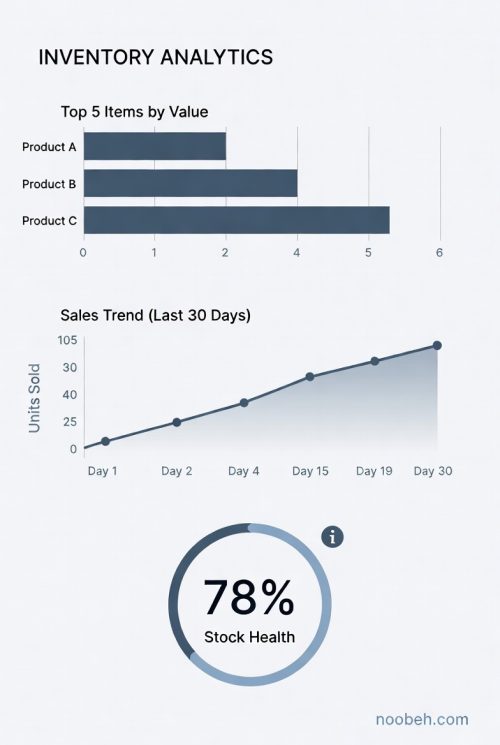
More and better data means more information to fuel KPI reporting. Key performance indicators can reflect operational performance in a variety of areas and may help identify where improvements are required.

Using data from the accounting and operational systems, businesses of all sizes measure their effectiveness using KPIs to evaluate the successes – or failures – of their processes and activities.

Mendelson Consulting’s team of QuickBooks Enterprise Experts and ERP consultants provide guidance, implementation and training, and report development to get beyond bookkeeping to proper processes that result in good accounting data. Mendelson’s cloud services team – Noobeh – sets it all up on Microsoft Azure, where data connectors, data warehouses and Microsoft Fabric weave it all together.

Whether just starting out or an enterprise or franchise expanding at a national or global level, we help businesses do more with their systems and software. We understand each stage of business and how to help our clients reach their next best level.

jm bunny feetMake sense?

J

Why Small Businesses Need Proactive Accounting

It has been demonstrated time and again that businesses working with experienced accounting professionals can benefit from the strategic financial guidance and compliance support they may provide. Yet these factors alone are often not enough to make the business owner happy. For most small business owners and growing enterprise stakeholders, the lack of proactive advice compounded by slow responses to business requests are the primary reasons for leaving their CPA.

Even if they don’t know how to ask for it, small businesses want proactive attention from their accounting professionals. Small businesses want and need to get information when it matters, and they need help deciphering what the information really means.

It is common for professional accounting firms to simply wait for their clients to provide after-the-fact information from which reports are prepared and delivered long after their relevance has passed. These firms often see no sense of urgency in helping clients address the business issues facing them in real-time.

Business owners attempting to grow a small enterprise from their budding small business especially need the benefit of experienced insight into operational metrics, cash flows and overall business performance. Without this meaningful data and advice delivered in real-time, stakeholders don’t really know what is going on or if they’re on the right path.

Advice on business planning and financial strategies should come to business owners from their accounting professionals, but it often does not. It is interesting that so many firms list business planning and strategy among the services promoted on their websites, yet they just sit back and wait for clients to ask for help.

Regulatory and reporting requirements for businesses are ever-increasing, so it makes some sense that many professional practices continue to focus on taxes and compliance work. Firms may find it challenging enough to keep up with changes to these core services provided. Yet this is why practitioners should take notice and accept that their ability to meet changing market and customer demands is wrapped in their ability to leverage technology to do what people and process can’t do alone.

Information technology is needed to speed up the bookkeeping, accounting and reporting processes, and it takes even more technology to help turn data into relevant and useful information. This is where Mendelson Consulting and Noobeh cloud services can help.
Working with businesses of all sizes and encouraging participation by the accounting professional, Mendelson and Noobeh help businesses implement the technology that facilitates faster collection of information throughout the business and then applying solutions that reflect those numbers in ways that helps users visualize the meaning of the data.

Mendelson and Noobeh help CPAs and accounting professionals remove threats of competition and irrelevance by helping them work closer with and deliver greater value to their small business clients. Applying proven, innovative technologies with improved processing methods and controls leads to better information provided in a timelier manner, which returns to the client as a better result offering greater insight. This is what small businesses want from their CPA, and Mendelson Consulting and Noobeh Cloud Services helps professionals deliver it.

jm bunny feetMake sense?

J

Enhancing Business Insight: Noobeh Cloud Services and Azure-Based Solutions

Technology is evolving and so are our ways of using it. While the rules of accounting haven’t changed for years, the solutions we use to do the work have changed a lot. Yet there remain many businesses that haven’t yet embraced the idea of fully digital workflows, integrating and automating how data moves through the “system” to provide a comprehensive view of the business and how it is performing.

This is where accountants and bookkeepers can best serve their clients, by helping them implement the platforms and solutions which transform operations and provide greater insight into these areas.

Over 20 years ago, a technology model was developed which allowed businesses and the accounting professionals who serve them to work directly and collaboratively in the clients’ accounting system. By hosting QuickBooks and Sage desktop products on host servers, small business users and their accountants could both access the software and the data in real time.

This new approach was a boon for accountants, bookkeepers and others working with small business clients as it not only enabled closer work, but also provided those advisors an opportunity to do more – and more complex – work with the client. Yet many platforms and working models created barriers to broadening the scope of service or access to client systems, limiting to just basic accounting products like QuickBooks, and not effectively addressing the rest of the business need.

As technology has evolved, so have these transformations.

More accounting professionals understand the benefits as well as the necessity of moving from analog to digital workflows, removing manual entry and improving efficiency and accuracy of data. Yet this improvement doesn’t require changing accounting software and undoing years of learning and business knowledge. Rather, the platforms and connections must be the primary focus, replacing the manual with automation and smoothing out the bumps where data isn’t flowing at all. If the system isn’t in place to handle the complete flow of the data, there is a break. Like a pipe leaking water, this break results in data loss – which is also loss of business intelligence.

A key to all of this is the consideration of where the data ultimately resides. When business data exists in closed silos – whether web-based software or closed hosting platform – it takes a comprehensive approach to collection, storage and analysis. This is among the benefits to be derived from the modern cloud and Noobeh’s Azure-based hosting approach.

Noobeh’s hosting is not just about the desktop or the applications.

The cloud platform, and Azure in particular, also provides resources for data analysis and business intelligence, workflow and data flow automations, improved security and identity management, IoT and computing on the network edge.

For professionals looking to evolve their practices by helping clients go beyond basic recordkeeping and reporting, it’s time to delve into the operational details, data flows and development of real business intelligence and insight. Noobeh Cloud Services and Mendelson Consulting have the platforms and the supporting services to help bring it all together, improving profitability and performance of their clients through the intelligent application of technology.

jm bunny feetMake Sense?

J

‘Tis the (Filing) Season – Time for W2s and 1099 Reporting

1099-santa-hatEvery year-end brings with it not just the holiday spirit, but also the underlying dread felt by small business owners – a creepy and back-of-your-neck hair-raising feeling associated with annual business tax reporting and filing. That old saying about “death and taxes” has a lot of validity to it; sometimes they feel like the same thing to a small business owner. And this is the filing season. Ho ho ho.

The reporting requirements for small businesses seem to be growing at a rapid pace, and business owners are struggling to find the information and tools that ease the adjustment to increasingly burdensome reporting and compliance. The IRS has implemented a number of measures to increase tax revenues and enforce compliance, including stricter 1099 reporting requirements. With information provided at both ends of the “transaction” it is easier to identify those discrepancies which trigger audits.   With this type of business intelligence, the IRS has developed a fairly strong weapon to combat non-compliance, so small business owners need to really pay attention (the IRS is).  If the feds are tooling up, then business owners should, too.

Just to add to the seasonal festivities, make sure you upgrade your accounting software in time to benefit from the right rules and forms. If you run a small business and keep most of your information on spreadsheets (still? really?), that’s OK because there are solutions available which draw the information from spreadsheets, eliminating the need to re-enter data. Seriously, though, you should consider using actual bookkeeping or accounting software.

It is also important to remember that payroll tax filing dates for W-2s and 1099 forms were changed for 2016 taxes, and these changes continue for 2017. The filing deadline for 2017 W-2s and 1099 forms (including Form 1099-MISC) is January 31, 2018, which is a month earlier than the pre-2017 filing date. Thankfully, the deadline for providing W-2 forms to employees and 1099-MISC forms to other workers for 2017 has not changed. This deadline is still January 31, 2018. 

Using a cloud-based service to file 1099s online should be something your business considers doing if it isn’t already. Because most services include form and feature updates, users don’t have to go looking for the right documents or worry that they are using an outdated form.  In an online or hosted solution, users benefit from updates without downloads and get stricter security around their data than would likely be present on their own PC.  As it relates to your accounting software, make sure it has the capabilities you need in this area and don’t settle for limited functionality.

Here are some features you’ll want to look for in your e-filing solution this year:

  • The ability to print and/or mail forms to recipients as well as e-filing forms directly with the IRS or SSA
  • Have Form 1096 or W-3 automatically calculated and transmitted electronically with the detail forms
  • Upload volumes of data with Excel templates or import from your accounting software (saves time and reduces input errors)
  • Store data securely and provide full access to filed forms for multiple years
  • Maintain payer and recipient records securely for use year after year.
  • Encrypt data upon submission and keep it encrypted throughout the entire process
  • Supports 1099 Corrections (should allow filing of corrected forms regardless of how the original form was filed)
  • Accountants, Bookkeepers and Tax Preparers should be able to set up multiple payers and file on behalf of many clients from a single account, even filing for all clients at once or via batch submission

Year-end tax filing, especially dealing with 1099s and W2s, is an arduous task for most small businesses and their professional service providers, yet it is one of those things that simply can’t be put off.  Where there is a single income tax return there could be literally hundreds of associated 1099s or W2s to file.  1099 filing in particular has become more of a focus as authorities crack down on contractor versus employer classifications and seek to develop easier identification of audit candidates (something every business owner wants to avoid).

The point of the discussion is that there are cloud-based tools which are highly useful, feature rich, and very affordable… and business owners and their accountants or bookkeepers would be wise to take a look rather than assuming that the general accounting software will do the trick this year and the next.  Remember that tax filing season is an annual event, and being able to rely on a consistently useful solution can make the season a bit merrier (or at least a little less stressful) for all.

jmbunnyfeetMake Sense?

J

Hi! I was looking for the Frangos.

Should You Take Your Practice To The Cloud?

I’ve seen a lot of articles lately (and written more than a few myself) directed towards accounting professionals and “taking your practice online” or “taking your practice to the cloud”.  At this point, when a professional asks me the question “should I take my practice to the cloud”, my response generally comes in the form of two return questions.

The first is “what leads you to believe you have a choice?”

The second is “what makes you think you haven’t already?”

There are a few realities about doing business today that can’t be ignored and cloud computing is at the top of the list.  Professionals can recognize these realities and work with them or fight the changing tide and lose out to more relevant providers.

To address the question of choice, let’s consider the fact that many of today’s entrepreneurs and small business owners have been exposed to Internet services and online technologies for quite a long time.  Use of these services has become an ingrained element in daily life.  Not using online technologies seems “old school” to these folks and is often perceived to be due to some deficiency in the ability to understand or use new tools.  If professional service providers aren’t able to leverage online tools to provide the access, collaboration, and higher level of service which business owners demand, they won’t work with those business owners for very long.

In addressing the “what makes you think you aren’t already?” question, let’s consider the fact that almost all of the accounting software offered today has incorporated cloud-service or Internet-based functionality in some manner.  Even the tried and true desktop editions of QuickBooks financial software  have quite a lot of web service functionality designed in to the product.  Where credit card processing was once an offline (or telephonic) process, it’s now an instantaneous service delivered via the net.  Payroll?  Tax tables aren’t just downloaded to the software where you perform the processing and calculations.  Payroll is a service, delivered via Internet connectivity to Intuit’s payroll service bureaus (or ADP, Paychex, etc.).  Even banking is less traveling to the establishment and more Internet access and data exchange.   We don’t think twice about downloading transactions from the bank computers instead of working from the paper bank statement.

Internet/web/cloud service and functionality has become a pervasive element to almost every aspect of software and computerized business support systems, and it’s a pretty good bet that your firm is already using it. So, let’s not spend our time asking a silly question about whether or not it makes sense to “take the practice to the cloud”.  The obvious answer is yes.

Make Sense?

J


Original article: Should You Take Your Practice To The Cloud? You’re Still Asking?

Cloud and Digital are Driving Change in Professional Practice

Accounting and Finance Professionals: Cloud and Digital are Driving Change in Professional Practice

Accountants and financial consultants working in public practice are experiencing a revolutionary change, evolving from documents and paper-based processes with after-the-fact reporting to real-time business management and providing services which support daily decision-making.  The underlying cause for this evolution in business accounting is the technology: cloud and collaborative computing models are enabling much closer and regular interaction between accounting professionals and the businesses they serve. Even more, technology is taking its proper place in automating once tedious activities, allowing professionals to focus on causes and results rather than on transactions.

What is the real impact this is having on the accounting profession?  It’s forcing a new focus and attention on change management within the practice, and is causing professionals to recognize the requirement for standardization of processes and development of controls which are the foundations for creating sustainability in a business.  The goal now is placing reliance on process rather than people, which establishes the basis for intelligent automation.  Standardization of processes does not require that the firm lose its personality.  Rather, the mission at hand is to imbue the organization with its unique flavor and approach and to use process automation to develop and support consistency in the functions performed.

While cloud computing models allow accounting and finance professionals to work closer with their business clients, it is important that the practice look at those client interactions and develop standards for processes supporting frequently performed functions.  These operations generally represent the activities within the firm which generate the highest levels of profitability due to the consistency in approach and repetition of tasks, and are the activities to apply intelligent automation to first.  Those activities or engagements which represent the “one-offs” are often the most costly for the firm to perform, and therefore may not be the most profitable of activities and are certainly the most challenging to support with any significant level of automation.  It is in this area where AI will find useful value in the practice, where a more informed answer than simple process automation is required.

The surprising finding when looking at many professional practices with more than one partner/professional involved is that these firms often fail to develop even the most basic of standard processes which apply throughout the firm.  Rather, each partner or professional has “their way” of handling things, which challenges the supporting personnel as they try to deal with multiple working methods. The result is a lack of consistency in the service delivery to the clientele and reduced productivity and profitability for the firm.

The thing that these firms are failing to recognize – the light bulb over their heads that just isn’t lighting up – is that cloud computing and collaborative working models aren’t designed just to enable and facilitate a closer working relationship with clients.  They’re also able to be applied inside the professional practice, enabling a more productive and efficient workflow which addresses the strengths and capabilities of the entire organization. And it doesn’t stop there.  Businesses are relying upon their accounting professionals to provide guidance and develop controls and standards to support the client transformation from paper-based to digital operations, and embracing the entire realm of data and interactions associating with the business. Digital transformation in a client business demands transformation in those firms who serve it.

As professionals learn to go deeper in client operations they would do well to look internally, too, exploring how increased attention to process automation and consideration for the firm’s own “digital transformation” might lead to great profitability through market differentiation and improved performance.

Make Sense?

J