Migrating Your Processes and Knowledge to the Cloud

Adopting cloud platforms can bring great business benefit without forcing dramatic change.

Many business owners believe they must dramatically change their software and business processes just to embrace cloud working models. Too often they are left believing that any business use of cloud technologies requires changing software and systems over to subscription web-based solutions which enable the much-desired anytime/anywhere working model.  What too many businesses aren’t being told is that there are ways to move to cloud platforms without losing their investments in people, processes and business knowledge.

The benefits of a cloud computing model are many, with mobility and managed service being the most obvious.  Less evident are the potential cost savings, because the subscription approach to paying for IT services may, on the surface, look like an equivalent or even higher cost over time. 

What isn’t being considered is the potential to improve processes and increase productivity.  These benefits are often achieved simply due to a centralized management and access approach, and are not necessarily attributable to the adoption of new software tools.

The cloud is the right answer for deploying and managing IT for many businesses, and delivers more value than on-premises systems can for the same price.

Eliminating the on-premises server and network with a cloud server implementation should be considered first, before changing out the software and tools in use throughout the organization. Hosting the existing applications means users can access their regular desktop software via the cloud, allowing the organization to fully retain their investments in people, processes and knowledge, and to build on that foundation with centralized service and improved collaboration..

Businesses of all sizes and types are are finding that the cloud, hosted applications and remote access provide the answers to a variety of business IT problems.  Even more, those answers are being provided affordably, with a simplicity of setup and with higher levels of service than is usually provided for with localized IT.

Small businesses and enterprise organizations alike can experience many benefits with a cloud hosted and managed IT approach.  It doesn’t take a comprehensive application or process overhaul to begin improving internal IT operations for the business, and it makes no sense for a business to give up investments in training, process development, and people knowledge in exchange for a centrally managed and remotely accessible system. 

Rather, the smart business takes the steps to solve the real issues of IT management and mobility while allowing users to continue performing their tasks and doing business as usual – only better now because the platform is working for them.

jm bunny feetMake Sense?

J

Integrated is Better: Connecting Your Systems and Workflows

Small businesses need software and systems to help them get business done efficiently. The global pandemic has been fuel for recent growth in the small business software market where companies of all types are adopting more applications and services to better support operations.  Especially when users are no longer able to work in the office and consumers are demanding increasingly more personalized services, businesses need to find ways to get more business done in less time and with fewer resources.

According to Intuit® research “small businesses, on the average, use four or more apps to run their business”. You could consider it that business owners and managers buy software apps to get jobs done. Software can help structure the work and the information, creating workflows that improve efficiency and accuracy.

The key to getting the full benefit from any application or service is to have it connected to or integrated with your other solutions. There is almost never a completely disconnected process in a business; everything flows from and to something else. It should be the same with software and data. Saving time and improving accuracy of information means that data should only be entered once, and key data should sync between systems to remain up to date.

QuickBooks Desktop (Pro, Premier, Accountant and Enterprise), as well as other desktop accounting or ERP solutions like Sage100, AccountEdge and more, have a variety of 3rd party applications and integrations offering additional functionality or services. Just because the main solution is a desktop application does not mean that all integrated applications must also be desktop products.

To extend functionality of desktop products, developers often create web-based applications and services that sync or integrate data with the desktop product. In fact, many of the services inside of QuickBooks desktop are web-based application services which sync data to and from QuickBooks. Payroll, payments, and more are subscription-based services connected in QuickBooks but look like they are just part of the installed program.

When QuickBooks and other desktop applications are hosted with NOOBEH’s QuickBooks on Azure service, the system is running entirely on the Microsoft Cloud. This improves system flexibility, resiliency, and security, as well as providing the optimum platform for desktop applications and web-based services to connect – the bandwidth they use is cloud to cloud instead of cloud to your PC.

Even if the average small business uses four or more apps in the business, it doesn’t necessarily mean that all those apps are talking. Often, a business will implement a new application to handle a particular job but won’t consider the additional benefits to be gained by connecting the new app to the accounting system. Yes, the new app may make getting data from the field easier, as with a timesheet or field service management solution. Maybe it makes doing payroll easier because the calculation, reporting and delivery of paychecks is automated. Perhaps it is a website that takes customer orders and manages their payments.

All are cases where a business benefits a great deal from increased efficiency in data capture, reporting and more, but if all the information from the app needs to be re-entered into the accounting system, then a great deal of additional benefit is simply not there.  Data entry takes time away from other work and introduces the potential for errors that can take hours to track down (if they are even noticed).

When connecting any 3rd party solution with your accounting or ERP system, it’s important to make sure that the company fully supports the integration. Whether it is a direct connection to your QB or other software or is a “brokered” connection (as with an Integration-as-a-service connector), just make sure that the integration has the features and functionality you need and that the data will flow as you want.

We know that businesses need more than a single solution to address the variety of business problems that arise. We also know that sub-standard or improperly configured integrations risk doing more damage than good to the business data. That’s why we offer consulting and deployment services for a wide range of add-ons and integrated products. Even if it is a solution we haven’t worked with yet, our consultants know how to validate and test the integration within QuickBooks to ensure that the data flows properly and gets the right treatment in the financial system.

Get your software connected and working better for your business. Mendelson Consulting and NOOBEH Cloud Services help you focus on your business and not the IT that supports it, so that you can get more done with the resources you have. We help you work smarter, not harder.

jm bunny feetMake Sense?

J

Direct-to-Consumer Causing Manufacturing Logistics Issues

Manufacturers have traditionally been positioned as a link in the long chain of supply. Somewhere between raw materials and finished products is where the manufacturer exists, transforming the materials into products that can be resold via distributors and wholesalers.

The supply chain was linear and relatively predictable, but that is all changing. With the introduction of broad internet connectivity, web-based services, large e-commerce platforms and increasingly innovative and competitive new logistics players, the supply chain is becoming a spiderweb of connectivity and communication, with linear approaches out the window and, to some extent, predictability along with it.

The economy we have today is an environment where customers demand more direct and personal approaches, and producers are being forced to find ways to accommodate. With the huge e-commerce platforms like Amazon and Alibaba, along with more direct-to-consumer channels, manufacturers are being turned into direct-to-consumer suppliers. Acting as drop shippers for the seller, the manufacturer isn’t shipping bulk or volume to distributors or wholesalers but smaller shipments direct to the consumer.

Many retail stores have now become more fulfillment locations than the place where the customer buys. This is causing tremendous change in logistics tools and approaches because the size of shipments is becoming smaller while the number of deliveries – and delivery locations – is only increasing.

Customers can go right to the brand’s website and buy direct, driving increased focus on building brand value and improving the overall customer experience. With the demand from consumers for flexibility in how and where they buy, retailers have shifted their approaches to bring e-commerce into the brick-and-mortar stores. This is where online and offline sales channels come together, creating pressure in ordering and fulfillment systems to offer the flexibility and experience consumers want.

While this converged channel model requires businesses to make new and continued investments in e-commerce and digital solutions to enable the flow of orders and information, it also delivers several potential benefits to the business, including the ability to better manage growing customer expectations, better compete in the digital marketplace, and address disruptions in the supply chain by having alternative options.

Delivering the goods has always been an operational challenge, with success often measured in performance and cost. Today’s marketplace requires more agility and flexibility, which means the role of supply chain managers is more strategic than ever. Simple logistics now has a direct impact on the customer’s decision to buy now, as well as buying again later.

jm bunny feetMake Sense?

J

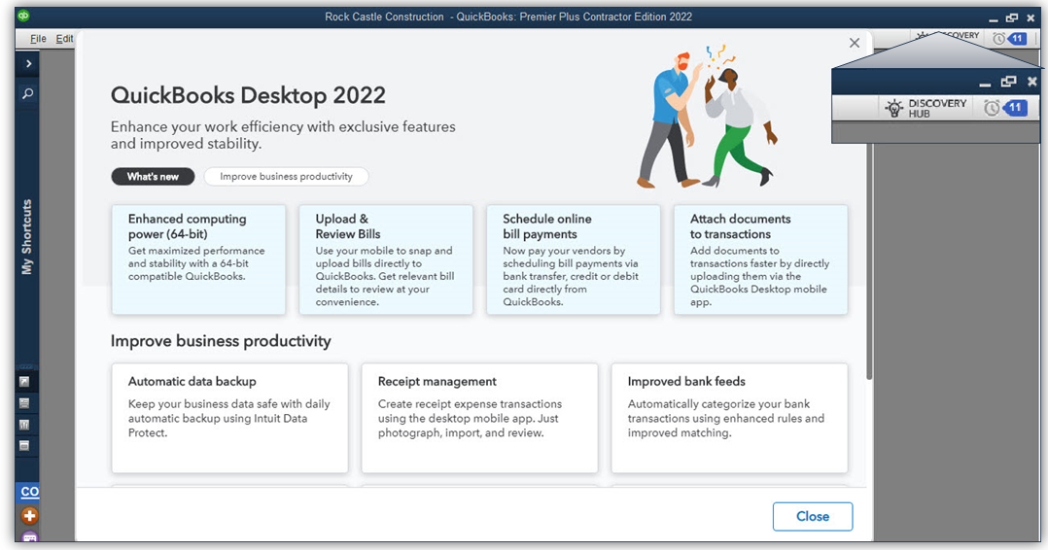
QuickBooks 2022 Boasts Modernized Foundation

Every year, businesses around the world anxiously await the release of the new versions of QuickBooks desktop software. While that may sound a bit silly, the truth is that QuickBooks is widely used in numerous countries around the world and when Intuit makes big changes to QuickBooks it impacts a lot of businesses.

While the focus for Intuit, like most software companies, is online subscription service, the fact remains that the desktop products and the ecosystem around them continues to grow.

Over the past few years, the company has invested in artificial intelligence and platform solutions that extend and add value to the desktop and online products. Some of these investments are becoming clearer with the launch of QuickBooks desktop 2022 editions.

64-bit QuickBooks [1]

The “guts” of QuickBooks was elderly and wasn’t up to current processing standards. Now, QuickBooks has a 64-bit foundation and the full capability of 64-bit processors can be used. This typically means faster application and data load times, faster report generation and an ability to handle larger data sets more efficiently. Beware of QB 2022 until you verify that your computers are all 64-bit machines, because QB 2022 can’t be installed on 32-bit systems. If you’re working with a hosting platform, you’ll need to make sure your host has modern infrastructure and up-to-date operating systems.

E-commerce for QuickBooks with Webgility [2]

Need to track your revenue from different selling platforms like Amazon, eBay, and Shopify, and sync the data directly with QuickBooks? There are a lot of e-commerce integrations for QuickBooks desktop, but Webgility wins when it comes to working with QuickBooks. There’s now a bundle that makes it easier to get the Webgility e-commerce integration for QuickBooks. Customers still must sign up with Webgility to get the service but purchasing the bundle package makes that quite a bit easier. Webgility uses a database to keep track of orders, so you’ll want to make sure your system is able to handle the extra load. If you’re on a hosting platform (other than NOOBEH), be ready to pay additional fees to support running Webgility.

Bill payment approval process

Improve your accounts payable process by creating a structured approval process so that only the right bills get paid. AP workflows can help businesses manage cash flow and improve transparency. Working in conjunction with the user’s Intuit.com account, the company can set up rules for QuickBooks to check which bills need approval for entry and payment. Users are then prompted to send bills for approval

Pay and schedule bills faster with Melio payments

Some subscription holders of QuickBooks Desktop Pro Plus, Premier Plus, or Enterprise are working with the new feature (from Melio Payments) that allows businesses to use QuickBooks to schedule and pay bills using a bank transfer, credit card or debit card. The vendor doesn’t have to have a Melio account; they can receive their payments either as ACH or paper check.

Bill entry automation and customized bill payment stubs

Save time and have QuickBooks automate bill entries from the QuickBooks Desktop mobile app (iOS or Android versions) or from bills sent via email. Review the bill data once it’s uploaded and match it to existing transactions in QB. Bill payment stubs are now on the list of customizable forms, so you can set up and email formal payment confirmations to vendors.

Upload documents [3]

Instead of scanning files on your PC to attach to QuickBooks transactions, you can now use the QuickBooks Desktop mobile app to attach documents to transactions. The attached documents feature of QuickBooks is awesome because it lets you use QB as kind of a document management solution where you can store original copies of bills, receipts, contracts, or other documents that associate with financial transactions or entities in your QB files. This new feature that allows documents to be uploaded via the QuickBooks Desktop mobile app is a great solution for businesses operating on some hosted platforms that can’t or won’t support scanning. One “gotcha” with attached documents is that many businesses forget that they have them, and when they go to migrate their QB data to another platform or computer, the file attachments either get forgotten or are so voluminous that it makes the migration difficult.

Choose from multiple customer contacts

Only available with Plus and Enterprise subscriptions is the ability to add multiple customer contacts to batch email runs. The program now lets you send emails more quickly by choosing batch mail recipients from a list of customer or vendor contacts, reducing the chances of email troubles caused by manual entry of addresses.

Instant deposit

When you use QuickBooks Payments (or any other payment service), it generally takes a few days for the money to wind up in your bank account. With a QuickBooks Payments account and for an additional fee, Intuit is now letting you get your money faster when customers pay. Instant Deposit is a service that works with a VISA or debit card to deposit the money into your checking account – any processing or other fees will continue to be debited from your regular payments bank account.

Payment links

Now you can do in QuickBooks what you can do with PayPal, Zelle and other money transfer apps. Businesses can use simple Payment links to collect payments before work is performed and even before an invoice is created. As with all other payments features, you need a QuickBooks Payments account to use this one.

Changes to software purchasing options

QuickBooks Desktop 2022 is only available as a subscription purchase. There is no outright purchase option for QuickBooks desktop any longer. For businesses that need only the most basic features of QB, Intuit is hoping the QBO platform will work, and changing the software from purchase to subscription is just one more step in moving users to adopt the web application. QuickBooks Pro and Premier are still widely used so they will be available for some time to come, but Intuit is clearly making moves to try to push smaller edition desktop users to the web.

[1] NOOBEH deploys only modern architecture, 64-bit systems for QB on Azure and other hosted solutions

[2] NOOBEH doesn’t charge extra to have Webgility or any other applications installed in your QB on Azure service

[3] NOOBEH QB on Azure  and other cloud hosting solutions support scanning directly from your local PC to QuickBooks, using specialty 3rd party tools. Whether you use QuickBooks mobile or scan directly to QB using the Attached Documents feature, NOOBEH supports it.

jm bunny feetMake Sense?

J

Considering Cybersecurity as Cloud Work Expands

When the pandemic forced many business users to move to remote work, it also forced the network security “boundary” to expand greatly and with great speed. Companies quickly adapted their tools and work so that it could be done somewhat effectively even as the employee working environment changed.  But new security models to match with new working models have not as quickly been adopted.

Business cloud workloads grew, by some estimates, as much as 20% just in the first 6 months of 2020. Yet many of those businesses electing to bring cloud working models to their business also made of the mistake of not expanding their security as they expanded the cloud network. This leaves systems and information vulnerable. Phishing, ransomware, credential theft and web app attacks have increased, catching businesses in their vulnerable states.

“In April to June of 2020 alone, security incidents increased by 188%.”

Even more than on-premises systems, it was the external cloud-based data and applications that were under attack because so many companies expanded their use of cloud services without enhanced security as part of the plan. Any expansion to include the cloud as network also significantly increases security risks. One report found that 35% of businesses made their cloud storage openly accessible to the public, allowing anyone to access it via the internet.

Don’t let your critical information be exposed or put at risk. When you begin using a cloud service, make sure to also address security for the new working mode or it could lead to lost or leaked information or a system breach.

Mendelson Consulting and NOOBEH cloud services take security very seriously. We help our clients keep their applications and data working properly and have a focus on methods to keep information safe regardless of what cloud you work on.

jm bunny feetMake Sense?

J

1 ( https://duo.com/blog/growing-security-safely-in-canada )

Finance Department Participation in Supply Chain Management

When most businesses approach Supply Chain Management, the focus is on the item or product – the physical thing that ultimately gets delivered somewhere, somehow. What many businesses do not consider is that the orchestration and timing of “supply chain” activities can have significant impacts on financial performance, reporting and cash flow. The current processes could just be working just “okay”, and not delivering the financial benefit that might be obtained through modernization of technologies and transformations in approaches. The key is to get the right people involved.

One big aspect of seeking to integrate electronic commerce and collaboration with customers, suppliers and payment services is the recognition that supply chain activities involving orders, invoices, payments, and remittances are directly related to finances, revenue recognition and cash management.

For any project to be successful, it should include execs from both the supply chain and finance areas so that all concerns relating to event timing may be addressed to allow proper treatment in the financial statements. After all, the same things that trigger supply chain activities (orders etc) are the same documents which drive finance. When the information is accurate and timely, and when the inefficient manual processes can be replaced with electronic workflows, the business is best positioned to improve cash flow and overall financial performance as well as business value.

Unfortunately, few business owners have a real understanding of the costs associated with manual entry activities and how the direct financial impacts they have. The speed and accuracy of processing orders and invoicing customers means faster cash in, and leveraging the speed of electronic data interchange with suppliers so that “just in time” orders may be placed and logistics processes more fully enabled means cash out when necessary and not ahead of time.

… using a digital transaction for payments allowed [businesses] to hold on to cash longer and better control the timing of the release of funds, something more difficult to control when mailing a physical check. Check fraud remains rampant across many industries. According to an AFP payment fraud and control survey, 70% of U.S. organizations reported check fraud in 2019, responsible for more than $18 billion in losses.” –

source: What Every CFO Needs to Know About Supply Chains; Study published by DiCentral and Lehigh University; 2012

For example, there are many studies which show that purchase orders that are not sent digitally are most often manually processed, and that this manual processing may be done by any number of departments in the company – but most often the job falls to finance. Rather than looking to eliminate the manual entry of data and the errors and delays that come along with it, businesses execs first looked to where the lowest labor cost rests and had them handle the extra data input.

A digital strategy that transforms inefficient manual process into efficient electronic workflows is the better solution. While many companies have approached streamlining of activities by exchanging manual entry operations for data file formatting and imports, they still have not solved the problem as would be with an integration that takes even less human time and effort.

The real goal of any business improvement effort is to improve overall business value. By bringing in finance along with supply chain execs to the “digital transformation” discussion, the business is much better positioned to make real progress in areas that directly impact cash performance as well as long-term business value. It comes down to having all the information and being able to weigh the risks against the potential rewards to be gained from the contemplated changes.

jm bunny feetMake Sense?

J