Integrated is Better: Connecting Your Systems and Workflows

Small businesses need software and systems to help them get business done efficiently. The global pandemic has been fuel for recent growth in the small business software market where companies of all types are adopting more applications and services to better support operations.  Especially when users are no longer able to work in the office and consumers are demanding increasingly more personalized services, businesses need to find ways to get more business done in less time and with fewer resources.

According to Intuit® research “small businesses, on the average, use four or more apps to run their business”. You could consider it that business owners and managers buy software apps to get jobs done. Software can help structure the work and the information, creating workflows that improve efficiency and accuracy.

The key to getting the full benefit from any application or service is to have it connected to or integrated with your other solutions. There is almost never a completely disconnected process in a business; everything flows from and to something else. It should be the same with software and data. Saving time and improving accuracy of information means that data should only be entered once, and key data should sync between systems to remain up to date.

QuickBooks Desktop (Pro, Premier, Accountant and Enterprise), as well as other desktop accounting or ERP solutions like Sage100, AccountEdge and more, have a variety of 3rd party applications and integrations offering additional functionality or services. Just because the main solution is a desktop application does not mean that all integrated applications must also be desktop products.

To extend functionality of desktop products, developers often create web-based applications and services that sync or integrate data with the desktop product. In fact, many of the services inside of QuickBooks desktop are web-based application services which sync data to and from QuickBooks. Payroll, payments, and more are subscription-based services connected in QuickBooks but look like they are just part of the installed program.

When QuickBooks and other desktop applications are hosted with NOOBEH’s QuickBooks on Azure service, the system is running entirely on the Microsoft Cloud. This improves system flexibility, resiliency, and security, as well as providing the optimum platform for desktop applications and web-based services to connect – the bandwidth they use is cloud to cloud instead of cloud to your PC.

Even if the average small business uses four or more apps in the business, it doesn’t necessarily mean that all those apps are talking. Often, a business will implement a new application to handle a particular job but won’t consider the additional benefits to be gained by connecting the new app to the accounting system. Yes, the new app may make getting data from the field easier, as with a timesheet or field service management solution. Maybe it makes doing payroll easier because the calculation, reporting and delivery of paychecks is automated. Perhaps it is a website that takes customer orders and manages their payments.

All are cases where a business benefits a great deal from increased efficiency in data capture, reporting and more, but if all the information from the app needs to be re-entered into the accounting system, then a great deal of additional benefit is simply not there.  Data entry takes time away from other work and introduces the potential for errors that can take hours to track down (if they are even noticed).

When connecting any 3rd party solution with your accounting or ERP system, it’s important to make sure that the company fully supports the integration. Whether it is a direct connection to your QB or other software or is a “brokered” connection (as with an Integration-as-a-service connector), just make sure that the integration has the features and functionality you need and that the data will flow as you want.

We know that businesses need more than a single solution to address the variety of business problems that arise. We also know that sub-standard or improperly configured integrations risk doing more damage than good to the business data. That’s why we offer consulting and deployment services for a wide range of add-ons and integrated products. Even if it is a solution we haven’t worked with yet, our consultants know how to validate and test the integration within QuickBooks to ensure that the data flows properly and gets the right treatment in the financial system.

Get your software connected and working better for your business. Mendelson Consulting and NOOBEH Cloud Services help you focus on your business and not the IT that supports it, so that you can get more done with the resources you have. We help you work smarter, not harder.

jm bunny feetMake Sense?

J

Direct-to-Consumer Causing Manufacturing Logistics Issues

Manufacturers have traditionally been positioned as a link in the long chain of supply. Somewhere between raw materials and finished products is where the manufacturer exists, transforming the materials into products that can be resold via distributors and wholesalers.

The supply chain was linear and relatively predictable, but that is all changing. With the introduction of broad internet connectivity, web-based services, large e-commerce platforms and increasingly innovative and competitive new logistics players, the supply chain is becoming a spiderweb of connectivity and communication, with linear approaches out the window and, to some extent, predictability along with it.

The economy we have today is an environment where customers demand more direct and personal approaches, and producers are being forced to find ways to accommodate. With the huge e-commerce platforms like Amazon and Alibaba, along with more direct-to-consumer channels, manufacturers are being turned into direct-to-consumer suppliers. Acting as drop shippers for the seller, the manufacturer isn’t shipping bulk or volume to distributors or wholesalers but smaller shipments direct to the consumer.

Many retail stores have now become more fulfillment locations than the place where the customer buys. This is causing tremendous change in logistics tools and approaches because the size of shipments is becoming smaller while the number of deliveries – and delivery locations – is only increasing.

Customers can go right to the brand’s website and buy direct, driving increased focus on building brand value and improving the overall customer experience. With the demand from consumers for flexibility in how and where they buy, retailers have shifted their approaches to bring e-commerce into the brick-and-mortar stores. This is where online and offline sales channels come together, creating pressure in ordering and fulfillment systems to offer the flexibility and experience consumers want.

While this converged channel model requires businesses to make new and continued investments in e-commerce and digital solutions to enable the flow of orders and information, it also delivers several potential benefits to the business, including the ability to better manage growing customer expectations, better compete in the digital marketplace, and address disruptions in the supply chain by having alternative options.

Delivering the goods has always been an operational challenge, with success often measured in performance and cost. Today’s marketplace requires more agility and flexibility, which means the role of supply chain managers is more strategic than ever. Simple logistics now has a direct impact on the customer’s decision to buy now, as well as buying again later.

jm bunny feetMake Sense?

J

Finance Department Participation in Supply Chain Management

When most businesses approach Supply Chain Management, the focus is on the item or product – the physical thing that ultimately gets delivered somewhere, somehow. What many businesses do not consider is that the orchestration and timing of “supply chain” activities can have significant impacts on financial performance, reporting and cash flow. The current processes could just be working just “okay”, and not delivering the financial benefit that might be obtained through modernization of technologies and transformations in approaches. The key is to get the right people involved.

One big aspect of seeking to integrate electronic commerce and collaboration with customers, suppliers and payment services is the recognition that supply chain activities involving orders, invoices, payments, and remittances are directly related to finances, revenue recognition and cash management.

For any project to be successful, it should include execs from both the supply chain and finance areas so that all concerns relating to event timing may be addressed to allow proper treatment in the financial statements. After all, the same things that trigger supply chain activities (orders etc) are the same documents which drive finance. When the information is accurate and timely, and when the inefficient manual processes can be replaced with electronic workflows, the business is best positioned to improve cash flow and overall financial performance as well as business value.

Unfortunately, few business owners have a real understanding of the costs associated with manual entry activities and how the direct financial impacts they have. The speed and accuracy of processing orders and invoicing customers means faster cash in, and leveraging the speed of electronic data interchange with suppliers so that “just in time” orders may be placed and logistics processes more fully enabled means cash out when necessary and not ahead of time.

“… using a digital transaction for payments allowed [businesses] to hold on to cash longer and better control the timing of the release of funds, something more difficult to control when mailing a physical check. Check fraud remains rampant across many industries. According to an AFP payment fraud and control survey, 70% of U.S. organizations reported check fraud in 2019, responsible for more than $18 billion in losses.” –

source: What Every CFO Needs to Know About Supply Chains; Study published by DiCentral and Lehigh University; 2012

For example, there are many studies which show that purchase orders that are not sent digitally are most often manually processed, and that this manual processing may be done by any number of departments in the company – but most often the job falls to finance. Rather than looking to eliminate the manual entry of data and the errors and delays that come along with it, businesses execs first looked to where the lowest labor cost rests and had them handle the extra data input.

A digital strategy that transforms inefficient manual process into efficient electronic workflows is the better solution. While many companies have approached streamlining of activities by exchanging manual entry operations for data file formatting and imports, they still have not solved the problem as would be with an integration that takes even less human time and effort.

The real goal of any business improvement effort is to improve overall business value. By bringing in finance along with supply chain execs to the “digital transformation” discussion, the business is much better positioned to make real progress in areas that directly impact cash performance as well as long-term business value. It comes down to having all the information and being able to weigh the risks against the potential rewards to be gained from the contemplated changes.

jm bunny feetMake Sense?

J

Connecting Your Web Store to QuickBooks on Azure

If you sell products via the Internet using a web store or shopping cart application, then you are probably facing the problem of getting your order and sales activities into QuickBooks and then getting shipping and product information back into the web store. For some, the additional need is to mirror the products and pricing information between the inventory management or financial system and the web store. In many businesses, this is a big chore and requires literally hours of redundant data entry and updating.

As with any manual process, there are many opportunities for errors and mistakes which ultimately cost the business both time and money.

Online selling is a dynamic business, and the sale is made when the customer is ready and willing to buy and the seller has the item available at the right price. The web store (ecommerce system) exists to process this sale in order to meet the immediacy of customer demand. If the system is not up to date with current product or pricing information, then the customer may not find what they want, and the sale is lost.

This means that the connectivity between the online selling system and the inventory/accounting system is of paramount importance in the ability to do business.

Synchronizing inventory information between the web store and the inventory/accounting system ensures that product and quantity information is updated on the web as product is sold and shipped (or received in). At the same time, importing invoices and sales receipts into the accounting system helps to ensure proper and accurate recording of sales and payment information and improves tracking of accounts receivable, shipping charges, and sales taxes.

cloud-small-business

To make this connection between the Web store and the inventory/accounting software, an integration solution or connector is generally required. The connector gets installed on the same systems as the inventory/accounting solution (on the same systems as QuickBooks, in this case) and provides the mechanism to synchronize data between the web store and the accounting system.

Integrating an always-on web store with an on-site accounting solution can be a challenge, even for the most tech savvy business owner.

Creating seamless processes for exchanging data between these remote systems requires that both solutions be operating in a secure and accessible platform. While the web store is accessible via the Internet, getting to data in accounting and other systems residing on local PCs or networks is more problematic.

An option that many successful online businesses have adopted is NOOBEH‘s QuickBooks on Azure service, which provides centralized hosting and management for the QuickBooks desktop and any connected inventory or warehouse management applications as well as the integration to the web store.

Enabling the accounting and operational systems to be online and always on, like the web store, allows them to exchange data when and where it is required.

Connecting services in a secure and managed environment introduces new efficiencies and eliminates risk due to data entry errors or lost transactions. The QuickBooks on Azure cloud hosting service provides the system management, platform security and uptime required to ensure that the inventory and accounting systems supporting the always-on web store are also always on.

jm bunny feetMake Sense?

J

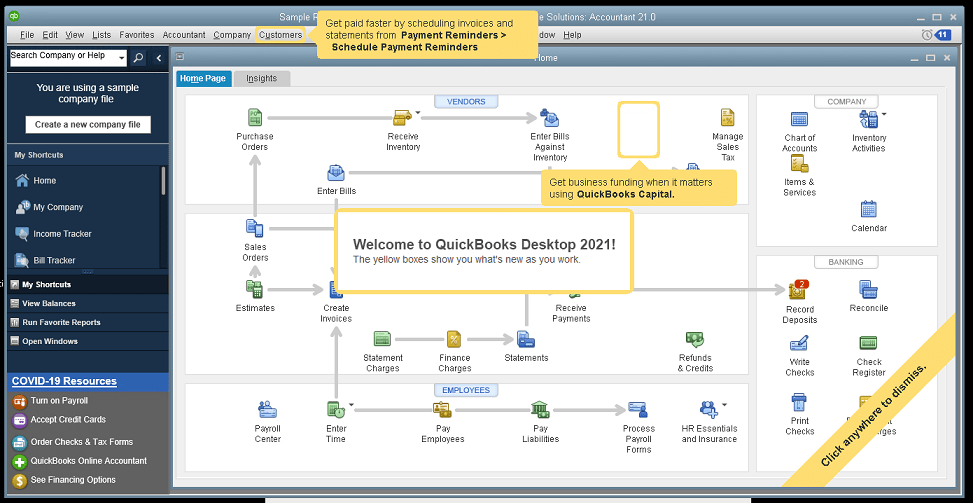
QuickBooks Desktop 2021: Getting Paid Faster, Being More Efficient, and Improving Data Security

The new QuickBooks Desktop 2021 editions have new and improved features that help businesses get paid faster and secure data more effectively, making the software work even better for your company.

Many of the improvements center on automation and workflow, enabling users to get more done with fewer keystrokes and setting up automatic activities so that items don’t have to be handled manually.

Other improvements center on data and information access, allowing admins to get granular with setting user permissions and access to certain types of information, even down to the record.

Intuit has also delivered several enhancements to existing functionality in QuickBooks desktop, especially in the Enterprise edition and where inventory is involved.

Here is a brief summary of the main changes or additions introduced with QuickBooks 2021 editions.

Improved Bank Feeds
Review bank transactions and match them to existing ones in your books or quickly add new transactions using the advanced bank feeds capability. You can automatically categorize or batch-edit bank transactions by payees, accounts and classes. This can dramatically reduce the time and complexity of reconciling entered transactions with the items the bank processes.

Automated Payment Reminders and Statements
Now you can send statements automatically to customers, with each statement tailored to the customer’s needs or preferences. Set automatic reminders for customers when their invoices are due and schedule statements for your customers to let them know when they have invoices they still need to pay you for. Timely communications with customers regarding their invoices and activity is more likely to keep a customer coming back for more. It also reduces the time required to communicate individually with customers, making AR management and collection activities more efficient.

Customized Payment Receipts
Want to send certain customers a customized message on their receipts? You can use custom templates for forms like invoices, sales receipts, estimates, statements, and purchase orders so each form has the right look and information. Then use the new customer groups capability to get the right form for the right customer every time.

PDF preview
It is always a good idea to preview a document before you send it via email, but that wasn’t always a convenient thing to do in QuickBooks. Now QuickBooks lets you automatically preview attachments before emailing them to customers. You can even preview multiple attachments at once without having to manually open each one outside of QuickBooks, saving huge time and effort and smoothing out a previously-clunky workflow.

Receipt Management
Receipt management in QuickBooks desktop is a new feature that makes entering expense receipts easier and faster. You can give users access to upload expense receipts to QuickBooks using the mobile app or directly from your computer. Automate creating categorized receipt expense entries using the QuickBooks Desktop Mobile App, an option available only with the Plus subscriptions (not the one-time purchase option).

Create Customer Groups
Improve customer communication with rule-based customer groups based on fields like customer type, location, or balance. Creating customer groups allows you to find all customers that match certain criteria. Then you can create automated statements, send payment reminders or create mailing lists for specific groups of customers.
In QuickBooks Desktop Enterprise, you can even use customer groups to define permissions and access at customer and vendor group level.

Data Level Permission
Data level permissions is a new feature in QuickBooks Enterprise 21.0 that gives you more control regarding restricting access for users and roles. This makes it so the admin can create users and roles with access permissions all the way down to the record level for customers and vendors.

With data level permissions you can improve security and confidentiality of information by assigning users access only to the specific data, transactions and reports that they are responsible for. Users will only be able view, edit, or delete specific customers, vendors, or data with the permissions you delegate to them.

NOTE: Data level permissions don’t appear to be available in QuickBooks Enterprise Accountant, nor are they available with a Silver or Gold subscription. To get this feature, you have to go Platinum or Diamond, so it’ll cost you.

Add prices to barcode labels
Wouldn’t it be great if you could print barcode labels with pricing information as well as the item name and description? Now you can! Barcode labels help you accurately identify and manage inventory, providing the information most often needed by employees and customers.

Landed cost
Gain more control and flexibility over how you calculate and share landed inventory costs. Set up landed cost accounts as “COGS” (Cost of Goods sold) or “Other current assets”, and accurately calculate landed cost for old item bills from closed accounting periods. You can also print bills with or without landed cost, allowing you to better control the information you present.

Alternate vendor reports
Key inventory reports can now include alternate vendor information, improving visibility into vendor information on inventory stock status by item, inventory valuation summary and other reports. Linking to alternate vendors via these reports simplifies and streamlines the process of reordering from alternate vendors.

QuickBooks desktop software continues to be the cornerstone of small business accounting. From very small business to the growing enterprise, QuickBooks delivers the functionality that every company needs to manage their income and outgo, customers and vendors, and all their banking activities.

Starting with the early 1999 version to the current 2021 release, Intuit has continued to add capability and enhance features and usability to keep QuickBooks as the most popular small business accounting product on the market. Remember the motto “if you can write a check, you can do your own books“? That’s QuickBooks.

jm bunny feetMake Sense?

J

Strong Passwords and MFA : It’s All About the Bots

Robbie the Robot from movie Forbidden Planet

You may have noticed that more online services are requiring strong passwords – cryptic phrases or letter combinations along with symbols and numbers – and Multi-Factor Authentication (MFA). The goal is to keep services more secure than a simple password allows.

These service providers have recognized that their services are far more secure when the user has to prove they are who they are, and prove it in more than one way. A password plus a special code texted to your phone, or maybe an email to your backup email account are examples of MFA. This means that the password alone isn’t good enough to gain access; the user must satisfy an additional challenge to confirm their identity.

Why is this additional level of account security a good idea? BOTS, that’s why.

A bot is a software application that is programmed to do certain tasks. Bots are automated, which means they run according to their instructions without a human user needing to start them up. Bots often imitate or replace a human user’s behavior. https://www.cloudflare.com/learning/bots/what-is-a-bot/

Bot (like roBOT) does what you tell it. Give it instructions and it runs. Give it some rules to follow and actions to perform when certain conditions are met and off it goes.

The problem with bots is that not just the good guys use them. Bad guys use them… a lot.

Bots can send emails, engage in chats and help you reset your password. They can also carry out cyberattacks at a pace that no human could match. Bots will search for public IP addresses, they’ll pummel an address with intrusion attempts and logins and may keep trying until they’re either successful or they give up. Bots are very good at brute force, because they have all the patience they need. It’s software, so it doesn’t get tired or bored and it can be programmed to not give up.

This is among the reasons for Noobeh’s strict password policy and why we strongly recommend our clients don’t store their passwords to make connecting to the service faster and simpler. Fast and simple is good but not where security is concerned. Our goal is to not only keep your applications and data available for anytime/anywhere access, we want to keep your cloud environment secure and as safe as possible.

Contact us today to get the cloud hosting platform your business needs, along with the privacy and security features the Microsoft Azure platform can provide. Keeping your systems secure isn’t just about keeping your secret password a secret. It’s about putting in place the best methods possible to ensure that your account doesn’t get compromised because a bot guessed your pet’s name.

Make Sense?

J